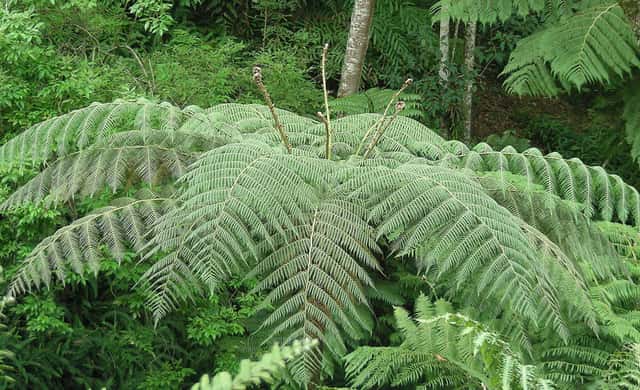
Cyatheaceae
Tree Fern: Pet-Safe Plant
Cyathea delgadii
Cultivate the tree fern in partial shade with high air humidity and a substrate rich in organic matter that is kept consistently moist but not waterlogged. It is a slow-growing species sensitive to both drought and water accumulation in the crown; therefore, watering should target the trunk and the soil, avoiding water buildup in the center of the plant.
Every 3 days
Partial shade
15° - 28°C
60% - 90%
Categories
What is Tree Fern?
Tree Fern (Cyathea delgadii) is a medium-care plant from the Cyatheaceae family. Cyathea delgadii, popularly known as the tree fern or lacy tree fern, is an arborescent fern native to the tropical and subtropical forests of Central and South America, including Brazil (Rio Grande do Sul and Santa Catarina). It forms an erect stipe (trunk) up to 4.5 m tall, covered with scars left...
Tree Fern grows up to 4.0m, spread of 300cm, watering every 3 days, 15°C – 28°C, 60–90% humidity. It is suitable for indoor environments and safe for pets.
Unlike many popular species, Tree Fern is safe to keep around pets. Without adequate drainage, root rot can develop within 7 days.
How to Care for Tree Fern?
TLDR: Tree Fern needs Partial shade, watering every 3 days, and temperatures between 15-28°C with 60-90% humidity.
How Often Should You Water Tree Fern?
Keep the substrate constantly moist, watering the trunk and the base—never the center of the crown where new fronds unfurl—to prevent rot. Check the soil moisture with your finger before watering again.
How Much Light Does Tree Fern Need?
Prefers filtered light or partial shade, similar to the conditions found in tropical forest understories. Avoid direct, intense sunlight, which burns the fronds.
What Is the Best Soil for Tree Fern?
Use a substrate rich in organic matter (humus) that is light and well-drained, retaining moisture without soaking the roots.
What Pot Should You Use for Tree Fern?
Prefer large, deep pots with good drainage, considering the size the plant reaches in its adult stage. Clay pots help maintain substrate moisture more evenly; regardless of the material, ensure multiple drainage holes and a light, organic substrate.
Care Schedule
Fertilize
Every 30 days
Misting
Every 2 days
What Is Tree Fern and Where Does It Come From?
Cyathea delgadii, popularly known as the tree fern or lacy tree fern, is an arborescent fern native to the tropical and subtropical forests of Central and South America, including Brazil (Rio Grande do Sul and Santa Catarina). It forms an erect stipe (trunk) up to 4.5 m tall, covered with scars left by fallen old fronds, and supports a crown of arching bipinnate fronds that can reach 1.5 to 3 m in length. It is found in the understory of humid forests at altitudes between 100 and 2,700 m, always in shaded locations with constant high humidity. Like other species in the genus, it produces extraordinary amounts of spores per frond, one of the highest recorded spore production rates among vascular plants.
How Big Does Tree Fern Grow?
TLDR: Tree Fern can reach up to 4.0m tall with Slow growth rate.
Max height
4.0m
Spread
3.0m
Growth rate
Slow
Foliage
Evergreen
Plant Uses
Ornamental
Great for decoration
Is your plant showing symptoms?
Click on the symptom to discover possible causes:
What Diseases Commonly Affect Tree Fern?
TLDR: Tree Fern is susceptible to 4 known diseases. Monitor regularly for early detection.
Crown Rot
Crown rot is a serious fungal disease that attacks the crown (base) of the plant where the stem meets the soil. It is caused by various fungal pathogens including Phytophthora, Fusarium, and Rhizoctonia. The disease thrives in waterlogged conditions and can quickly spread to kill the entire plant if not addressed promptly.
Root Rot
Root rot is a serious fungal disease that affects the root system of plants, causing them to decay and die. It is primarily caused by overwatering, poor drainage, or soil-borne fungi such as Pythium, Phytophthora, Rhizoctonia, and Fusarium. The disease thrives in waterlogged conditions where roots are deprived of oxygen, making them susceptible to fungal infection.
Low Humidity Stress
Low humidity stress occurs when indoor air becomes too dry, causing plants to lose moisture faster than they can absorb it through their roots. This is especially common during winter heating periods, near radiators and heating vents, or in air-conditioned spaces. Tropical plants are particularly susceptible to low humidity damage.
Sunburn (Sun Scorch)
Sunburn or sun scorch is an environmental condition that occurs when plants are exposed to intense, direct sunlight beyond their tolerance level. This causes the breakdown of chlorophyll in the leaves, resulting in bleached, dried, and damaged foliage. The damage can happen rapidly, sometimes within just a few hours of exposure.
Meaning & Symbolism
Like other tree ferns, Cyathea delgadii belongs to an ancestral botanical lineage present on Earth long before flowering plants, symbolizing resilience, longevity, and the permanence of life in primary forests.
Compare with similar plants
| Attribute | Difficulty | Light | Watering | Pet Safe |
|---|---|---|---|---|
| Dark Fieldcap | Medium | Low light | 2d | ⚠️ |
| Azalea | Medium | Partial shade | 3d | ⚠️ |
| Muriel's Bamboo | Medium | Partial shade | 3d | ✓ |
| Bougainvillea | Medium | Direct sun | 7d | ⚠️ |




