Podocarpaceae
Sea Teak (Podocarpus costalis)
Podocarpus costalis
Sea teak thrives in full sun with excellent drainage and tolerates salty coastal air and wind extremely well. Let the soil dry between waterings, as it is far more tolerant of drought than of soggy roots. It grows slowly, making it ideal for containers, hedges, and bonsai with minimal pruning.
Every 10 days
Bright indirect
20° - 35°C
% - %
Categories
What is Sea Teak?
Sea Teak (Podocarpus costalis) is a medium-care plant from the Podocarpaceae family. Podocarpus costalis, known as sea teak or arius, is a small evergreen conifer native to coastal cliffs and limestone outcrops of the Philippines and Taiwan, including Lanyu (Orchid Island). Growing as a dense, shrubby tree from 1 to 5 meters tall, it has narrow, leathery, dark-green needle-like leav...
Sea Teak grows up to 5.0m, watering every 10 days, 20°C – 35°C. It is suitable for indoor environments and not safe for pets.
Without precautions, ingestion can cause irritation in pets. Keep out of reach of cats and dogs. Without adequate drainage, root rot can develop within 20 days.
How to Care for Sea Teak?
TLDR: Sea Teak needs Bright indirect, watering every 10 days, and temperatures between 20-35°C with 40-70% humidity.
How Often Should You Water Sea Teak?
Water deeply, then let the top few centimeters of soil dry out before watering again, roughly every 10 days. Reduce frequency in cool months and always prioritize drainage over frequency to prevent root rot.
How Much Light Does Sea Teak Need?
Give it full sun to very bright light for the densest, most compact growth. It tolerates partial shade but will grow slower and looser.
What Is the Best Soil for Sea Teak?
Plant in a light, well-draining mix, such as sandy or loamy soil amended with perlite or coarse sand. It tolerates a wide pH range but prefers slightly acidic conditions.
What Pot Should You Use for Sea Teak?
A wide, shallow, well-draining pot (unglazed terracotta or a bonsai training pot) suits its shallow root system and slow growth.
What Is Sea Teak and Where Does It Come From?
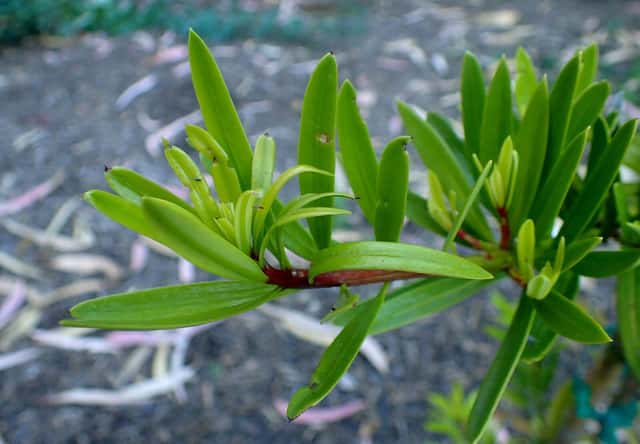
Podocarpus costalis, known as sea teak or arius, is a small evergreen conifer native to coastal cliffs and limestone outcrops of the Philippines and Taiwan, including Lanyu (Orchid Island). Growing as a dense, shrubby tree from 1 to 5 meters tall, it has narrow, leathery, dark-green needle-like leaves and a gnarled, gray-brown trunk shaped by constant sea winds. As a conifer it bears no true flowers; instead it produces small, fleshy, edible cone-fruits. Prized for its salt tolerance and slow, sculptural growth, it is one of the most sought-after species for bonsai and coastal landscaping in East Asia, though wild populations are now endangered from overcollection.
How to Propagate Sea Teak?
Semi-hardwood stem cutting
Rooting is slow and can take several months; bottom heat and consistent humidity improve success.
- 1 Select a healthy semi-hardwood shoot about 8-10 cm long from the current season's growth.
- 2 Cut just below a node using clean, sharp shears.
- 3 Strip the lower leaves and dip the cut end in rooting hormone.
- 4 Insert the cutting into a well-draining mix of sand and perlite.
- 5 Keep warm, humid, and out of direct sun until roots form.
Materials needed:
How Big Does Sea Teak Grow?
TLDR: Sea Teak can reach up to 5.0m tall with Slow growth rate.
Max height
5.0m
Growth rate
Slow
Foliage
Evergreen
Warning: Toxic Plant
This plant can be toxic if ingested. Keep out of reach of:
Plant Uses
Ornamental
Great for decoration
Edible
Can be consumed
Culinary Uses
- The small fleshy cone-fruit is edible, though rarely eaten outside its native range.
Is your plant showing symptoms?
Click on the symptom to discover possible causes:
What Diseases Commonly Affect Sea Teak?
TLDR: Sea Teak is susceptible to 7 known diseases. Monitor regularly for early detection.
Root Rot
Root rot is a serious fungal disease that affects the root system of plants, causing them to decay and die. It is primarily caused by overwatering, poor drainage, or soil-borne fungi such as Pythium, Phytophthora, Rhizoctonia, and Fusarium. The disease thrives in waterlogged conditions where roots are deprived of oxygen, making them susceptible to fungal infection.
Leaf Spot
Leaf spot is a common fungal disease caused by various pathogens including Alternaria, Ascochyta, Colletotrichum, Septoria, and Venturia. It primarily affects leaves, causing discolored spots that can lead to premature leaf drop if left untreated.
Spider Mites
Spider mites are tiny arachnids (less than 1/20 inch long) related to spiders and ticks that feed on plant sap. They thrive in hot, dry conditions and can cause significant damage to ornamental and vegetable plants. During severe infestations, crop losses can reach 14% or higher as these pests disrupt vital plant processes including photosynthesis, carbon dioxide absorption, and transpiration.
Scale Insects
Scale insects are small sap-sucking pests that appear as brown, shell-like bumps on plant stems and leaves. There are over 25 species, divided into armored (hard) and unarmored (soft) scales. They feed by piercing plant tissue and extracting sap, which weakens the plant and can lead to yellowing, stunted growth, and even death if left untreated. They also excrete honeydew, which attracts ants and promotes sooty mold growth.
Meaning & Symbolism
In Taiwanese culture, Podocarpus costalis is regarded as a tree of luck and prosperity, and is a favorite subject for bonsai passed down through generations.
Fun Facts
Its wild populations are classified as Endangered by the IUCN, largely due to overcollection for the bonsai trade.
Despite being a conifer, it produces small fleshy, edible cone-fruits instead of true flowers or dry cones.
It naturally grows on wind-battered limestone sea cliffs, giving cultivated specimens their characteristic gnarled trunks.
Frequently asked questions
Is Podocarpus costalis toxic to pets?
How often should I water sea teak?
Can Podocarpus costalis be grown indoors?
Why is sea teak popular for bonsai?
Compare with similar plants
| Attribute | Difficulty | Light | Watering | Pet Safe |
|---|---|---|---|---|
| Dark Fieldcap | Medium | Low light | 2d | ⚠️ |
| Azalea | Medium | Partial shade | 3d | ⚠️ |
| Muriel's Bamboo | Medium | Partial shade | 3d | ✓ |
| Bougainvillea | Medium | Direct sun | 7d | ⚠️ |




