Euphorbiaceae
Sausage Spurge (Euphorbia guentheri): Complete Care Guide
Euphorbia guentheri
Prefers full to partial sun and extremely well-draining soil. Allow the soil to dry out completely between waterings and water very sparingly in winter. Tolerates drought well but is sensitive to overwatering, which causes root rot.
Every 14 days
Bright indirect
16° - 29°C
20% - 50%
Categories
What is Sausage Spurge?
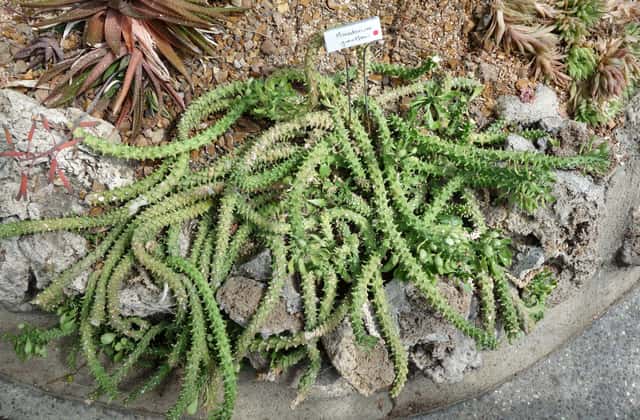
Sausage Spurge (Euphorbia guentheri) is a medium-care plant from the Euphorbiaceae family. Euphorbia guentheri, commonly known as sausage spurge, is a succulent subshrub native to southeast Kenya. It produces numerous unbranched, fleshy, cylindrical stems covered in spine-tipped tubercles, reaching up to 90 cm (3 ft) long. Small obovate leaves emerge along the stems and drop during winter...
Sausage Spurge grows up to 90cm, watering every 14 days, 16°C – 29°C, 20–50% humidity. It is suitable for indoor environments and not safe for pets.
Without precautions, ingestion can cause irritation in pets. Keep out of reach of cats and dogs. Without adequate drainage, root rot can develop within 28 days.
How to Care for Sausage Spurge?
TLDR: Sausage Spurge needs Bright indirect, watering every 14 days, and temperatures between 16-29°C with 20-50% humidity.
How Often Should You Water Sausage Spurge?
Water only when the soil is completely dry, roughly every 2 weeks during spring/summer, and cut back significantly in fall/winter. Never let the pot sit in standing water.
How Much Light Does Sausage Spurge Need?
Place in full to partial sun with at least 3-5 hours of direct light daily. Rotate the pot occasionally for even growth.
What Is the Best Soil for Sausage Spurge?
Use a well-draining cactus and succulent mix with 50-70% coarse sand, pumice, or perlite. Ideal pH is 6.0-7.0.
What Pot Should You Use for Sausage Spurge?
Unglazed terracotta or ceramic pot with drainage holes to help the soil dry out faster.
What Is Sausage Spurge and Where Does It Come From?
Euphorbia guentheri, commonly known as sausage spurge, is a succulent subshrub native to southeast Kenya. It produces numerous unbranched, fleshy, cylindrical stems covered in spine-tipped tubercles, reaching up to 90 cm (3 ft) long. Small obovate leaves emerge along the stems and drop during winter dormancy. In spring, it produces tiny red cyathia surrounded by greenish-white bracts. Like all euphorbias, it exudes a toxic milky latex when cut or damaged.
How to Propagate Sausage Spurge?
Stem Cutting
Always use clean, sharp tools, and avoid watering until the cutting is well rooted to prevent rot.
- 1 Wear gloves to protect skin from the irritant latex
- 2 Cut a healthy stem segment at least 10 cm long
- 3 Let the cutting dry and callus for 3-5 days in a shaded, dry spot
- 4 Plant the cutting in well-draining soil, burying about 2-3 cm
- 5 Water lightly only after roots have developed
Materials needed:
Offset Division
Larger offsets root faster and more reliably than small cuttings.
- 1 Identify offsets (pups) growing at the base of the mother plant
- 2 Carefully remove the offset, cutting close to the base
- 3 Let it dry for a few days before planting
- 4 Plant in well-draining soil and keep in indirect light until rooted
Materials needed:
Seed Propagation
Slower and less predictable method, recommended mainly for patient collectors.
- 1 Sow seeds in a light, well-draining substrate
- 2 Keep lightly moist in a warm spot with indirect light
- 3 Wait for germination, which can be irregular
- 4 Transplant seedlings once large enough to handle
Materials needed:
How Big Does Sausage Spurge Grow?
TLDR: Sausage Spurge can reach up to 90cm tall with Medium growth rate.
Max height
90cm
Growth rate
Medium
Foliage
Evergreen
Warning: Toxic Plant
This plant can be toxic if ingested. Keep out of reach of:
Plant Uses
Ornamental
Great for decoration
Is your plant showing symptoms?
Click on the symptom to discover possible causes:
What Diseases Commonly Affect Sausage Spurge?
TLDR: Sausage Spurge is susceptible to 4 known diseases. Monitor regularly for early detection.
Root Rot
Root rot is a serious fungal disease that affects the root system of plants, causing them to decay and die. It is primarily caused by overwatering, poor drainage, or soil-borne fungi such as Pythium, Phytophthora, Rhizoctonia, and Fusarium. The disease thrives in waterlogged conditions where roots are deprived of oxygen, making them susceptible to fungal infection.
Powdery Mildew
Powdery mildew is a common fungal disease caused by various fungi species including Erysiphe, Podosphaera, Oïdium, and Leveillula. It affects over 10,000 plant species worldwide. The disease thrives in warm, dry climates with high humidity and appears as a distinctive white powdery coating on plant surfaces.
Spider Mites
Spider mites are tiny arachnids (less than 1/20 inch long) related to spiders and ticks that feed on plant sap. They thrive in hot, dry conditions and can cause significant damage to ornamental and vegetable plants. During severe infestations, crop losses can reach 14% or higher as these pests disrupt vital plant processes including photosynthesis, carbon dioxide absorption, and transpiration.
Mealybugs
Mealybugs are small, soft-bodied insects covered with a white, waxy, cottony material. They are common pests of houseplants and outdoor plants in mild climates. These sap-sucking insects feed on plant tissue, causing damage, stunted growth, and can lead to plant death if left untreated. They produce sticky honeydew which attracts sooty mold.
Meaning & Symbolism
Like other succulent euphorbias, it is associated with resilience and adaptation to harsh, arid environments.
Fun Facts
Its fleshy, cylindrical stems resemble sausages, which is how it got its common name.
It was previously classified in the genus Monadenium before being reclassified as Euphorbia guentheri.
It is native only to a restricted region of southeast Kenya, in the Teita district.
Like all euphorbias, its milky latex is a chemical defense against herbivores.
Frequently asked questions
Is sausage spurge toxic to pets?
How often should I water my Euphorbia guentheri?
Why is my plant losing its leaves?
What kind of soil should I use?
Compare with similar plants
| Attribute | Difficulty | Light | Watering | Pet Safe |
|---|---|---|---|---|
| Dark Fieldcap | Medium | Low light | 2d | ⚠️ |
| Azalea | Medium | Partial shade | 3d | ⚠️ |
| Muriel's Bamboo | Medium | Partial shade | 3d | ✓ |
| Bougainvillea | Medium | Direct sun | 7d | ⚠️ |




