Verbenaceae
Sandpaper Vine: Full Sun Plant
Petrea volubilis
Prefers full sun to bloom well, though it tolerates partial shade in very hot climates. It thrives in fertile, well-drained soil with moderate watering that avoids waterlogging, and requires protection from heavy frosts. It is fast-growing and needs support (trellises, pergolas) to develop as a climber.
Every 4 days
Direct sun
10° - 32°C
% - %
Categories
What is Sandpaper Vine?
Sandpaper Vine (Petrea volubilis) is a medium-care plant from the Verbenaceae family. The Sandpaper Vine (Petrea volubilis) is a vigorous woody climber native to Brazil and other tropical regions of the Americas, belonging to the Verbenaceae family. It can reach up to 5 meters in length when supported by structures such as pergolas, arbors, and fences. Its leaves are leathery, rough...
Sandpaper Vine grows up to 5.0m, spread of 200cm, watering every 4 days, 10°C – 32°C. It is suitable for indoor environments and safe for pets.
Unlike many popular species, Sandpaper Vine is safe to keep around pets. Without adequate drainage, root rot can develop within 8 days.
How to Care for Sandpaper Vine?
TLDR: Sandpaper Vine needs Direct sun, watering every 4 days, and temperatures between 10-32°C with 40-70% humidity.
How Often Should You Water Sandpaper Vine?
Water when the top few inches of the substrate are dry, about 2 to 3 times a week in spring and summer; reduce frequency in fall and winter. The Sandpaper Vine tolerates drought better than waterlogging—poorly drained soil promotes root rot.
How Much Light Does Sandpaper Vine Need?
Grow under full sun (4 to 6 hours of direct light per day) to ensure abundant flowering. In very hot climates, it tolerates partial shade but will produce fewer flowers.
What Is the Best Soil for Sandpaper Vine?
Use fertile soil rich in organic matter and, most importantly, well-drained—a mix of potting soil, organic compost, and sand or perlite works well. A slightly acidic to neutral pH (6 to 7) is ideal; avoid waterlogged or highly alkaline soils.
What Pot Should You Use for Sandpaper Vine?
If grown in a pot, prefer large containers with good drainage at the bottom, as it is a vigorous climber; clay pots help prevent excess moisture in the roots.
What Is Sandpaper Vine and Where Does It Come From?
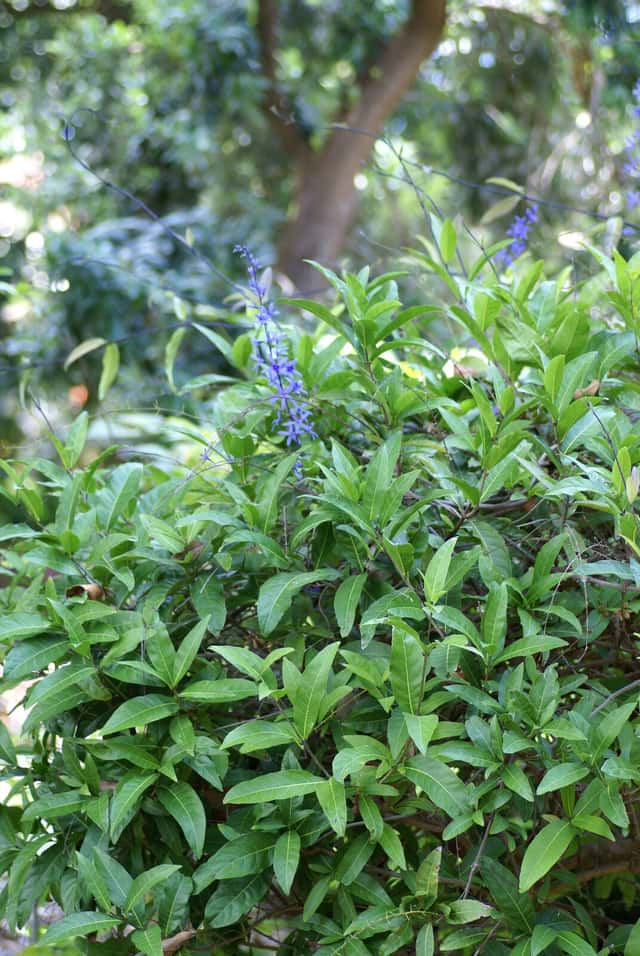
The Sandpaper Vine (Petrea volubilis) is a vigorous woody climber native to Brazil and other tropical regions of the Americas, belonging to the Verbenaceae family. It can reach up to 5 meters in length when supported by structures such as pergolas, arbors, and fences. Its leaves are leathery, rough to the touch, and have serrated margins, and may partially drop during colder periods. Flowering occurs mainly in winter and spring, forming clusters (panicles) of small star-shaped flowers in shades of lilac to bluish-purple, with a white variety (Alba) also available. It is widely used in landscaping for its exuberant ornamental effect over trellises and pergolas.
How to Propagate Sandpaper Vine?
How Big Does Sandpaper Vine Grow?
TLDR: Sandpaper Vine can reach up to 5.0m tall with Fast growth rate.
Max height
5.0m
Spread
2.0m
Growth rate
Fast
Foliage
Semi-evergreen
Plant Uses
Ornamental
Great for decoration
Medicinal Uses
- Traditional folk use as an expectorant (without robust scientific evidence)
- Traditional folk use as an antiseptic (without robust scientific evidence)
Is your plant showing symptoms?
Click on the symptom to discover possible causes:
What Diseases Commonly Affect Sandpaper Vine?
TLDR: Sandpaper Vine is susceptible to 6 known diseases. Monitor regularly for early detection.
Root Rot
Root rot is a serious fungal disease that affects the root system of plants, causing them to decay and die. It is primarily caused by overwatering, poor drainage, or soil-borne fungi such as Pythium, Phytophthora, Rhizoctonia, and Fusarium. The disease thrives in waterlogged conditions where roots are deprived of oxygen, making them susceptible to fungal infection.
Powdery Mildew
Powdery mildew is a common fungal disease caused by various fungi species including Erysiphe, Podosphaera, Oïdium, and Leveillula. It affects over 10,000 plant species worldwide. The disease thrives in warm, dry climates with high humidity and appears as a distinctive white powdery coating on plant surfaces.
Scale Insects
Scale insects are small sap-sucking pests that appear as brown, shell-like bumps on plant stems and leaves. There are over 25 species, divided into armored (hard) and unarmored (soft) scales. They feed by piercing plant tissue and extracting sap, which weakens the plant and can lead to yellowing, stunted growth, and even death if left untreated. They also excrete honeydew, which attracts ants and promotes sooty mold growth.
Mealybugs
Mealybugs are small, soft-bodied insects covered with a white, waxy, cottony material. They are common pests of houseplants and outdoor plants in mild climates. These sap-sucking insects feed on plant tissue, causing damage, stunted growth, and can lead to plant death if left untreated. They produce sticky honeydew which attracts sooty mold.
Meaning & Symbolism
The common names associated with 'widowhood' in Portuguese refer to the dark silhouette and purple tone of the flower calyx, popularly associated with mourning and longing. Nevertheless, the plant is most remembered for its ornamental exuberance, symbolizing discreet elegance and lasting beauty thanks to the cascades of lilac flowers that cover structures and gardens.
Compare with similar plants
| Attribute | Difficulty | Light | Watering | Pet Safe |
|---|---|---|---|---|
| Dark Fieldcap | Medium | Low light | 2d | ⚠️ |
| Azalea | Medium | Partial shade | 3d | ⚠️ |
| Muriel's Bamboo | Medium | Partial shade | 3d | ✓ |
| Bougainvillea | Medium | Direct sun | 7d | ⚠️ |




