Crassulaceae
Red Pagoda (Crassula corymbulosa)
Crassula corymbulosa
An easy succulent: plenty of light, well-drained cactus mix, moderate water in the warm months and little in winter. It dislikes cold, wet soil and frost.
Every 10 days
Bright indirect
1° - °C
% - %
Categories
What is Red Pagoda?
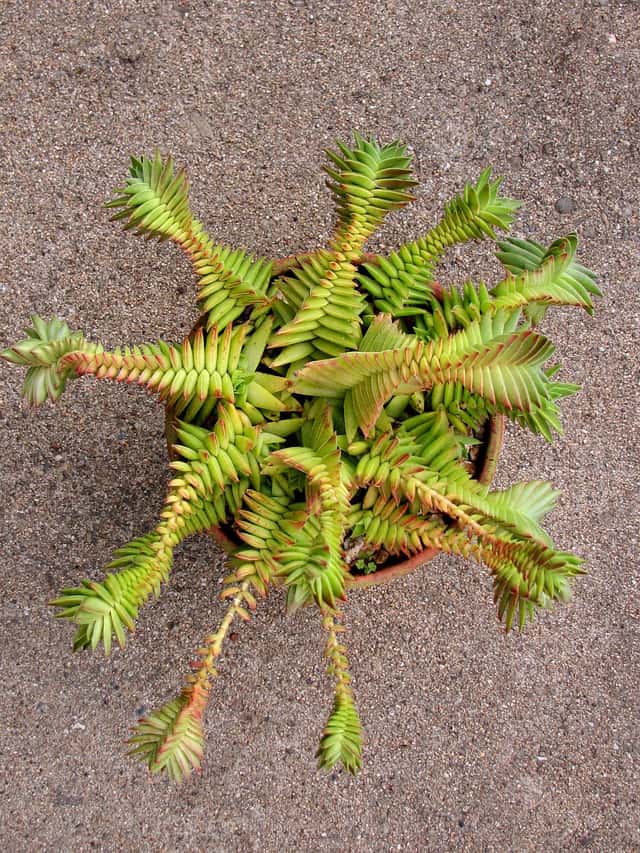
Red Pagoda (Crassula corymbulosa) is a easy-care plant from the Crassulaceae family. Crassula corymbulosa is the trade name of a South African succulent whose accepted name is now Crassula capitella subsp. thyrsiflora. It comes from dry, rocky Karoo slopes in South Africa and southeastern Namibia. It forms low mats of rosettes with fleshy, pointed leaves stacked in four ranks or in...
Red Pagoda grows up to 40cm, spread of 50cm, watering every 10 days. It is suitable for indoor environments and safe for pets.
Unlike many tropical plants, Red Pagoda tolerates watering mistakes. Best for beginners. Unlike many popular species, Red Pagoda is safe to keep around pets. Without adequate drainage, root rot can develop within 20 days.
How to Care for Red Pagoda?
TLDR: Red Pagoda needs Bright indirect, watering every 10 days, and temperatures between 1-30°C with 40-70% humidity.
How Often Should You Water Red Pagoda?
From spring to autumn, water when the mix is completely dry, about every 10 days, without wetting the leaves. Water sparingly in winter. Soggy soil rots the roots.
How Much Light Does Red Pagoda Need?
Full sun or bright part shade. The more sun, the redder the leaves. Indoors, by the brightest window.
What Is the Best Soil for Red Pagoda?
Gritty cactus and succulent mix with sand, grit or perlite and excellent drainage.
What Pot Should You Use for Red Pagoda?
A shallow clay pot with a drainage hole; it looks good spilling over the rim.
Care Schedule
Fertilize
Every 30 days
What Is Red Pagoda and Where Does It Come From?
Crassula corymbulosa is the trade name of a South African succulent whose accepted name is now Crassula capitella subsp. thyrsiflora. It comes from dry, rocky Karoo slopes in South Africa and southeastern Namibia. It forms low mats of rosettes with fleshy, pointed leaves stacked in four ranks or in a spiral, like small pagodas. The leaves are apple green and blush red in strong sun or drought. From midsummer into autumn the stems stretch to 30-40 cm and carry tiny cream or white flowers, sometimes pink-tinged. After flowering the plant falls apart, and the dropped leaves root into new plants.
How to Propagate Red Pagoda?
Leaf cutting
Leaves that drop after flowering often root in the pot on their own.
- 1 Twist off a whole leaf
- 2 Let it dry for a day
- 3 Set the leaf base on lightly moist, sandy mix
- 4 Keep in bright light out of harsh sun until it roots
Materials needed:
Stem cutting
Use the stems trimmed off after flowering.
- 1 Cut a stem with a few rosettes
- 2 Let the cut dry for 1-2 days
- 3 Plant in dry succulent mix
- 4 Water lightly after a week
Materials needed:
How Big Does Red Pagoda Grow?
TLDR: Red Pagoda can reach up to 40cm tall with Medium growth rate.
Max height
40cm
Spread
50cm
Growth rate
Medium
Foliage
Evergreen
Plant Uses
Ornamental
Great for decoration
Ground Cover
Soil coverage
Is your plant showing symptoms?
Click on the symptom to discover possible causes:
What Diseases Commonly Affect Red Pagoda?
TLDR: Red Pagoda is susceptible to 4 known diseases. Monitor regularly for early detection.
Mealybugs
Mealybugs are small, soft-bodied insects covered with a white, waxy, cottony material. They are common pests of houseplants and outdoor plants in mild climates. These sap-sucking insects feed on plant tissue, causing damage, stunted growth, and can lead to plant death if left untreated. They produce sticky honeydew which attracts sooty mold.
Scale Insects
Scale insects are small sap-sucking pests that appear as brown, shell-like bumps on plant stems and leaves. There are over 25 species, divided into armored (hard) and unarmored (soft) scales. They feed by piercing plant tissue and extracting sap, which weakens the plant and can lead to yellowing, stunted growth, and even death if left untreated. They also excrete honeydew, which attracts ants and promotes sooty mold growth.
Root Rot
Root rot is a serious fungal disease that affects the root system of plants, causing them to decay and die. It is primarily caused by overwatering, poor drainage, or soil-borne fungi such as Pythium, Phytophthora, Rhizoctonia, and Fusarium. The disease thrives in waterlogged conditions where roots are deprived of oxygen, making them susceptible to fungal infection.
Edema
Edema (also spelled oedema) is a non-infectious physiological disorder caused by an imbalance between water uptake and transpiration. When roots absorb water faster than leaves can release it through transpiration, cells in the leaf tissue swell and burst, forming characteristic wart-like blisters. This is purely a cosmetic issue and does not threaten plant health.
Fun Facts
Crassula comes from the Latin crassus, "thick", for its fleshy leaves.
The flowering stems look like stacked pagoda towers, hence the name.
In Afrikaans it is called veldrosie, "field rose".
Frequently asked questions
Are Crassula corymbulosa and Crassula capitella the same plant?
Why did my red pagoda turn red?
My plant fell apart after flowering. Is it dead?
Is it toxic to pets?
Compare with similar plants
| Attribute | Difficulty | Light | Watering | Pet Safe |
|---|---|---|---|---|
| Field Maple | Easy | Bright indirect | 14d | ✓ |
| Iberian Houseleek | Easy | Direct sun | 14d | ✓ |
| Silver Birch | Easy | Direct sun | 14d | ✓ |
| Common Blanketflower | Easy | Direct sun | 10d | ✓ |





