Asphodelaceae
Prickly Aloe (Aloe aculeata)
Aloe aculeata
An easy plant that wants sun or light shade, a fast-draining mix and little water. Water regularly in summer and hardly at all in winter, when it rests. Keep it away from frost and constant winter rain.
Every 14 days
Bright indirect
5° - 35°C
20% - 50%
Categories
What is Prickly aloe?
Prickly aloe (Aloe aculeata) is a easy-care plant from the Asphodelaceae family. Aloe aculeata is a stemless aloe from northern South Africa (Limpopo and Mpumalanga), Zimbabwe and Mozambique, where it grows among rocks in grassland and dry bushveld at 500 to 1,700 m. It forms a single rosette up to 1 m tall and wide, with broad leaves that curve inward. What sets it apart is the...
Prickly aloe grows up to 1.0m, spread of 100cm, watering every 14 days, 5°C – 35°C, 20–50% humidity. It is suitable for indoor environments and not safe for pets.
Unlike many tropical plants, Prickly aloe tolerates watering mistakes. Best for beginners. Without precautions, ingestion can cause irritation in pets. Keep out of reach of cats and dogs. Without adequate drainage, root rot can develop within 28 days.
How to Care for Prickly aloe?
TLDR: Prickly aloe needs Bright indirect, watering every 14 days, and temperatures between 5-35°C with 20-50% humidity.
How Often Should You Water Prickly aloe?
In summer, water deeply once the mix is completely dry. In winter, or when nights drop below 10 °C, barely water. Almost every problem comes from too much water with poor airflow.
How Much Light Does Prickly aloe Need?
Full sun or bright light shade. In strong heat, shield it from afternoon sun and heat reflected off walls. Good light turns the leaves reddish; too little light distorts the rosette.
What Is the Best Soil for Prickly aloe?
Gritty, sandy cactus and succulent mix with excellent drainage. It does fine in poor soil: little fertilizer avoids soft growth that catches fungus.
What Pot Should You Use for Prickly aloe?
A fairly shallow, wide pot, since the roots are fibrous and shallow, with excellent drainage. Terracotta or unglazed clay helps it dry out. It can stay in the same pot for many years.
Care Schedule
Fertilize
Every 30 days
What Is Prickly aloe and Where Does It Come From?
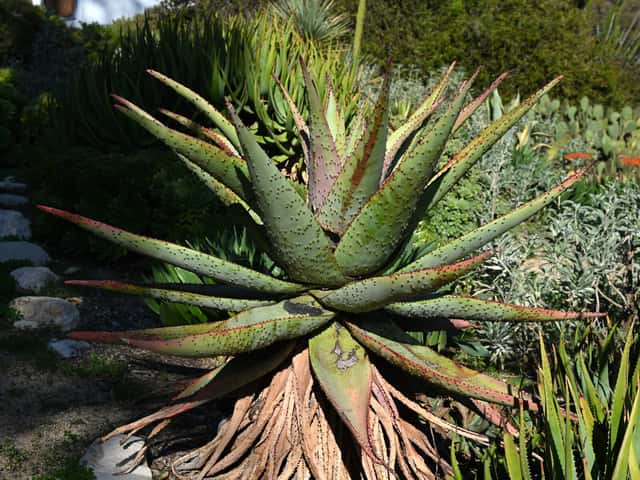
Aloe aculeata is a stemless aloe from northern South Africa (Limpopo and Mpumalanga), Zimbabwe and Mozambique, where it grows among rocks in grassland and dry bushveld at 500 to 1,700 m. It forms a single rosette up to 1 m tall and wide, with broad leaves that curve inward. What sets it apart is the leaf surface covered in spines, each rising from a thickened base, plus reddish-brown teeth along the margins. In winter it sends up long, tapering racemes of tubular flowers in yellow to reddish orange.
How to Propagate Prickly aloe?
Seed
It rarely offsets, so seed is the way to go. Seedlings damp off easily: good airflow and a fungicide in the bottom watering help.
- 1 Sow fresh seed in spring or summer in coarse sandy mix
- 2 Cover lightly and top with a thin layer of fine grit
- 3 Water from below and cover the pot with glass or clear plastic for 1 to 2 weeks
- 4 Remove the cover, keep under light shade cloth and mist once or twice a day for two more weeks
- 5 Gradually space out misting as the seedlings grow
Materials needed:
How Big Does Prickly aloe Grow?
TLDR: Prickly aloe can reach up to 1.0m tall with Slow growth rate.
Max height
1.0m
Spread
1.0m
Growth rate
Slow
Foliage
Evergreen
Warning: Toxic Plant
This plant can be toxic if ingested. Keep out of reach of:
Plant Uses
Ornamental
Great for decoration
Is your plant showing symptoms?
Click on the symptom to discover possible causes:
What Diseases Commonly Affect Prickly aloe?
TLDR: Prickly aloe is susceptible to 4 known diseases. Monitor regularly for early detection.
Root Rot
Root rot is a serious fungal disease that affects the root system of plants, causing them to decay and die. It is primarily caused by overwatering, poor drainage, or soil-borne fungi such as Pythium, Phytophthora, Rhizoctonia, and Fusarium. The disease thrives in waterlogged conditions where roots are deprived of oxygen, making them susceptible to fungal infection.
Damping Off
Damping off is a soil-borne fungal disease that affects seeds and young seedlings, causing rotting of stem and root tissues at and below the soil line. It is caused by several fungi including Pythium, Rhizoctonia, Fusarium, and Phytophthora. The disease thrives in cold, wet conditions with poor air circulation.
Scale Insects
Scale insects are small sap-sucking pests that appear as brown, shell-like bumps on plant stems and leaves. There are over 25 species, divided into armored (hard) and unarmored (soft) scales. They feed by piercing plant tissue and extracting sap, which weakens the plant and can lead to yellowing, stunted growth, and even death if left untreated. They also excrete honeydew, which attracts ants and promotes sooty mold growth.
Aphids
Aphids are small, soft-bodied, pear-shaped insects (1/16 to 1/8 inch long) that feed by sucking nutrient-rich sap from plants. They reproduce rapidly and can quickly weaken plants, causing distorted growth and transmitting plant viruses. Aphids come in various colors including green, black, red, yellow, brown, and gray. They secrete honeydew, a sticky substance that attracts ants and encourages sooty mold growth.
Meaning & Symbolism
Featured on the reverse of the South African 10-cent coin from 1965 to 1989.
Fun Facts
Aculeata means prickly, after the spines on the leaf faces
It appeared on the South African 10-cent coin from 1965 to 1989
In droughts, baboons and rock hyraxes eat the leaves for water
Frequently asked questions
How often should I water Aloe aculeata?
Why did the leaves turn red?
Does it produce pups?
Is it cold hardy?
Compare with similar plants
| Attribute | Difficulty | Light | Watering | Pet Safe |
|---|---|---|---|---|
| Field Maple | Easy | Bright indirect | 14d | ✓ |
| Iberian Houseleek | Easy | Direct sun | 14d | ✓ |
| Silver Birch | Easy | Direct sun | 14d | ✓ |
| Common Blanketflower | Easy | Direct sun | 10d | ✓ |





