Araliaceae
Pennywort (genus Hydrocotyle)
Hydrocotyle
Easy and fast-growing: medium to bright light, water or permanently wet soil and pH 6 to 7.5. In aquariums, CO2 and liquid fertiliser make denser growth but are not essential. Trim often so it does not smother other plants. Tropical species want 18-28 °C; temperate ones such as H. vulgaris cope with cold at pond edges.
Every 1 days
Partial shade
° - °C
% - %
Categories
What is Pennywort (genus)?
Pennywort (genus) (Hydrocotyle) is a easy-care plant from the Araliaceae family. Hydrocotyle is a genus of more than 280 species of low, creeping perennials of water and wet ground in the family Araliaceae (formerly placed in the carrot family, Apiaceae), found in tropical and temperate regions worldwide. Long stems run over soil or water and root at the nodes, forming dense mat...
Pennywort (genus) grows up to 15cm, watering every 1 days. It is suitable for indoor environments and safe for pets.
Unlike many tropical plants, Pennywort (genus) tolerates watering mistakes. Best for beginners. Unlike many popular species, Pennywort (genus) is safe to keep around pets. Without adequate drainage, root rot can develop within 7 days.
How to Care for Pennywort (genus)?
TLDR: Pennywort (genus) needs Partial shade, watering every 1 days, and temperatures between 15-30°C with 40-70% humidity.
How Often Should You Water Pennywort (genus)?
Never let it dry out: grow it submerged, floating or in a pot standing in a saucer of water. In ponds, plant on the shallow margin or in bog soil.
How Much Light Does Pennywort (genus) Need?
Medium to bright light. In low light the leaf stalks stretch and growth turns sparse; in strong light it stays low and compact. Out of water, avoid harsh midday sun.
What Is the Best Soil for Pennywort (genus)?
Nutrient-rich aquarium substrate or permanently moist bog soil. Many species also grow floating, without any substrate.
What Pot Should You Use for Pennywort (genus)?
An aquarium, paludarium or pot without drainage holes (or standing in a saucer of water) to keep the substrate saturated; in ponds, an aquatic planting basket on the shallow shelf.
What Is Pennywort (genus) and Where Does It Come From?
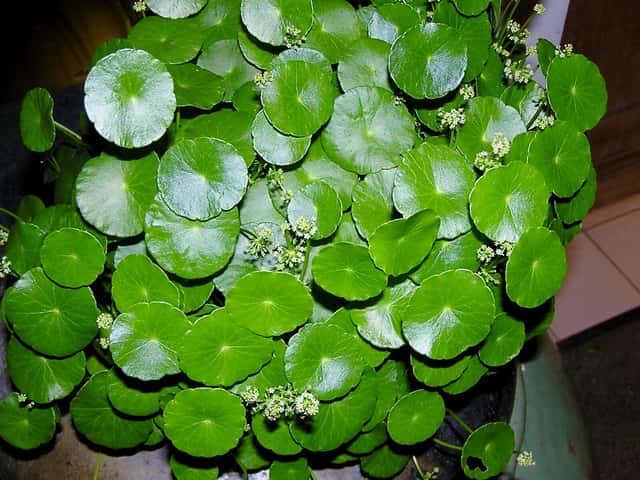
Hydrocotyle is a genus of more than 280 species of low, creeping perennials of water and wet ground in the family Araliaceae (formerly placed in the carrot family, Apiaceae), found in tropical and temperate regions worldwide. Long stems run over soil or water and root at the nodes, forming dense mats; the leaves are round to kidney-shaped with scalloped edges, often attached at the centre like tiny umbrellas, and the tiny white flowers are borne in umbels. They grow in ponds, rivers, marshes and damp lawns. Several are grown in aquariums, paludariums and ponds, including H. leucocephala (Brazilian pennywort), H. verticillata (whorled umbrella plant) and H. tripartita; H. ranunculoides (floating pennywort) is a serious invasive in Europe.
How to Propagate Pennywort (genus)?
Stem cuttings
It roots very quickly. Any fragment can become a new plant, so bin trimmings and never dump them in rivers or ponds.
- 1 Cut a length of stem with a few nodes and leaves
- 2 Plant the base in substrate or leave it floating
- 3 Keep in good light until roots appear at the nodes
Materials needed:
Division and runners
For creeping species such as H. verticillata and H. tripartita, this is the easiest way to build a carpet.
- 1 Separate a rooted piece of the mat or cut a runner with a plantlet
- 2 Replant in moist substrate or in the tank
- 3 Keep wet until established
Materials needed:
How Big Does Pennywort (genus) Grow?
TLDR: Pennywort (genus) can reach up to 15cm tall with Fast growth rate.
Max height
15cm
Growth rate
Fast
Plant Uses
Ornamental
Great for decoration
Ground Cover
Soil coverage
Is your plant showing symptoms?
Click on the symptom to discover possible causes:
What Diseases Commonly Affect Pennywort (genus)?
TLDR: Pennywort (genus) is susceptible to 2 known diseases. Monitor regularly for early detection.
Lack of Light
Lack of light, also known as etiolation, is an environmental condition that occurs when a plant does not receive adequate light for normal photosynthesis and growth. Without sufficient light, the plant cannot produce enough chlorophyll, leading to pale coloration, weakened tissues, and abnormal elongation as the plant stretches toward any available light source. Etiolation affects virtually all plant species, from sun-loving tropicals to shade-tolerant houseplants. While the condition is not contagious, it progressively weakens the plant over time, making it more susceptible to pests, disease, and physical damage. Prompt correction of lighting conditions is essential to reverse the effects and restore healthy growth.
Aphids
Aphids are small, soft-bodied, pear-shaped insects (1/16 to 1/8 inch long) that feed by sucking nutrient-rich sap from plants. They reproduce rapidly and can quickly weaken plants, causing distorted growth and transmitting plant viruses. Aphids come in various colors including green, black, red, yellow, brown, and gray. They secrete honeydew, a sticky substance that attracts ants and encourages sooty mold growth.
Fun Facts
The name comes from Greek hydro (water) and kotyle (cup), for the cup-shaped leaves
Gotu kola (Centella asiatica) was once classified as Hydrocotyle asiatica
Floating pennywort can grow up to 20 cm a day and regrow from a tiny fragment
Frequently asked questions
Does pennywort need CO2 in an aquarium?
Why is my pennywort tall and leggy?
Can I grow it in a garden pond?
How do I propagate pennywort?
Compare with similar plants
| Attribute | Difficulty | Light | Watering | Pet Safe |
|---|---|---|---|---|
| Field Maple | Easy | Bright indirect | 14d | ✓ |
| Iberian Houseleek | Easy | Direct sun | 14d | ✓ |
| Silver Birch | Easy | Direct sun | 14d | ✓ |
| Common Blanketflower | Easy | Direct sun | 10d | ✓ |
Choose & Compare
Sources & References
- Wikipedia — Hydrocotyle
- Flowgrow aquatic plant database — Hydrocotyle leucocephala
- Aquasabi — Hydrocotyle verticillata (whorled umbrella plant)
- Flowgrow aquatic plant database — Hydrocotyle vulgaris
- Aquariadise — Growing Hydrocotyle leucocephala
- Inside Ecology — Invasive non-native species: floating pennywort
- EPPO Global Database — Hydrocotyle ranunculoides datasheet





