Rutaceae
Ruta angustifolia - Narrow-leaved Rue Care Guide
Ruta angustifolia
Grow narrow-leaved rue in full sun with well-draining, loamy soil. It's drought-tolerant once established and prefers to dry out between waterings. Feed monthly during the growing season and prune hard in early spring to keep growth compact. Handle with gloves - the sap is phototoxic.
Every 7 days
Direct sun
10° - 30°C
40% - 60%
Categories
What is Narrow-leaved rue?
Narrow-leaved rue (Ruta angustifolia) is a medium-care plant from the Rutaceae family. Ruta angustifolia, known as narrow-leaved rue or fringed rue, is an aromatic evergreen subshrub in the Rutaceae family, native to the Mediterranean region and widely naturalized across Southeast Asia. It grows 40-100 cm tall with slender woody stems and finely divided, blue-green leaves that release...
Narrow-leaved rue grows up to 1.0m, watering every 7 days, 10°C – 30°C, 40–60% humidity. It is suitable for indoor environments and not safe for pets.
Without precautions, ingestion can cause irritation in pets. Keep out of reach of cats and dogs. Without adequate drainage, root rot can develop within 14 days.
How to Care for Narrow-leaved rue?
TLDR: Narrow-leaved rue needs Direct sun, watering every 7 days, and temperatures between 10-30°C with 40-60% humidity.
How Often Should You Water Narrow-leaved rue?
Water only when the top of the soil is dry, roughly once a week; this plant tolerates drought far better than soggy roots.
How Much Light Does Narrow-leaved rue Need?
Provide at least 6 hours of direct sun daily; leggy, weak growth signals too little light.
What Is the Best Soil for Narrow-leaved rue?
Use a well-draining loamy or sandy mix with a neutral to slightly alkaline pH; wet, compacted soil quickly leads to root rot.
What Pot Should You Use for Narrow-leaved rue?
Terracotta pot with drainage holes to help excess moisture evaporate quickly.
Care Schedule
Fertilize
Every 30 days
Repot
Every 730 days
What Is Narrow-leaved rue and Where Does It Come From?
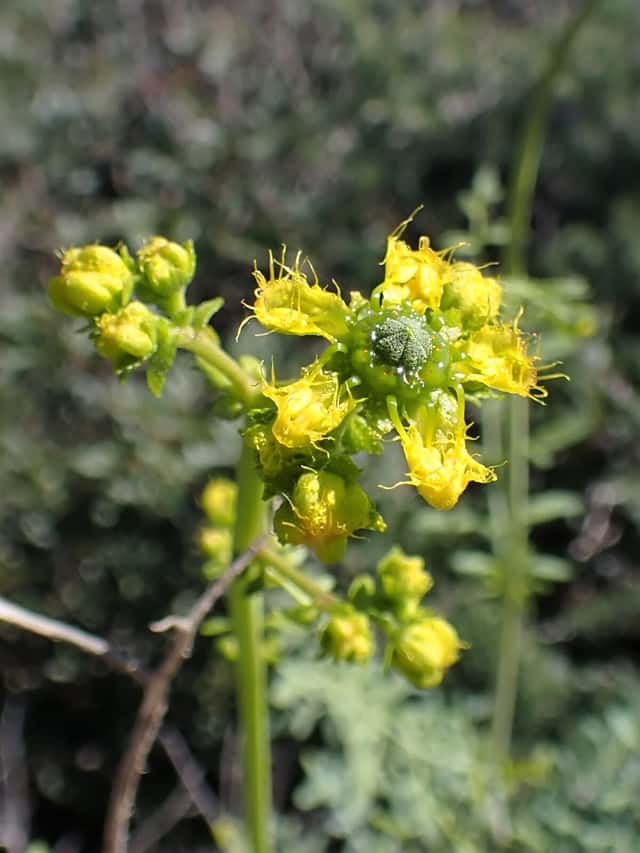
Ruta angustifolia, known as narrow-leaved rue or fringed rue, is an aromatic evergreen subshrub in the Rutaceae family, native to the Mediterranean region and widely naturalized across Southeast Asia. It grows 40-100 cm tall with slender woody stems and finely divided, blue-green leaves that release a strong, pungent scent when bruised. Clusters of small yellow flowers with a fetid odor bloom from spring through summer. The plant has a long history of traditional medicinal use for ailments such as fever, cramps and liver complaints, but all parts are toxic if ingested and the sap can cause severe skin burns when exposed to sunlight.
How to Propagate Narrow-leaved rue?
Seed sowing
Germination can be slow and uneven; wear gloves when handling seedlings since the sap is already mildly phototoxic.
- 1 Sow seeds shallowly in a well-draining seed-starting mix
- 2 Keep the mix lightly moist and in bright, indirect light
- 3 Transplant seedlings once they have 2-3 true leaves
Materials needed:
Stem cutting
Always wear gloves and long sleeves when taking cuttings - the sap can cause severe skin burns in sunlight.
- 1 Take a 10-15 cm semi-hardwood cutting from a healthy, non-flowering stem
- 2 Remove the lower leaves and dip the cut end in rooting hormone
- 3 Insert into moist, well-draining potting mix and keep in bright, indirect light until rooted
Materials needed:
How Big Does Narrow-leaved rue Grow?
TLDR: Narrow-leaved rue can reach up to 1.0m tall with Medium growth rate.
Max height
1.0m
Foliage
Evergreen
Warning: Toxic Plant
This plant can be toxic if ingested. Keep out of reach of:
Plant Uses
Medicinal
Medicinal properties
Aromatic
Pleasant fragrance
Medicinal Uses
- Traditional treatment for fever
- Used for digestive cramps and flatulence
- Traditional liver and jaundice remedy
Is your plant showing symptoms?
Click on the symptom to discover possible causes:
What Diseases Commonly Affect Narrow-leaved rue?
TLDR: Narrow-leaved rue is susceptible to 2 known diseases. Monitor regularly for early detection.
Aphids
Aphids are small, soft-bodied, pear-shaped insects (1/16 to 1/8 inch long) that feed by sucking nutrient-rich sap from plants. They reproduce rapidly and can quickly weaken plants, causing distorted growth and transmitting plant viruses. Aphids come in various colors including green, black, red, yellow, brown, and gray. They secrete honeydew, a sticky substance that attracts ants and encourages sooty mold growth.
Root Rot
Root rot is a serious fungal disease that affects the root system of plants, causing them to decay and die. It is primarily caused by overwatering, poor drainage, or soil-borne fungi such as Pythium, Phytophthora, Rhizoctonia, and Fusarium. The disease thrives in waterlogged conditions where roots are deprived of oxygen, making them susceptible to fungal infection.
Fun Facts
Its strong-smelling sap has been used historically as an insect repellent and to deter cats from gardens.
The species name angustifolia means 'narrow-leaved' in Latin, referring to its finely divided foliage.
In parts of Indonesia and Malaysia it's known as 'daun inggu' or 'garuda' and brewed as a traditional remedy.
Frequently asked questions
Is Ruta angustifolia toxic?
How much light does narrow-leaved rue need?
How often should I water Ruta angustifolia?
Can I grow narrow-leaved rue indoors?
What is Ruta angustifolia traditionally used for?
Compare with similar plants
| Attribute | Difficulty | Light | Watering | Pet Safe |
|---|---|---|---|---|
| Dark Fieldcap | Medium | Low light | 2d | ⚠️ |
| Azalea | Medium | Partial shade | 3d | ⚠️ |
| Muriel's Bamboo | Medium | Partial shade | 3d | ✓ |
| Bougainvillea | Medium | Direct sun | 7d | ⚠️ |
Choose & Compare
Sources & References
- Ruta angustifolia - Wikipedia
- Ruta Angustifolia Plant Care & Growing Basics - PlantIn
- How To Grow Ruta angustifolia - EarthOne
- Ruta angustifolia Pers. (Narrow-Leaved Fringed Rue): Pharmacological Properties and Phytochemical Profile
- Is Rue Toxic to Cats & Dogs? - Growli
- Especie Ruta angustifolia - Jardim Botanico UTAD
- Ruta angustifolia - Wikipedia (espanol)




