Crassulaceae
Mexican Hens (Echeveria shaviana)
Echeveria shaviana
A beautiful but slightly demanding succulent. Give it plenty of light, with morning sun and protection from strong afternoon sun in hot weather; move it into sun gradually so it does not scorch. Water deeply only when the soil is completely dry and never let it get waterlogged: it loses roots easily. Use a very porous mix and a pot with a drainage hole. It tolerates light frost if kept dry, but ideally spends winter at 5-10 °C. Avoid touching the leaves so the white powder stays on.
Every 14 days
Bright indirect
-1° - °C
% - %
Categories
What is Mexican hens?
Mexican hens (Echeveria shaviana) is a medium-care plant from the Crassulaceae family. Mexican hens (Echeveria shaviana) is a succulent in the family Crassulaceae, native to the mountains of northeastern Mexico (Nuevo León and Tamaulipas), where it grows on shaded boulders among pine needles. It forms stemless rosettes 8 to 15 cm across with 50 or more thin, spoon-shaped leaves that a...
Mexican hens grows up to 8cm, spread of 15cm, watering every 14 days. It is suitable for indoor environments and safe for pets.
Unlike many popular species, Mexican hens is safe to keep around pets. Without adequate drainage, root rot can develop within 28 days.
How to Care for Mexican hens?
TLDR: Mexican hens needs Bright indirect, watering every 14 days, and temperatures between -1-30°C with 40-70% humidity.
How Often Should You Water Mexican hens?
Water deeply when the soil is completely dry, every 10-15 days in summer and much less in winter. Water the soil only, never the center of the rosette.
How Much Light Does Mexican hens Need?
Full sun to part shade. In hot climates, morning sun and afternoon shade is best. Indoors, give it a very sunny window or a grow light, or the rosette stretches and loses color.
What Is the Best Soil for Mexican hens?
Very porous cactus and succulent mix with coarse sand, grit or perlite, and a drainage layer at the bottom of the pot.
What Pot Should You Use for Mexican hens?
A terracotta pot with a drainage hole and a layer of crocks or gravel at the bottom; repot every other year in spring and wait a week before watering.
Care Schedule
Repot
Every 730 days
What Is Mexican hens and Where Does It Come From?
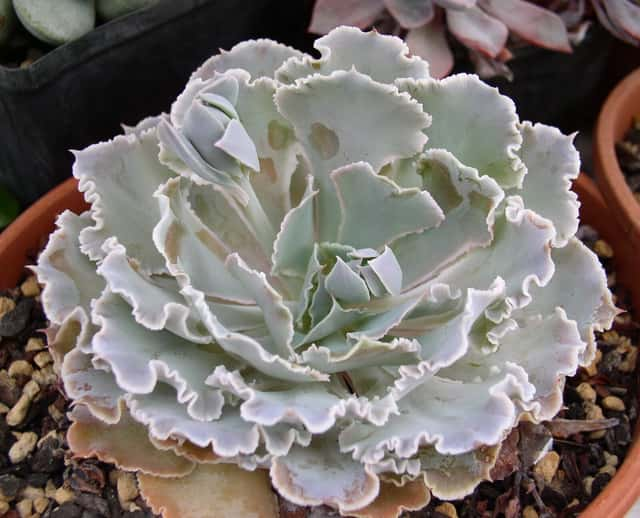
Mexican hens (Echeveria shaviana) is a succulent in the family Crassulaceae, native to the mountains of northeastern Mexico (Nuevo León and Tamaulipas), where it grows on shaded boulders among pine needles. It forms stemless rosettes 8 to 15 cm across with 50 or more thin, spoon-shaped leaves that are silvery grey or bluish, dusted with white powder (farina) and edged with wavy, crinkled frills. In strong light the edges and leaves blush pink. From late spring into summer it sends up branched stems up to 30 cm with bell-shaped flowers, pink outside and yellow inside. It has received the Royal Horticultural Society's Award of Garden Merit.
How to Propagate Mexican hens?
Leaf
This species' thin leaves often dry out before rooting: start several at once and be patient.
- 1 Remove whole leaves from the bottom of the rosette or from the flower stem with a gentle twist
- 2 Let them dry in shade for 2-3 days
- 3 Lay the leaves on dry, porous mix
- 4 Mist lightly once roots and plantlets appear
Materials needed:
Rosette cutting
The plant is slow to make offsets, so a rosette cutting is the fastest way to multiply it.
- 1 Cut the rosette with a piece of stem, if there is one
- 2 Let the cut callus for 3-5 days
- 3 Set it on dry, porous mix
- 4 Water lightly only after 1-2 weeks
Materials needed:
Seed
The seeds are tiny; water from below so you do not wash them away.
- 1 Scatter seeds on fine, moist mix without covering them
- 2 Cover the pot with clear plastic
- 3 Keep in bright light out of direct sun at 20-25 °C
- 4 Remove the plastic gradually once seedlings grow
Materials needed:
How Big Does Mexican hens Grow?
TLDR: Mexican hens can reach up to 8cm tall with Slow growth rate.
Max height
8cm
Spread
15cm
Growth rate
Slow
Foliage
Evergreen
Plant Uses
Ornamental
Great for decoration
Is your plant showing symptoms?
Click on the symptom to discover possible causes:
What Diseases Commonly Affect Mexican hens?
TLDR: Mexican hens is susceptible to 6 known diseases. Monitor regularly for early detection.
Root Rot
Root rot is a serious fungal disease that affects the root system of plants, causing them to decay and die. It is primarily caused by overwatering, poor drainage, or soil-borne fungi such as Pythium, Phytophthora, Rhizoctonia, and Fusarium. The disease thrives in waterlogged conditions where roots are deprived of oxygen, making them susceptible to fungal infection.
Overwatering
Overwatering occurs when plants receive too much water, depriving roots of oxygen and causing root rot. This environmental stress is one of the most common causes of houseplant death, as waterlogged soil prevents roots from breathing and functioning properly.
Mealybugs
Mealybugs are small, soft-bodied insects covered with a white, waxy, cottony material. They are common pests of houseplants and outdoor plants in mild climates. These sap-sucking insects feed on plant tissue, causing damage, stunted growth, and can lead to plant death if left untreated. They produce sticky honeydew which attracts sooty mold.
Aphids
Aphids are small, soft-bodied, pear-shaped insects (1/16 to 1/8 inch long) that feed by sucking nutrient-rich sap from plants. They reproduce rapidly and can quickly weaken plants, causing distorted growth and transmitting plant viruses. Aphids come in various colors including green, black, red, yellow, brown, and gray. They secrete honeydew, a sticky substance that attracts ants and encourages sooty mold growth.
Fun Facts
In the wild it grows on shaded boulders among pine needles in the mountains of Mexico.
It sometimes sends up two flower stems that curve into a heart shape.
The white powder on the leaves protects them from sun and rubs off at a touch.
Frequently asked questions
Why is my Echeveria shaviana losing its roots?
How do I make the leaves pinker?
Is it cold hardy?
Is it toxic to pets?
Compare with similar plants
| Attribute | Difficulty | Light | Watering | Pet Safe |
|---|---|---|---|---|
| Dark Fieldcap | Medium | Low light | 2d | ⚠️ |
| Azalea | Medium | Partial shade | 3d | ⚠️ |
| Muriel's Bamboo | Medium | Partial shade | 3d | ✓ |
| Iberian Houseleek | Easy | Direct sun | 14d | ✓ |




