Asparagaceae
Mexican Grass Tree: Full Sun Plant
Dasylirion longissimum
Requires full sun or bright partial shade, sparse and spaced watering, and a very well-drained sandy or cactus-type substrate. It is a very resilient species against pests and diseases; its main weakness is excess moisture in the substrate or the crown, which can cause rot. It requires almost no pruning or fertilization.
Every 14 days
Direct sun
-9° - °C
% - %
Categories
What is Mexican Grass Tree?
Mexican Grass Tree (Dasylirion longissimum) is a easy-care plant from the Asparagaceae family. Dasylirion longissimum, commonly known as the Mexican Grass Tree or Toothless Desert Spoon, is a xerophytic perennial plant in the Asparagaceae family, native to the Chihuahuan Desert and arid regions of northeastern Mexico (Tamaulipas, San Luis Potosí, and Nuevo León). It forms a dense, symmetrical...
Mexican Grass Tree grows up to 4.0m, spread of 240cm, watering every 14 days. It is suitable for indoor environments and safe for pets.
Unlike many tropical plants, Mexican Grass Tree tolerates watering mistakes. Best for beginners. Unlike many popular species, Mexican Grass Tree is safe to keep around pets. Without adequate drainage, root rot can develop within 28 days.
How to Care for Mexican Grass Tree?
TLDR: Mexican Grass Tree needs Direct sun, watering every 14 days, and temperatures between -9-30°C with 40-70% humidity.
How Often Should You Water Mexican Grass Tree?
Allow the substrate to dry out completely between waterings: approximately once a week in summer and every two weeks in winter, reducing watering even further during cold months. Avoid wetting the crown (the center of the rosette) and do not leave standing water in the saucer: excess moisture is the most common cause of root and crown rot in this species.
How Much Light Does Mexican Grass Tree Need?
Prefers full sun, although it also tolerates partial shade. Indoors, place it in the brightest spot possible with access to direct natural light for most of the day, as low light causes it to lose its compact shape and vigor.
What Is the Best Soil for Mexican Grass Tree?
Needs a very porous and well-drained substrate: a mix of universal potting soil with coarse sand and perlite, or a specific substrate for cacti and succulents. Good drainage is more critical for its health than the nutrient richness of the soil.
What Pot Should You Use for Mexican Grass Tree?
Unglazed clay or terracotta pot with large drainage holes at the base; the porous material helps evaporate excess moisture from the substrate and reduces the risk of root rot.
Care Schedule
Fertilize
Every 180 days
Repot
Every 1095 days
What Is Mexican Grass Tree and Where Does It Come From?
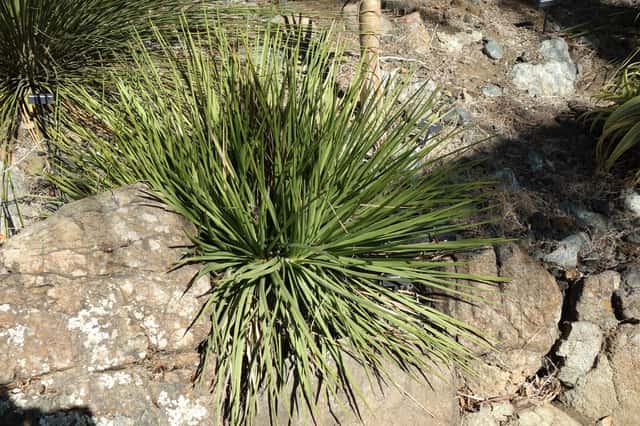
Dasylirion longissimum, commonly known as the Mexican Grass Tree or Toothless Desert Spoon, is a xerophytic perennial plant in the Asparagaceae family, native to the Chihuahuan Desert and arid regions of northeastern Mexico (Tamaulipas, San Luis Potosí, and Nuevo León). It forms a dense, symmetrical rosette of cylindrical, thin, flexible, blue-green leaves over a meter long, emerging from a thick, woody trunk. It is very slow-growing—taking over a decade to develop a visible trunk—and is extremely tolerant of drought and moderate frosts (down to about -9 °C / 15 °F). In summer, it produces long flower spikes with small cream or white flowers, which later form attractive clusters of reddish seeds. It is primarily cultivated as an architectural ornamental plant in xeriscapes, rock gardens, and low-maintenance landscapes.
How to Propagate Mexican Grass Tree?
Seed Propagation
- Initial growth is extremely slow; it can take years to see a visible trunk.
- Avoid overwatering seedlings, as they are very prone to fungal issues.
- 1 Scarification
Lightly scarify the seeds (gentle sanding) to improve germination, which can increase rates from 10-15% to 80-100%.
- 2 Sowing
Sow in a sandy, well-drained substrate, covering the seeds with a very thin layer.
- 3 Germination
Keep the substrate slightly moist and maintain a warm, constant temperature until germination occurs.
Materials needed:
Clump Division
- A less common method than seed sowing for this species.
- 1 Separation
Carefully separate a section from the base with its own roots if the plant has developed multiple rosettes.
- 2 Transplanting
Plant the section in a pot with well-drained substrate and water sparingly until it takes root.
Materials needed:
How Big Does Mexican Grass Tree Grow?
TLDR: Mexican Grass Tree can reach up to 4.0m tall with Slow growth rate.
Max height
4.0m
Spread
2.4m
Growth rate
Slow
Foliage
Evergreen
Plant Uses
Ornamental
Great for decoration
Is your plant showing symptoms?
Click on the symptom to discover possible causes:
What Diseases Commonly Affect Mexican Grass Tree?
TLDR: Mexican Grass Tree is susceptible to 4 known diseases. Monitor regularly for early detection.
Root Rot
Root rot is a serious fungal disease that affects the root system of plants, causing them to decay and die. It is primarily caused by overwatering, poor drainage, or soil-borne fungi such as Pythium, Phytophthora, Rhizoctonia, and Fusarium. The disease thrives in waterlogged conditions where roots are deprived of oxygen, making them susceptible to fungal infection.
Scale Insects
Scale insects are small sap-sucking pests that appear as brown, shell-like bumps on plant stems and leaves. There are over 25 species, divided into armored (hard) and unarmored (soft) scales. They feed by piercing plant tissue and extracting sap, which weakens the plant and can lead to yellowing, stunted growth, and even death if left untreated. They also excrete honeydew, which attracts ants and promotes sooty mold growth.
Mealybugs
Mealybugs are small, soft-bodied insects covered with a white, waxy, cottony material. They are common pests of houseplants and outdoor plants in mild climates. These sap-sucking insects feed on plant tissue, causing damage, stunted growth, and can lead to plant death if left untreated. They produce sticky honeydew which attracts sooty mold.
Crown Rot
Crown rot is a serious fungal disease that attacks the crown (base) of the plant where the stem meets the soil. It is caused by various fungal pathogens including Phytophthora, Fusarium, and Rhizoctonia. The disease thrives in waterlogged conditions and can quickly spread to kill the entire plant if not addressed promptly.
Meaning & Symbolism
A symbol of resilience, patience, and strength in the face of extreme desert conditions.
Compare with similar plants
| Attribute | Difficulty | Light | Watering | Pet Safe |
|---|---|---|---|---|
| Field Maple | Easy | Bright indirect | 14d | ✓ |
| Silver Birch | Easy | Direct sun | 14d | ✓ |
| Common Blanketflower | Easy | Direct sun | 10d | ✓ |
| Cushion Bush | Easy | Direct sun | 14d | ✓ |
Choose & Compare
Sources & References
- Dasylirion longissimum: cuidados y características - Jardín Postal
- Dasylirion longissimum o Junquillo | Cuidados - ConsultaPlantas
- Dasylirion longissimum - Wikipedia
- Dasylirion Longissimum (Care Guide) - Succulents Network
- Mexican grass tree (Dasylirion longissimum) Care Guide - ForwardPlant
- De la Semilla al Trago: Dasylirion - Seed World





