Arecaceae
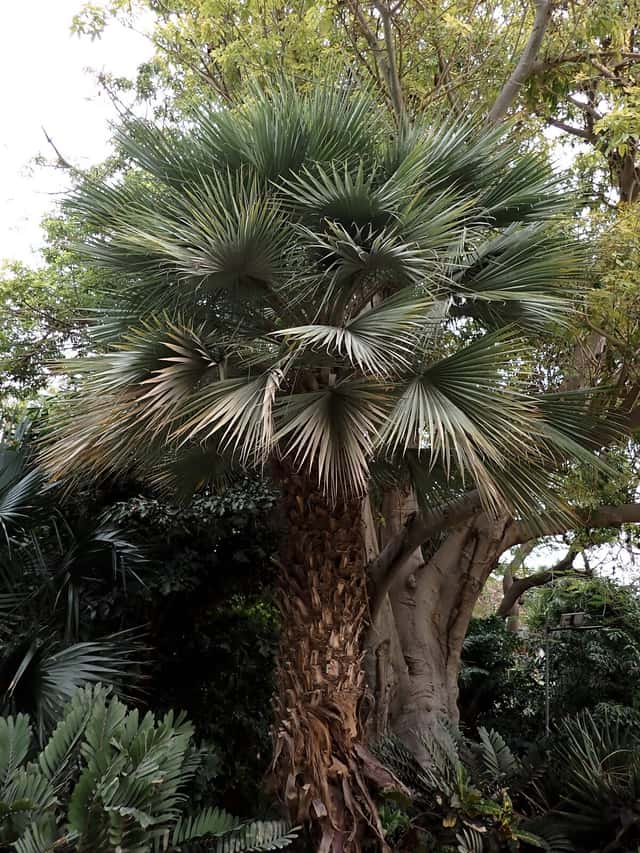
Mexican blue palm (Brahea armata)
Brahea armata
A full-sun, low-water palm: fast-draining soil, deep but infrequent watering once established, and never soggy roots. Handles light frost.
Every 14 days
Direct sun
-10° - 45°C
% - %
Categories
What is Mexican blue palm?
Mexican blue palm (Brahea armata) is a easy-care plant from the Arecaceae family. Brahea armata is a fan palm native to Baja California, Mexico, where it grows in canyons and dry washes of the Sonoran Desert. It has a stout trunk and reaches 11 to 15 m. The stiff fan leaves, 1 to 2 m across, are silver-blue, and the leaf stalks carry curved teeth. In late winter it sends out arch...
Mexican blue palm grows up to 15.0m, spread of 300cm, watering every 14 days, -10°C – 45°C. It is not suitable for indoor environments and safe for pets.
Unlike many tropical plants, Mexican blue palm tolerates watering mistakes. Best for beginners. Unlike many popular species, Mexican blue palm is safe to keep around pets.
How to Care for Mexican blue palm?
TLDR: Mexican blue palm needs Direct sun, watering every 14 days, and temperatures between -10-45°C with 40-70% humidity.
How Often Should You Water Mexican blue palm?
Water every 1 to 2 weeks in the first year. Once established, a deep soak every 2 to 4 weeks in hot weather is enough. Overwatering, especially in containers, is the most common way to lose it.
How Much Light Does Mexican blue palm Need?
Full sun all day. The more sun, the bluer the leaves. It tolerates part shade but turns greener and leggier.
What Is the Best Soil for Mexican blue palm?
Sandy or rocky, very well-drained soil. In alkaline soil it can run short of magnesium, which yellows the tips of older leaves.
What Pot Should You Use for Mexican blue palm?
Young plants do well in a deep terracotta pot with drainage and a sandy mix. Mature palms belong in the ground: the roots run deep and they dislike being moved.
Care Schedule
Fertilize
Every 90 days
What Is Mexican blue palm and Where Does It Come From?
Brahea armata is a fan palm native to Baja California, Mexico, where it grows in canyons and dry washes of the Sonoran Desert. It has a stout trunk and reaches 11 to 15 m. The stiff fan leaves, 1 to 2 m across, are silver-blue, and the leaf stalks carry curved teeth. In late winter it sends out arching sprays of cream flowers that reach up to 5 m, well beyond the crown, followed by brown fruits. It is one of the most cold- and drought-tolerant palms, and a slow grower.
How to Propagate Mexican blue palm?
Seed
Germination is slow and uneven. Soak seeds for 2 to 3 days and keep the mix warm, around 30 °C.
- 1 Clean the pulp off ripe fruits
- 2 Soak the seeds in warm water for 2 to 3 days
- 3 Sow 1 cm deep in a sandy mix
- 4 Keep warm and lightly moist until they sprout
- 5 Pot up when the seedling has 2 to 3 leaves
Materials needed:
How Big Does Mexican blue palm Grow?
TLDR: Mexican blue palm can reach up to 15.0m tall with Slow growth rate.
Max height
15.0m
Spread
3.0m
Growth rate
Slow
Foliage
Evergreen
Plant Uses
Ornamental
Great for decoration
Is your plant showing symptoms?
Click on the symptom to discover possible causes:
What Diseases Commonly Affect Mexican blue palm?
TLDR: Mexican blue palm is susceptible to 4 known diseases. Monitor regularly for early detection.
Root Rot
Root rot is a serious fungal disease that affects the root system of plants, causing them to decay and die. It is primarily caused by overwatering, poor drainage, or soil-borne fungi such as Pythium, Phytophthora, Rhizoctonia, and Fusarium. The disease thrives in waterlogged conditions where roots are deprived of oxygen, making them susceptible to fungal infection.
Overwatering
Overwatering occurs when plants receive too much water, depriving roots of oxygen and causing root rot. This environmental stress is one of the most common causes of houseplant death, as waterlogged soil prevents roots from breathing and functioning properly.
Magnesium Deficiency
Magnesium deficiency is a nutrient disorder characterized by interveinal chlorosis, where leaf tissue between veins turns yellow while the veins remain green. This deficiency affects older leaves first as magnesium is a mobile nutrient that plants relocate to support new growth. Magnesium is essential for chlorophyll production and photosynthesis, making this deficiency critical for plant health.
Scale Insects
Scale insects are small sap-sucking pests that appear as brown, shell-like bumps on plant stems and leaves. There are over 25 species, divided into armored (hard) and unarmored (soft) scales. They feed by piercing plant tissue and extracting sap, which weakens the plant and can lead to yellowing, stunted growth, and even death if left untreated. They also excrete honeydew, which attracts ants and promotes sooty mold growth.
Fun Facts
Its flower sprays can reach 5 m and arch far beyond the crown
The Cocopah people roasted and ate the seeds
The leaf stalks carry curved teeth, hence the name armata
Frequently asked questions
How cold-hardy is the Mexican blue palm?
Does it grow fast?
Why are the leaves turning yellow?
Can I grow it indoors?
Compare with similar plants
| Attribute | Difficulty | Light | Watering | Pet Safe |
|---|---|---|---|---|
| Field Maple | Easy | Bright indirect | 14d | ✓ |
| Iberian Houseleek | Easy | Direct sun | 14d | ✓ |
| Silver Birch | Easy | Direct sun | 14d | ✓ |
| Common Blanketflower | Easy | Direct sun | 10d | ✓ |





