2257 Easy Plants | 2026 Guide - Page 62
Discover 2257 easy plants for your garden. Complete care guide.
2257 Easy Plants
Showing 2197-2232 of 2257
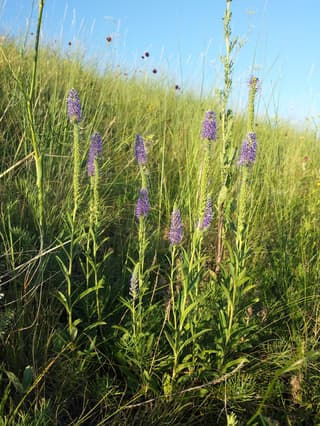
Spiked Speedwell
Veronica spicata
Veronica spicata, commonly known as Spiked Speedwell, is a hardy perennial flowering plant native to Europe and Asia. It produces striking upright spikes of tiny blue, purple, pink, or white flowers in summer, making it a favourite in cottage gardens and pollinator-friendly borders. A vigorous, low-maintenance plant that thrives in full sun with well-drained soil.
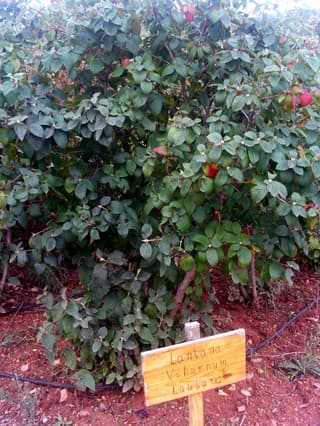
Wayfaring Tree
Viburnum lantana
Viburnum lantana, commonly known as the wayfaring tree, is a robust deciduous shrub native to Europe, North Africa and western Asia. It forms a broad, multi-stemmed mound of felty, grey-green leaves that turn deep red-purple in autumn. Flat clusters of small creamy-white flowers open in late spring, followed by berries that ripen from green to red and finally glossy black, often showing several colors on the same cluster at once. Traditionally planted along hedgerows and footpaths, it earned its common name for marking the way for travelers across the English countryside.
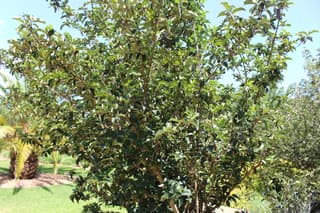
Chinese Snowball Viburnum
Viburnum macrocephalum
Viburnum macrocephalum, known as the Chinese snowball viburnum, is a rounded, vase-shaped deciduous to semi-evergreen shrub native to mainland China. It is prized for its enormous spherical flower clusters, which open lime-green and mature to pure white, resembling giant snowballs held above dark green, serrated leaves.
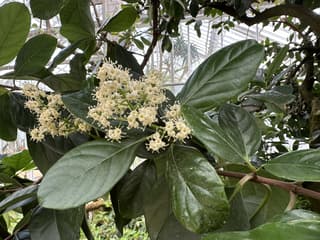
Sweet Viburnum
Viburnum odoratissimum
Sweet Viburnum (Viburnum odoratissimum) is a large, fast-growing evergreen shrub prized across warm climates for its dense, glossy foliage and its ability to form an impenetrable privacy hedge in just a few seasons. Native to East and Southeast Asia, it produces broad, leathery, deep-green leaves and, in late spring to early summer, showy conical clusters of small white flowers with a sweet, honey-like fragrance that gives the plant its name. The flowers are followed by small red fruits that ripen to black. Left unpruned, Sweet Viburnum can reach 4-6 m tall and wide, but it takes shearing extremely well and is one of the most popular screening and hedging shrubs in subtropical and warm-temperate landscapes.
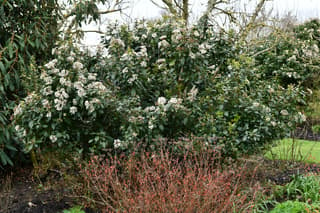
Laurustinus
Viburnum tinus
Laurustinus is a dense, evergreen Mediterranean shrub prized for its leathery dark-green leaves and clusters of pink-budded white flowers that open through the winter months. Following the blooms, it produces small, metallic blue-black berries that add extra seasonal interest and attract birds. Hardy and low-maintenance, it is widely used as a hedge, screen or specimen shrub in mild-winter gardens.
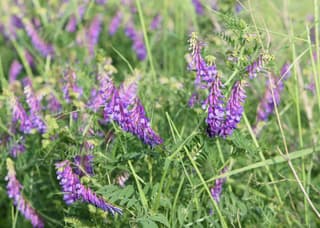
Vetch
Vicia
Vicia is a large genus of climbing and scrambling legumes commonly called vetches, native to Europe, Asia, Africa, and the Americas. With over 240 species, vetches are best known as nitrogen-fixing cover crops and livestock forage, though some species have been cultivated as food for thousands of years. Their slender, trailing stems climb via tendrils, bearing pea-like flowers in shades of purple, pink, blue, and white from spring through summer.
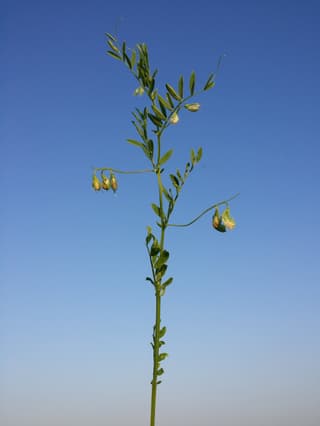
Lentil
Vicia lens
The lentil (Vicia lens) is an annual legume native to Southwest Asia and the Mediterranean, cultivated for over 9,000 years. A short-cycle crop producing small protein- and fiber-rich seeds, it is one of the oldest food plants in human history.
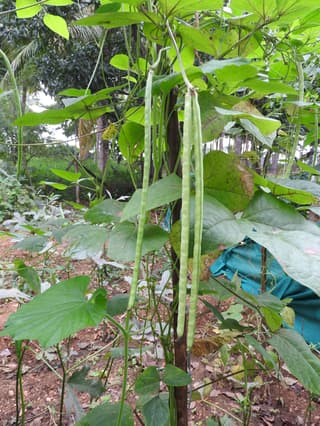
Black-eyed pea
Vigna unguiculata
The black-eyed pea (Vigna unguiculata) is an annual legume native to West Africa, widely grown across tropical and subtropical regions worldwide. Recognized by its distinctive black spot around the hilum, it is one of humanity's oldest and most nutritious food crops, rich in protein, fiber, and micronutrients. It also plays a vital role in soil health by fixing atmospheric nitrogen.
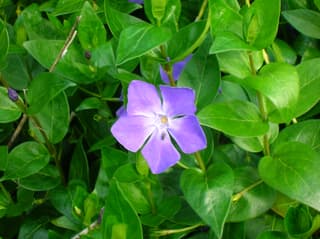
Greater Periwinkle
Vinca major
Vinca major, commonly known as Greater Periwinkle, is a vigorous evergreen ground cover native to the Mediterranean region of Europe. It produces glossy dark green leaves and charming five-petaled violet-blue flowers from spring through summer. Fast-spreading and highly adaptable, it thrives in partial shade and is widely used to cover slopes, suppress weeds, and fill shaded garden areas. Despite its ornamental appeal, it can become invasive outside its native range.
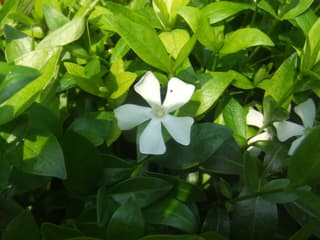
Lesser Periwinkle
Vinca minor
Lesser periwinkle (Vinca minor) is a low-growing, evergreen perennial ground cover native to central and southern Europe. It produces charming star-shaped flowers in shades of violet-blue, lavender, or white atop a dense mat of glossy dark-green leaves. Thriving in shaded spots where few other plants succeed, it is a staple of woodland gardens, slopes, and areas under trees. The plant contains vinca alkaloids (including vincamine) that are toxic if ingested by humans, cats, or dogs, though it is generally safe to handle.

Variegated Lesser Periwinkle
Vinca minor 'Variegata'
Variegated lesser periwinkle is a low, trailing evergreen subshrub in the Apocynaceae family, native to central and southern Europe, prized for its grey-green oval leaves edged in creamy white. Its wiry stems root at the nodes wherever they touch soil, quickly forming a dense mat, and it produces solitary violet-blue, five-lobed flowers mainly in spring. It is exceptionally tough, tolerating anything from full sun to deep shade.
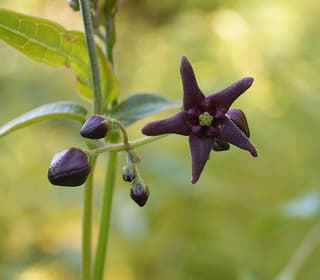
Black Swallow-wort
Vincetoxicum nigrum
Black Swallow-wort (Vincetoxicum nigrum) is a perennial herbaceous twining vine native to Mediterranean Europe. It produces small star-shaped flowers in deep black to dark purple hues during late spring and summer. Highly invasive in North America, it forms dense colonies that crowd out native vegetation. All plant parts are severely toxic.
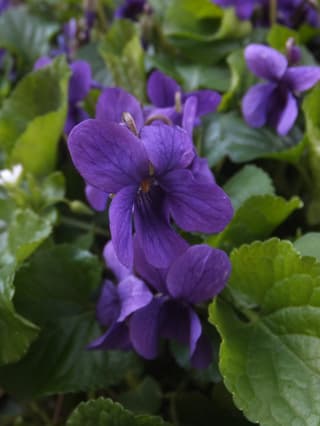
Sweet Violet
Viola
Sweet Violet (Viola) is a low, spreading perennial prized for its heart-shaped leaves and small, deeply fragrant purple, blue, or white flowers that open in early spring. Native to Europe and temperate Asia, it forms neat rosettes that creep gently by runners, making it a classic choice for shaded borders, woodland gardens, and containers. Both flowers and leaves are edible and have been used since antiquity for perfume, confectionery, and folk medicine.
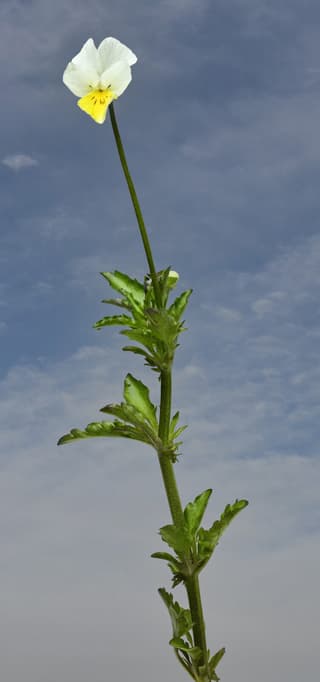
Field Pansy
Viola arvensis
Viola arvensis, the field pansy, is a low-growing annual to biennial wildflower native to Europe, Western Asia, and North Africa. It forms a basal rosette of spoon-shaped leaves with bluntly toothed edges and produces small, five-petaled flowers usually creamy white to pale yellow with a purple-flecked lower petal, though color can vary. Widely naturalized, it thrives in disturbed soils, meadows, and cultivated fields, flowering from early spring through fall.

Sweet Violet
Viola odorata
Sweet violet is a low-growing, hardy herbaceous perennial native to Europe and western Asia, prized for its sweetly fragrant purple or white flowers and heart-shaped leaves. It spreads via stolons to form a dense flowering mat, making it a popular ground cover for shaded borders and woodland gardens.
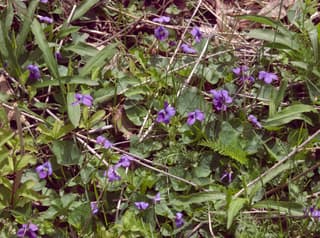
Common Blue Violet
Viola sororia
Viola sororia, commonly known as the Common Blue Violet or Wood Violet, is a native North American herbaceous perennial celebrated for its charming blue-purple spring flowers. It thrives in moist, shaded woodland edges, meadows, and naturalistic gardens. Hardy from zones 3a to 7b, it self-seeds freely and spreads via rhizomes, making it an excellent low-maintenance ground cover for shaded areas.
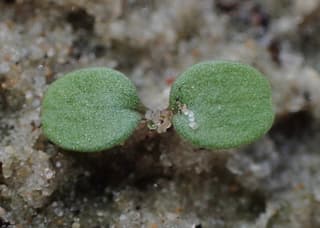
Wild Pansy
Viola tricolor
Wild Pansy (Viola tricolor) is a small herbaceous plant native to Europe and Western Asia, considered the wild ancestor of modern cultivated pansies. It produces charming tricolor flowers in shades of purple, yellow, and white, blooming from winter through summer.
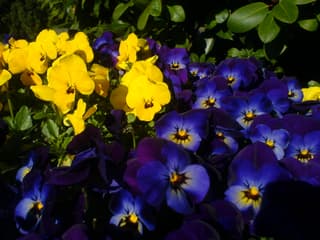
Pansy
Viola x wittrockiana
Viola x wittrockiana, commonly known as Pansy, is a hybrid flowering plant developed from European wild violets. One of the most beloved cool-season bedding plants, pansies produce cheerful, velvety blooms with distinctive "face-like" markings in a wide range of colors. They thrive in cool temperatures and are commonly planted in spring and fall gardens.
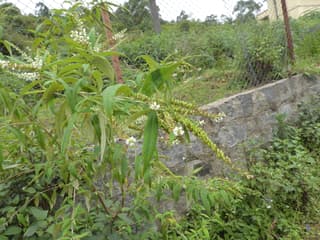
Chaste tree
Vitex
Vitex is a genus of aromatic, sun-loving shrubs and small trees, best known from the cultivated chaste tree (Vitex agnus-castus). These deciduous plants grow to about 3-6 m and produce showy summer spikes of fragrant purple, blue, pink or white flowers above palmate, grey-green foliage.
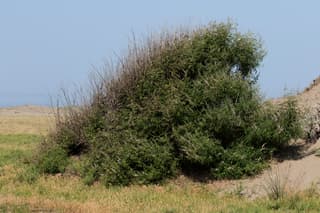
Chaste Tree
Vitex agnus-castus
Vitex agnus-castus, commonly known as chaste tree or monk's pepper, is a deciduous Mediterranean shrub in the Lamiaceae family. It produces fragrant spikes of lavender-blue flowers throughout summer and fall, attracting butterflies and pollinators. Highly drought-tolerant and adaptable, it has centuries of history as a medicinal herb.
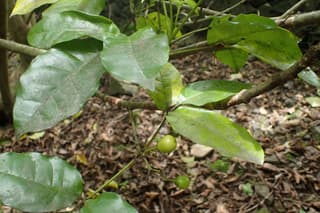
Puriri
Vitex lucens
Puriri (Vitex lucens) is a majestic evergreen tree endemic to northern New Zealand. It can reach up to 20 metres tall with a massive spreading canopy, glossy palmate leaves, and tubular pink-to-red flowers that bloom year-round. It is one of New Zealand's most iconic native trees, providing critical food and habitat for native birds such as the kererū (native pigeon).
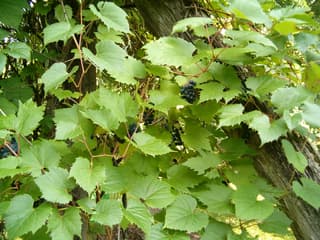
Riverbank Grape
Vitis riparia
Vitis riparia, commonly known as Riverbank Grape or Frost Grape, is a vigorous deciduous climbing vine native to North America, ranging from Canada through the central United States. It thrives along riverbanks, forest edges, and rocky slopes, climbing trees and structures to heights exceeding 20 metres. In autumn, its heart-shaped lobed leaves turn golden-yellow, while its clusters of small, dark-blue berries — sweetened after the first frost — provide vital food for wildlife and are used by foragers for juices, jellies, and wine.
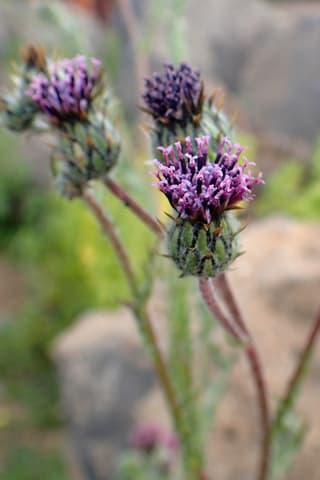
Tubular Knapweed
Volutaria tubuliflora
Tubular Knapweed (Volutaria tubuliflora) is an annual herb in the Asteraceae family, native to North Africa and the Mediterranean Basin. Recognized by its pink-purple tubular flowers and deeply lobed hairy leaves, it thrives in sandy, arid to semi-arid environments. It is considered an invasive species in California, USA, where it poses a threat to native desert ecosystems, producing up to 2,500 seeds per plant.
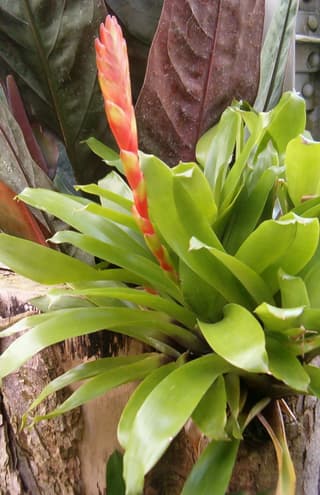
Vriesea
Vriesea
Vriesea is a genus of approximately 250 epiphytic bromeliads native to the Americas, particularly Central and South America. They form tank-shaped rosettes with long, often ornamentally banded or spotted leaves. The dramatic, flat flower spikes display vibrant bracts in shades of red, yellow, orange, and pink that last for weeks.
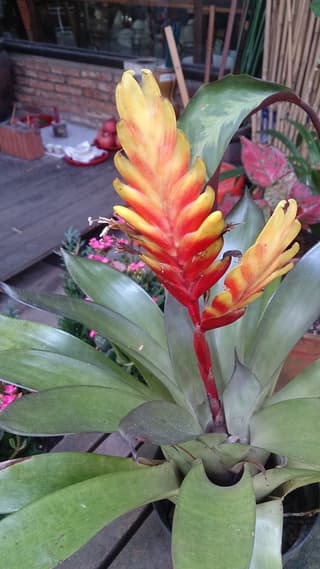
Lobster Claws Bromeliad
Vriesea carinata
Vriesea carinata, commonly known as Lobster Claws Bromeliad or Painted Feather, is an epiphytic bromeliad native to the Atlantic Forest of Brazil. It is prized for its stunning red and yellow flower bracts that resemble lobster claws. A compact, low-maintenance plant ideal for indoor tropical settings.
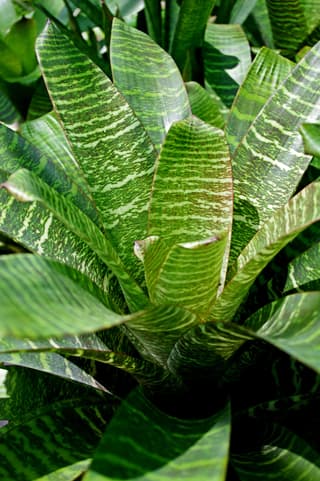
King of Bromeliads
Vriesea hieroglyphica
Tank bromeliad with distinctive banded green leaves featuring dark cross-banding and recurved tips, resembling hieroglyphic markings. Produces branching yellow, cream, or white flowers on tall inflorescences. Endemic to southeastern Brazil, thriving in humid conditions beneath tree shade.
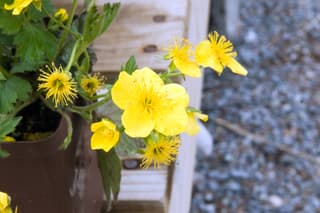
Barren Strawberry
Waldsteinia ternata
Barren strawberry (Waldsteinia ternata) is a low-growing, semi-evergreen perennial groundcover belonging to the Rosaceae family. It is native to a region spanning from Central Europe to Siberia and Japan. Its trifoliate, dark green leaves form a dense mat that effectively covers the ground throughout the growing season. The foliage remains green under the snow and recovers quickly in the spring. In May, the plant bursts into yellow blooms that resemble strawberry flowers. Barren strawberry is very low-maintenance and is an excellent choice for a groundcover in semi-shaded gardens.
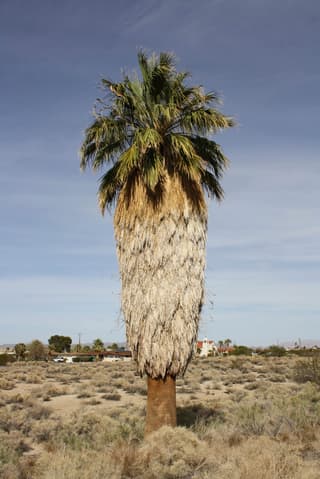
California Fan Palm
Washingtonia filifera
Washingtonia filifera, the California fan palm (also called desert fan palm), is a massive, single-trunked palm native to desert oases of the southwestern United States. It is the only palm species native to the western United States and forms dense groves around natural springs in the Colorado and Mojave deserts. Mature palms develop a thick, fibrous gray-brown trunk topped with a crown of large, fan-shaped (palmate) leaves that can reach 1.5-2 m across, each armed with curling filaments along the leaf margins that give the species its epithet "filifera" (thread-bearing). Older, uncultivated specimens often retain a skirt of dead fronds hanging down the trunk, earning it the nickname "petticoat palm."
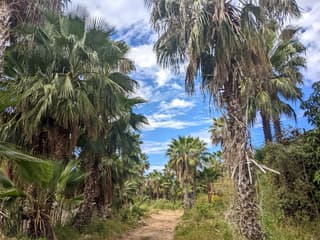
Mexican Fan Palm
Washingtonia robusta
Washingtonia robusta, commonly known as the Mexican Fan Palm or Skyduster, is a fast-growing palm native to Baja California and Sonora, Mexico. Prized for its slender towering trunk and large fan-shaped fronds, it can reach up to 30 meters tall and is widely planted along boulevards, in parks, and in warm-climate gardens worldwide.
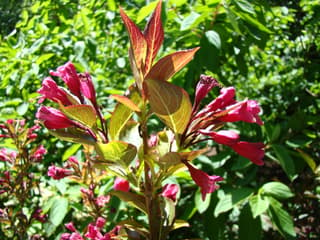
Old Fashioned Weigela
Weigela florida
Weigela florida, commonly known as Old Fashioned Weigela, is a deciduous flowering shrub native to northern China and Korea. It is celebrated for its profuse, trumpet-shaped blooms in shades of pink, red, and white that emerge in late spring and early summer, making it a beloved choice for garden borders and foundation plantings. Its arching branches create an elegant silhouette, and modern cultivars offer a wide range of foliage colors from deep burgundy to variegated cream.
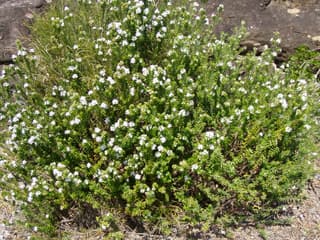
Coastal Rosemary
Westringia fruticosa
Westringia fruticosa, commonly known as Coastal Rosemary, is a hardy evergreen shrub native to coastal areas of southeastern Australia. Despite its common name and rosemary-like foliage, it is not related to true rosemary but belongs to the mint family (Lamiaceae). It produces an abundance of small white to lavender flowers almost year-round, making it a popular ornamental shrub in Australian and Mediterranean-style gardens.
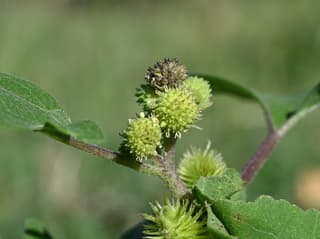
Cocklebur
Xanthium
Xanthium is a genus of annual herbaceous weeds in the family Asteraceae, native to the Americas and eastern Asia. It is best known for its spiny bur fruits that cling to clothing and animal fur, aiding seed dispersal. Plants grow in disturbed soils, roadsides, and open fields, reaching up to 120 cm tall.
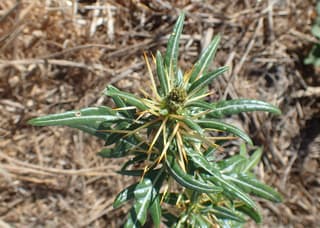
Spiny Cocklebur
Xanthium spinosum
Xanthium spinosum, commonly known as Spiny Cocklebur or Bathurst Burr, is an annual invasive herb in the Asteraceae family, presumed native to South America. It is characterized by long yellowish three-pronged spines at leaf bases and spiny burs that cling readily to animal fur and clothing. It is considered a serious agricultural weed and is highly toxic to livestock and humans.
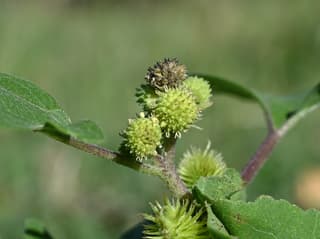
Rough Cocklebur
Xanthium strumarium
Xanthium strumarium, known as Rough Cocklebur, is an annual herbaceous weed belonging to the Asteraceae family. It is a cosmopolitan invasive species found on all continents except Antarctica, thriving in disturbed soils, floodplains, roadsides, and agricultural fields. It is best known for its hard, spiny burs that cling to animal fur and clothing — a property that inspired the invention of velcro. The plant is highly toxic, particularly in the seedling and cotyledon stages, where it contains carboxyatractyloside, a diterpenoid glycoside fatal to livestock and potentially to humans.
Maritime sunburst lichen
Xanthoria parietina
Xanthoria parietina, commonly known as the maritime sunburst lichen or common orange lichen, is a highly resilient lichen species often seen on rocks, walls, and tree bark. Its characteristic bright yellow or orange color is provided by a pigment called parietin, which protects the cells from intense UV radiation. This species lives in symbiosis, with its body composed of a fungus and an alga. It is an excellent bioindicator, as it tolerates nitrogen-rich environments well but remains sensitive to certain types of air pollution.
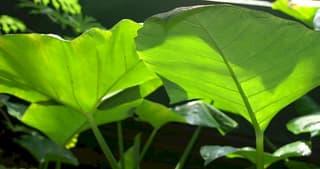
Arrowleaf Elephant Ear
Xanthosoma sagittifolium
Xanthosoma sagittifolium, popularly known as Arrowleaf Elephant Ear, is a lush tropical plant with large heart- or arrow-shaped leaves. Native to Central and South America, it is widely cultivated for both its ornamental value and its culinary use in various regions. Its leaves can reach impressive sizes, creating a jungle-like look in gardens or well-lit interiors.
What are Easy Plants?
Easy Plants are ideal for beginners or people with little time for care. These species are tolerant of watering mistakes, light variations, and don't require constant attention. Perfect for those just starting out with plants.
Tips for Growing Easy Plants
To succeed with easy plants, remember: less is more. Avoid overwatering, choose a spot with adequate light, and let the soil dry between waterings. Most of these plants prefer to be 'forgotten' occasionally.