1411 Easy Pet Safe | 2026 Guide - Page 30
Find 1411 easy pet safe. Complete guide for your garden.
1411 Pet Safe with easy level
Showing 1045-1080 of 1411
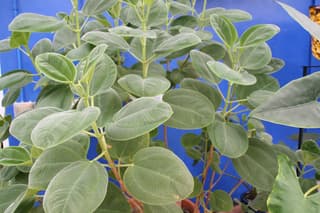
Pink Princess Flower
Pleroma granulosum
Pleroma granulosum (syn. Tibouchina granulosa), commonly known as Pink Princess Flower or Purple Glory Tree, is a fast-growing flowering tree native to Brazil's Atlantic Forest, belonging to the family Melastomataceae. It produces spectacular clusters of large violet-purple to magenta blooms mainly in late summer through autumn. Widely planted as a street tree and garden ornamental in tropical and subtropical regions worldwide.
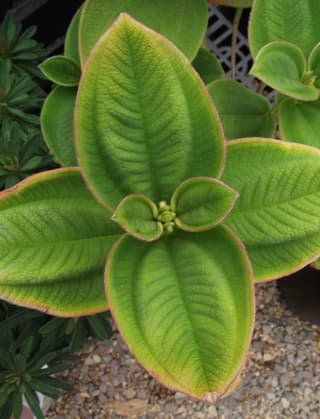
Silver-leaved Princess Flower
Pleroma heteromalla
Pleroma heteromalla, commonly known as Silver-leaved Princess Flower, is a shrub native to the Brazilian Cerrado, belonging to the family Melastomataceae. Previously classified as Tibouchina heteromalla, this species is prized for its velvety silver-gray foliage and vibrant purple flowers. Well-adapted to the challenging conditions of the Cerrado savanna, it is a resilient and ornamentally striking plant.
Oyster mushroom
Pleurotus ostreatus
The oyster mushroom is an edible, wood-decaying fungus that grows in clusters. It has oyster-shaped caps, ranging in color from light gray to dark brown. It is highly valued for its meaty texture and its ability to grow on various cellulose-rich substrates, such as straw or wood.

Camphor Weed
Pluchea
Pluchea is a genus of aromatic shrubs in the Asteraceae family, commonly known as camphor weeds or marsh fleabanes. Native to tropical and subtropical regions of the Americas, these robust plants are widely used in traditional medicine for their anti-inflammatory, antioxidant, and antimicrobial properties. Leaves emit a characteristic camphor-like aroma and produce clusters of small pink or lilac flower heads.
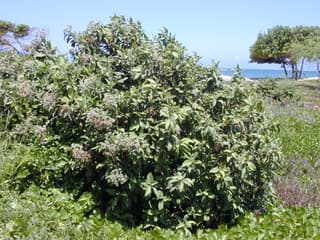
Cure-for-all
Pluchea carolinensis
Cure-for-all (Pluchea carolinensis) is an aromatic, fast-growing perennial shrub native to the Caribbean, Florida, and Central and South America. Its velvety, camphor-scented leaves and delicate pink-lavender flowers make it both ornamentally attractive and medicinally prized. Widely used in Caribbean and Brazilian folk medicine for centuries, it is traditionally employed to treat colds, fever, bronchitis, sore throats, and rheumatic pain. It thrives in full sun and well-drained soils, reaching up to 2.5 m in height.
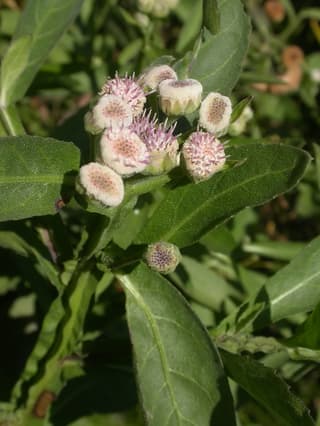
Wingstem Camphorweed
Pluchea sagittalis
Wingstem Camphorweed (Pluchea sagittalis) is an aromatic medicinal herb native to South America, notable for its winged stems and small pink to white flowers. It thrives in warm, humid environments and has a long history of use in traditional medicine across the continent.
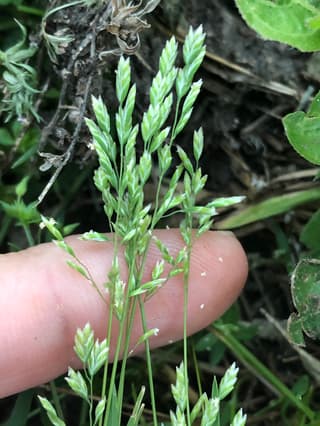
Annual Meadow Grass
Poa annua
Poa annua, commonly known as Annual Meadow Grass or Annual Bluegrass, is a small, tufted annual or short-lived perennial grass native to temperate Europe and Asia but now found worldwide. It forms dense low mats of fine-textured, bright yellow-green blades with characteristic boat-shaped leaf tips. Despite often being considered a lawn weed, it is also cultivated on golf-course putting greens and used as a ground cover in low-maintenance areas. It germinates in cool weather, flowers in spring, and dies back as summer heat arrives.
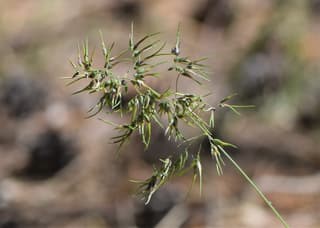
Bulbous Bluegrass
Poa bulbosa
Bulbous Bluegrass (Poa bulbosa) is a perennial grass native to Europe and the Mediterranean, now widespread globally. It forms dense clumps up to 70 cm tall with distinctive bulbous stem bases that store water reserves, making it extremely drought and cold tolerant. In spring it produces small spikelets that develop into bulbils for vegetative reproduction.
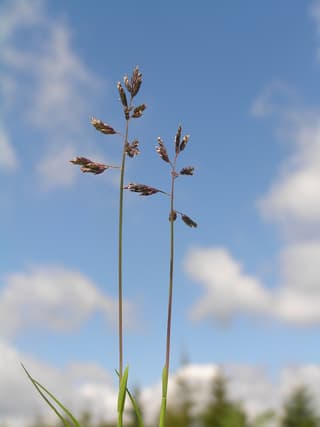
Supine bluegrass
Poa supina
Supine bluegrass (Poa supina) is a low-growing perennial grass native to the alpine and subalpine regions of Europe. It is distinguished by its smooth, soft, bright green leaves and its creeping habit, which forms a dense turf through stolon propagation. It is one of the few grasses capable of thriving in conditions of intense shade, up to 90% shade, making it ideal for difficult areas such as under dense trees, walkways, and sports fields in shady environments. In spring, it produces seed heads with characteristic purplish coverings.
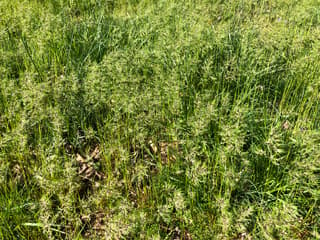
Lawn grass
Poaceae
Poaceae, the grass family, is one of the world's most widespread and species-rich plant families, forming the foundation for most lawns, pastures, and sports fields. Lawn grass is characterized by narrow, elongated leaves and a dense, fibrous root system that, along with runners (rhizomes and stolons), creates a cohesive, durable green carpet. Depending on the species, a distinction is made between cool-season grasses (e.g., Kentucky bluegrass and perennial ryegrass), which thrive best in temperate climates, and warm-season grasses (e.g., Bermuda grass), which prefer warmer regions. Grass is extremely hardy, tolerates mowing and foot traffic well, and is a central component of gardens, parks, and public spaces worldwide.
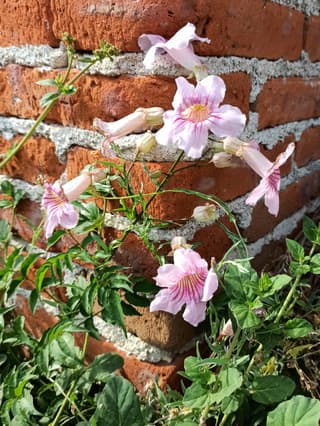
Pink Trumpet Vine
Podranea ricasoliana
Podranea ricasoliana, commonly known as Pink Trumpet Vine or Port St. Johns Creeper, is a vigorous woody climber in the family Bignoniaceae, native to South Africa. It produces spectacular lilac-pink, trumpet-shaped flowers with violet veining that bloom profusely from summer through fall. A fast grower capable of reaching 5 metres (16 ft), it is prized for covering pergolas, walls, and fences with a lush tropical floral display.
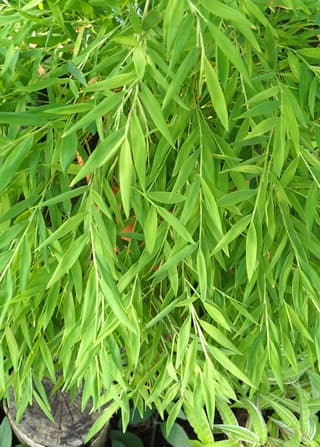
Baby Bamboo
Pogonatherum paniceum
Pogonatherum paniceum, commonly known as Baby Bamboo, is a compact ornamental grass native to Southeast Asia and China. Despite not being a true bamboo, its slender, arching culms and delicate foliage create a strikingly similar appearance. It is a fast-growing, low-maintenance houseplant that thrives indoors with bright indirect light and consistently moist soil, making it an ideal choice for those seeking a tropical aesthetic in small spaces.
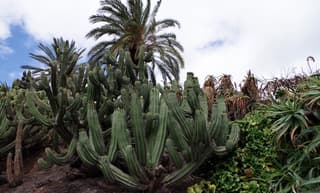
Chichipe Cactus
Polaskia chichipe
Polaskia chichipe is an arborescent and branched columnar cactus, endemic to the Tehuacán-Cuicatlán Valley in the states of Puebla and Oaxaca, Mexico. It grows at altitudes between 1,600 and 2,300 meters in the thorny vegetation known as "chichipera." It reaches 4 to 5 meters in height with a defined trunk and numerous glaucous-green branches with 9 to 12 prominent ribs, armed with short, grayish spines with dark tips. Its flowers are small (2-3 cm), white or yellowish-green with a central pink stripe, with partially nocturnal anthesis in spring-summer. The fruits, called chichitunas, are sweet, red globose berries that ripen in mid-summer; they are consumed fresh and used in artisanal jams and ice creams. The species has a long history of domestication and human management in the indigenous communities of the valley, being considered a fundamental cultural and food element.
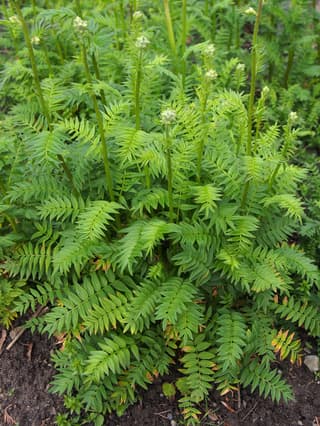
Jacob's ladder
Polemonium caeruleum
Jacob's ladder (Polemonium caeruleum) is an elegant perennial from the Polemoniaceae family, growing wild in damp meadows, thickets, and forest edges of temperate Europe and Asia. It forms dense clumps with erect stems reaching 18–24 inches (45–60 cm) in height. The leaves are odd-pinnate, light green, and composed of 7–27 leaflets arranged like the rungs of a ladder—this appearance gave the plant its common name. From late April to early June, the plant is covered in raceme-like clusters of cup-shaped flowers in intense blue, sometimes white, with prominent yellow stamens. It is frost-hardy (USDA zones 3–8) and is perfect for shade gardens, rock gardens, and cottage-style gardens. The plant is non-toxic to humans and pets.
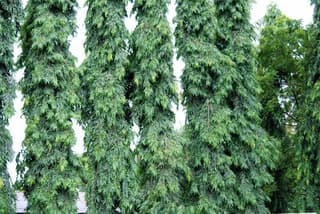
Mast Tree
Polyalthia longifolia
The Mast Tree is an elegant tropical evergreen with a columnar canopy, native to southern India and Sri Lanka. Its long, narrow leaves with wavy margins emerge in a coppery-bronze tone and mature into a glossy dark green, cascading downward along the branches—giving it a 'weeping' appearance. In spring, it produces small, star-shaped pale green flowers for a few weeks, followed by clusters of fruits that ripen from green to dark purple, which are favored by birds. It is often confused with the true Ashoka tree (Saraca asoca), which is why it is commonly called 'False Ashoka'.
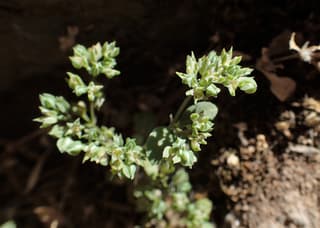
Four-leaved Allseed
Polycarpon tetraphyllum
Polycarpon tetraphyllum is a low-growing, herbaceous annual plant with branched, prostrate stems that typically reach 15-20 cm in height. The leaves are obovate, glossy, and arranged in pseudo-whorls of four (hence the name "tetraphyllum" - four-leaved). The small, white flowers, sometimes tinged with pink, are clustered in compact inflorescences at the tips of the stems, and the round seeds are tiny (0.4-0.5 mm). Native to Southern Europe, the Mediterranean region, Great Britain, the Middle East, and the Indian subcontinent, the plant has naturalized on nearly every continent. It typically grows in sandy soils in coastal areas, disturbed sites, sidewalk cracks, gardens, and vacant lots, often behaving as a weed.
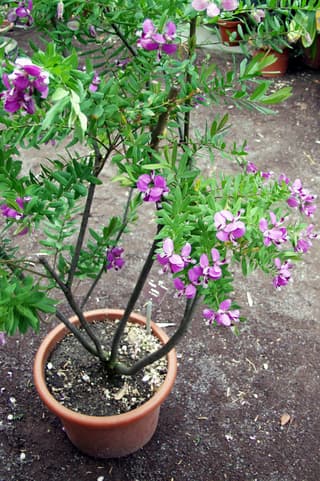
Sweet Pea Bush
Polygala myrtifolia
Polygala myrtifolia, commonly known as Sweet Pea Bush or Myrtle-leaf Milkwort, is an evergreen shrub native to South Africa. It produces prolific butterfly-shaped flowers in shades of purple, mauve, and pink throughout almost the entire year, making it one of the most ornamental low-maintenance shrubs for gardens, patios, and coastal landscapes. It belongs to the family Polygalaceae and is a fast-growing species.
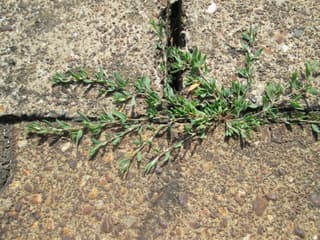
Oval-leaf Knotweed
Polygonum arenastrum
Polygonum arenastrum, commonly known as oval-leaf knotweed or common knotweed, is a low-growing annual weed in the family Polygonaceae. Native to Eurasia and naturalized worldwide, it forms dense, mat-like colonies on compacted soils, roadsides, paths, and disturbed ground. Its small, oval leaves are nearly equal in size along the stem, giving it the name "equal-leaved knotgrass." Tiny pink or white flowers bloom from summer through autumn, attracting beneficial insects.

Prostrate knotweed
Polygonum aviculare
Prostrate knotweed is a low, mat-forming annual weed frequently found in compacted soils, sidewalk cracks, and heavily trafficked paths. It has wiry, branching stems with small blue-green lanceolate leaves and produces tiny green flowers edged in white or pink from summer into fall, followed by small dark seeds. Extremely tough and adaptable, it is one of the most widespread and cosmopolitan weeds in the world, thriving where few other plants can survive.

Polypody
Polypodium
Polypodium is a genus of around 100 species of evergreen ferns native to temperate regions of the Northern Hemisphere, often growing as epiphytes on tree trunks or as lithophytes on rocks and walls. Their creeping, scaly rhizomes produce leathery, once-pinnate fronds and give the genus its common name, polypody ('many feet').
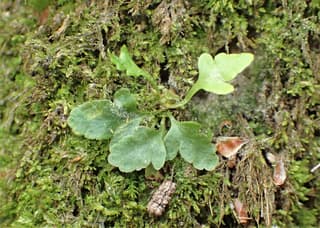
Common Polypody
Polypodium vulgare
Polypodium vulgare, or common polypody, is a small evergreen fern native to the woodlands, rocky outcrops, and old stone walls of Europe and North Africa. Its horizontal, creeping rhizome anchors leathery, deeply lobed fronds that stay green through winter, while golden-orange spore clusters (sori) dot the undersides of mature leaves from midsummer into autumn. Remarkably tolerant of both shade and dry spells, it thrives as a lithophyte on rocks and walls or as an epiphyte on mossy tree trunks, making it one of the easiest ferns to naturalize in a temperate garden.
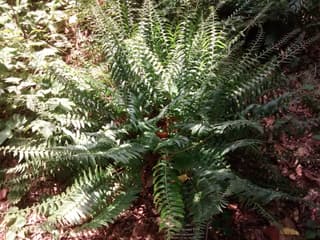
Christmas Fern
Polystichum acrostichoides
Polystichum acrostichoides, commonly known as the Christmas Fern, is a robust, evergreen fern native to eastern North America. Its leathery, lance-shaped fronds remain green throughout winter, making it a standout plant during the holiday season. It thrives in shaded woodland settings and is prized for its low maintenance and year-round visual interest.
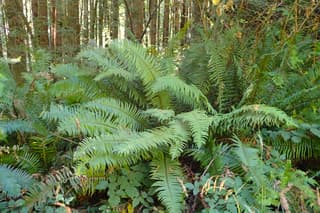
Western Sword Fern
Polystichum munitum
Polystichum munitum, commonly known as the Western Sword Fern, is a large evergreen fern native to the temperate rainforests of the Pacific Northwest of North America. Its glossy, dark green fronds arch outward from a dense central crown and can reach up to 180 cm in length. It is one of the most abundant and resilient ferns in Pacific Northwest forests, highly valued in shaded gardens and naturalistic landscaping.
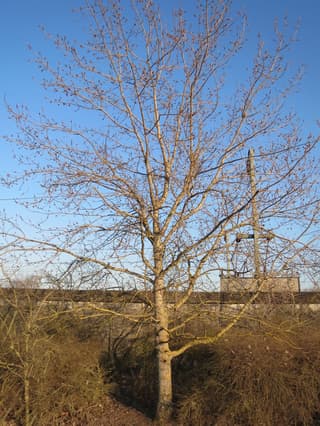
Poplar
Populus
Populus is a large genus of about 25–57 deciduous trees in the family Salicaceae, commonly known as poplars, aspens, and cottonwoods. Native to the Northern Hemisphere across North America, Europe, and Asia, these fast-growing trees can reach heights of 15–50 m and are recognized by their trembling leaves, wind-pollinated catkins in early spring, and cottony seed dispersal. They thrive in full sun and moist, well-drained soils and are valued for timber, phytoremediation, windbreaks, and ornamental planting.
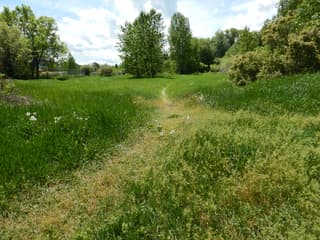
Balsam Poplar
Populus balsamifera
Balsam Poplar (Populus balsamifera) is a fast-growing deciduous tree native to northern North America. It is recognized by its fragrant, resinous buds in early spring and can grow up to 30 meters tall. Widely used in riparian restoration, windbreaks, and as a shade tree, it thrives in cold climates and is one of the northernmost hardwood trees in North America.
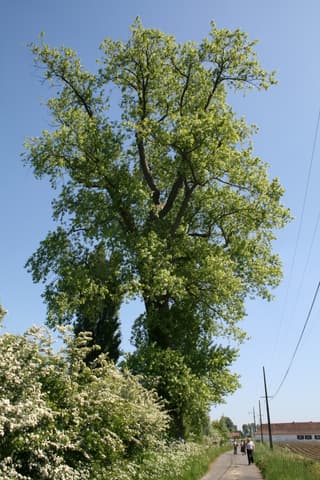
Black Poplar
Populus nigra
Populus nigra, commonly known as Black Poplar, is a large deciduous tree native to Europe and Western Asia. It is one of the most iconic trees of the European landscape, renowned for its fast growth, dark furrowed bark, and graceful triangular leaves that shimmer in the breeze. The Lombardy Poplar (P. nigra 'Italica') is a well-known columnar cultivar widely used as a windbreak and for landscape definition.
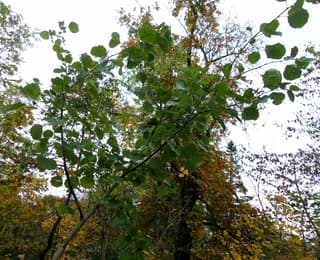
European aspen
Populus tremula
The European aspen (Populus tremula) is a fast-growing deciduous tree native to Europe and parts of Asia, known for its rounded, silvery-green leaves that tremble and whisper in the slightest breeze thanks to their flattened petioles. It can reach up to 25 meters in height, with smooth grey-green bark that darkens and cracks with age. In spring, before the leaves emerge, long greyish catkins appear, and in autumn the foliage turns golden. It spreads easily via root suckers, often forming dense clonal groves, and serves as an important habitat for insects, birds, and lichens.
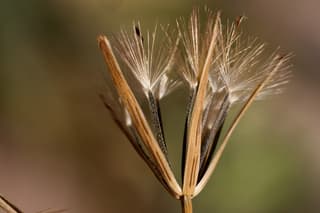
Papalo
Porophyllum ruderale
Papalo (Porophyllum ruderale) is a fast-growing annual herb in the daisy family, native to Mexico and South America, prized for its pungent leaves that taste like a blend of arugula, cilantro and rue. Plants form loose, willowy stands up to 1.5 m tall with rounded, blue-green leaves and small tubular purplish-green flower heads in summer and fall.
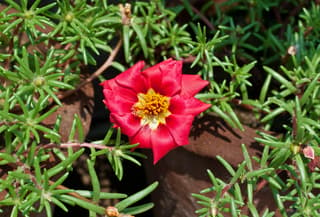
Moss Rose
Portulaca grandiflora
Portulaca grandiflora, commonly known as Moss Rose or Rose Moss, is a popular annual succulent native to South America (Argentina, Brazil, and Uruguay). It produces brilliant, rose-like flowers in shades of red, pink, orange, yellow, white, and purple that open only under direct sunlight. This drought-tolerant, low-maintenance plant thrives in hot, sunny conditions and poor soils.
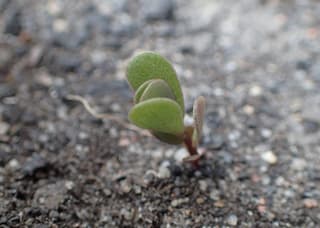
Common Purslane
Portulaca oleracea
Common Purslane (Portulaca oleracea) is an edible succulent groundcover found across the globe. It features reddish, fleshy stems, thick succulent leaves, and tiny yellow flowers that open only on sunny mornings. Extremely hardy and drought-tolerant, it thrives in poor soils and hot climates.
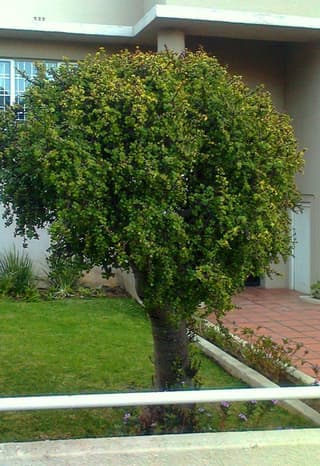
Spekboom
Portulacaria
Portulacaria is a small genus of semi-woody succulent shrubs native to South Africa, represented almost entirely by its popular species, commonly called spekboom or elephant bush. Prized for its thick, glossy jade-green leaves and reddish-brown stems, it forms a compact, low-maintenance shrub that thrives in bright light and tolerates long dry spells. Popular as a houseplant, bonsai subject, and drought-tolerant landscaping choice, spekboom is also celebrated in its homeland for its remarkable ability to capture carbon from the atmosphere.
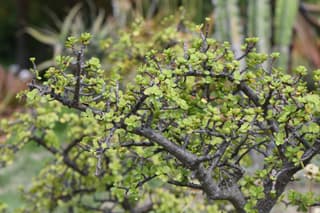
Elephant bush
Portulacaria afra
Portulacaria afra, commonly known as Elephant Bush or Spekboom, is a succulent shrub native to South Africa. It features small, fleshy, emerald-green leaves on attractive reddish-brown stems. In its natural habitat, it can grow into a large shrub or small tree, but it is frequently used as a bonsai or indoor plant. It is renowned for its exceptional ability to sequester carbon dioxide from the atmosphere, making it an environmentally significant species.
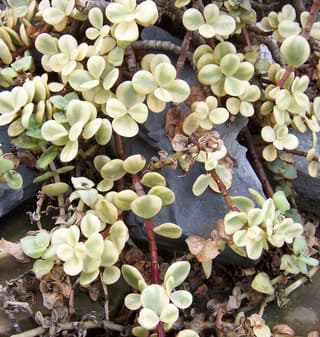
Rainbow Bush
Portulacaria afra 'Variegata'
Portulacaria afra 'Variegata' is a striking succulent shrub prized for its cream-and-green marbled leaves, a variegated sport of the South African elephant bush. Compact, easy-going and slow-growing, it forms a dense, jade-like shrub of thick reddish-brown stems studded with small rounded leaves that blush pink in strong light. Popular as a houseplant, bonsai subject or drought-tolerant hedge, it is also a favorite among succulent collectors for its rainbow-toned foliage.
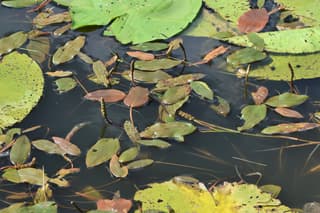
Broad-leaved Pondweed
Potamogeton natans
Potamogeton natans, also known as broad-leaved pondweed, is a perennial aquatic plant that produces oval, leathery, olive-green floating leaves. Its submerged leaves are narrow and translucent, often disappearing as the plant matures. It is a fundamental species for freshwater ecosystems, providing shelter for fish and oxygenating the water.
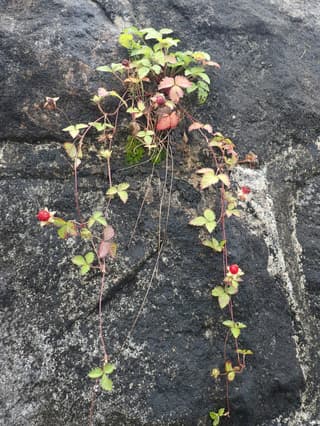
yellow-flowered strawberry
Potentilla indica
Potentilla indica, commonly known as mock strawberry or Indian strawberry, is a perennial herbaceous plant that closely resembles true strawberries. It is distinguished by its five-petaled yellow flowers and red, bumpy fruit that points upward. While the fruit is edible, it is generally considered flavorless or watery. It spreads aggressively through stolons (runners), making it a highly effective, though sometimes invasive, ground cover.
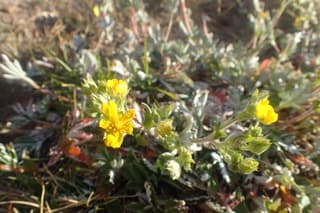
Beautiful Cinquefoil
Potentilla pulcherrima
Potentilla pulcherrima, commonly known as Beautiful Cinquefoil, is a native North American perennial wildflower in the rose family (Rosaceae). It produces cheerful yellow five-petalled flowers from spring through fall and features distinctive silvery-white leaf undersides. Highly cold-hardy and drought-tolerant once established, it thrives in rocky meadows, alpine slopes, and open woodlands across Canada and the western United States.
Easy Care Pet Safe
Our selection of 1411 easy pet safe combines the characteristics of this category with reduced care needs. Perfect for beginners who love this category.
Why Choose Easy Pet Safe?
Combining the beauty of pet safe with easy difficulty level lets you enjoy this category without excessive maintenance worries. Each plant was selected to offer the best characteristics of the category at the care level you are looking for.