2320 Easy Easy Care | 2026 Guide - Page 56
Find 2320 easy easy care. Complete guide for your garden.
2320 Easy Care with easy level
Showing 1981-2016 of 2320
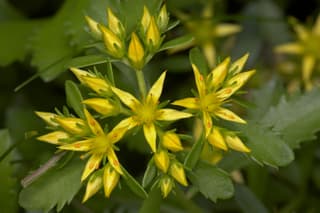
Orange Stonecrop
Sedum kamtschaticum
Sedum kamtschaticum, commonly known as Orange Stonecrop or Russian Stonecrop, is a low-growing succulent groundcover in the Crassulaceae family, native to rocky mountain slopes across Japan, Korea, northeastern China, and the Russian Far East (including the Kamchatka Peninsula, from which it takes its name). It forms dense, spreading mats of glossy, spoon-shaped green leaves that flush bronze-red in cooler weather, topped in late spring through midsummer by clusters of star-shaped golden-yellow flowers that attract bees and butterflies. Extremely drought-tolerant once established, it is prized as a rock garden, wall, or edging plant that thrives where little else will grow.
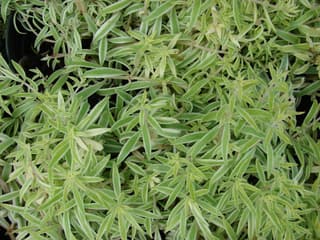
Needle Stonecrop
Sedum lineare
Sedum lineare, commonly known as Needle Stonecrop or Carpet Sedum, is a mat-forming succulent groundcover native to eastern China, Japan, and Taiwan. It has slender, branching stems covered in narrow, light green leaves arranged in whorls of three. In late spring to early summer it produces small star-shaped yellow flowers. Extremely tough, it tolerates poor soil, drought, and full sun, making it a popular choice for rock gardens, borders, and hanging containers.
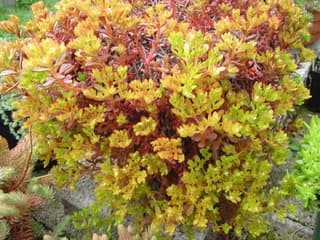
Japanese Stonecrop
Sedum makinoi
Sedum makinoi is a perennial creeping succulent plant native to Japan. It is characterized by its small, rounded, fleshy, bright green leaves that form a dense and attractive carpet. During the summer, it produces small, star-shaped yellow flowers that stand out against the foliage. It is an excellent choice for rock gardens, ground cover in sunny areas, or as a trailing plant in pots and hanging baskets.
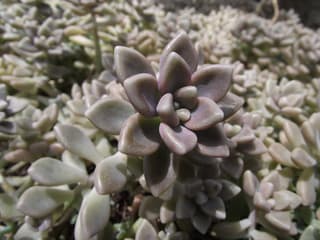
Marbled Succulent
Sedum mendozae
Sedum mendozae, commonly known as the Marbled Succulent, is a compact rosette-forming succulent in the Crassulaceae family. Native to the volcanic hillsides of Veracruz, Mexico, it features thick, fleshy leaves in grayish tones with green and pink hues depending on sun exposure. It produces small white star-shaped flowers in spring and summer. Also known as Graptopetalum mendozae, it is prized in succulent arrangements and rock gardens.
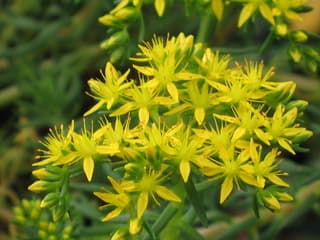
Mexican Stonecrop
Sedum mexicanum
Mexican Stonecrop (Sedum mexicanum) is a low-growing succulent groundcover in the Crassulaceae family, native to Mexico. It forms dense mats of bright green, needle-like leaves and produces masses of small, star-shaped yellow flowers in late spring to early summer. It is widely used in rock gardens, borders, and green roofs.
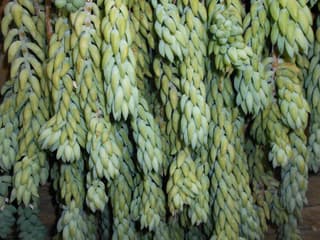
Burro's Tail
Sedum morganianum
Sedum morganianum is a trailing succulent native to Mexico, famous for its long stems covered with plump, blue-green fleshy leaves that can reach up to 60 cm (24 inches) in length. Pink to red flowers appear in summer. Perfect for hanging baskets, but must be handled carefully as leaves detach easily.
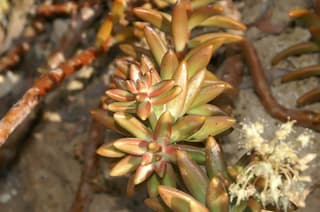
Coppertone Stonecrop
Sedum nussbaumerianum
Sedum nussbaumerianum, commonly called Coppertone Stonecrop, is a trailing succulent in the Crassulaceae family native to the volcanic highlands of Veracruz, Mexico. Its fleshy, teardrop-shaped leaves form loose rosettes that shift from pale yellow-green to a vivid copper-orange under strong sun, giving the plant its common name. Left to spread, it cascades attractively over pot edges or spills across rock gardens as ground cover.
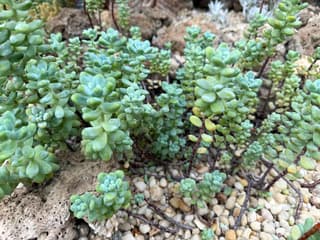
Jelly Bean Plant
Sedum pachyphyllum
Sedum pachyphyllum is a charming perennial succulent native to Mexico. It is characterized by its short, cylindrical, fleshy leaves that grow on upright or slightly trailing stems. Its coloration is a pale bluish-green (glaucous), but what makes it special are the leaf tips, which turn bright red or pink when the plant is exposed to full sun or moderate cold. It produces small, star-shaped yellow flowers during the spring.
Palmer's Sedum
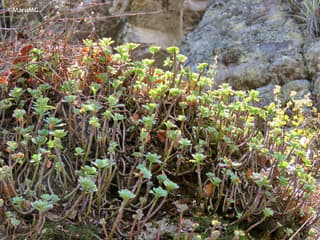
Sedum palmeri
Sedum palmeri is an evergreen perennial succulent native to the rocky cliffs of the Sierra Madre in Mexico. It forms compact rosettes of glaucous blue-green leaves on trailing stems, making it an excellent choice for hanging baskets, rock gardens, and container gardens. In spring, it produces bright yellow star-shaped flowers that attract pollinators.
Shrubby Stonecrop
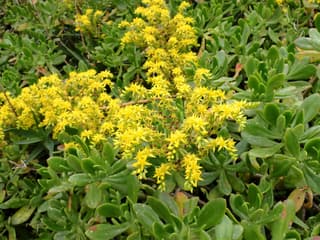
Sedum praealtum
Shrubby stonecrop (Sedum praealtum) is a shrub-forming succulent native to Mexico, growing up to 90 cm tall. Its spatula-shaped, yellow-green leaves turn reddish under strong sun or cold temperatures and cluster into rosettes at the stem tips. In late winter and early spring it produces abundant clusters of small yellow flowers. It is an extremely hardy, low-maintenance plant, well suited to rock gardens, borders and outdoor containers.

Blue Spruce Stonecrop
Sedum reflexum
Sedum reflexum is a low, mat-forming evergreen succulent with needle-like blue-green leaves that resemble tiny spruce foliage. In summer it sends up arching stems topped with star-shaped yellow flowers. A tough, drought-tolerant groundcover ideal for rock gardens, green roofs and containers.
Jelly Bean Plant
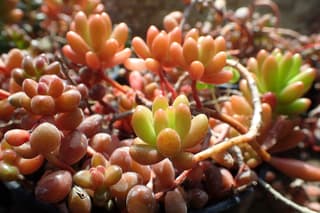
Sedum rubrotinctum
Sedum rubrotinctum, commonly known as the Jelly Bean Plant or Pork and Beans, is a charming succulent native to Mexico. Its plump, bean-shaped leaves are bright green at the base, turning vivid red at the tips when exposed to bright sunlight or stress — a natural phenomenon called anthocyanin production. It is a popular choice for rock gardens, container arrangements, and indoor windowsills.
Jenny's Stonecrop
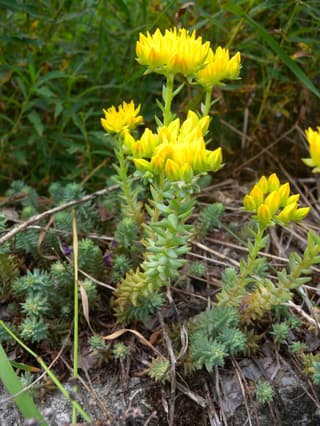
Sedum rupestre
Jenny's stonecrop is a low, mat-forming evergreen succulent native to central, western, and southern Europe. Its trailing stems are densely packed with narrow, cylindrical, blue-gray to gray-green leaves that resemble miniature spruce sprigs, giving rise to one of its other common names, blue spruce stonecrop. In summer, upright flowering stems rise above the foliage mat and open into clusters of small, star-shaped yellow flowers that are pendent in bud and turn upward as they open. The plant spreads steadily by rooting along its stems, forming a dense groundcover that tolerates poor, dry soils and long dry spells once established. It is widely grown in rock gardens, on green roofs, in gravel gardens, and as a filler for containers and stone walls.
Stringy Stonecrop
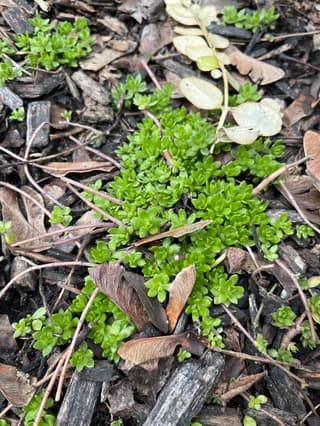
Sedum sarmentosum
Sedum sarmentosum is a fast-spreading creeping succulent native to China, Korea, and Japan. It forms dense mats of fleshy yellow-green leaves and produces cheerful star-shaped yellow flowers in late spring to summer. Widely used as a ground cover in rock gardens and slopes.
tasteless stonecrop
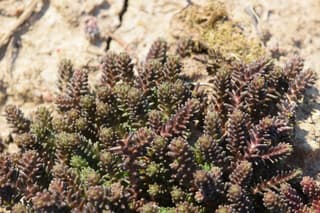
Sedum sexangulare
Sedum sexangulare, commonly called tasteless stonecrop, is a mat-forming evergreen succulent groundcover native to Europe and western Asia. Its cylindrical, densely packed leaves spiral around each stem in six distinctive rows, giving rise to the epithet "sexangulare" (six-angled). Unlike the related Sedum acre, its foliage lacks a peppery taste, hence the common name. From June to August it bears abundant star-shaped, bright yellow flowers that attract bees and other pollinators. Extremely cold-hardy (USDA zones 3-9) and drought-tolerant, it forms a dense, fast-spreading, moss-like mat prized for rock gardens, green roofs and erosion control.
October Daphne
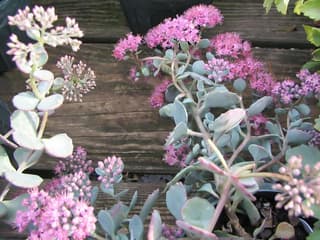
Sedum sieboldii
Sedum sieboldii, commonly known as October Daphne, is a charming trailing succulent native to Japan. It features whorls of three blue-green, coin-shaped leaves with rosy-pink edges that trail gracefully over rocks and container edges. In autumn, it produces clusters of small, star-shaped pink flowers that attract pollinators. The plant dies back to its rootstock in winter and re-emerges each spring, making it a delightful surprise in the garden.
Pacific Stonecrop
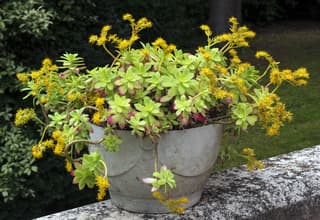
Sedum spathulifolium
Sedum spathulifolium, commonly known as Pacific Stonecrop, is a low-growing evergreen succulent native to the west coast of North America, from British Columbia to California. It forms dense, mat-like colonies of spoon-shaped, fleshy rosettes in silvery blue-green or purple tones. In spring and summer it produces clusters of bright yellow star-shaped flowers beloved by pollinators.
Showy Stonecrop
Sedum spectabile
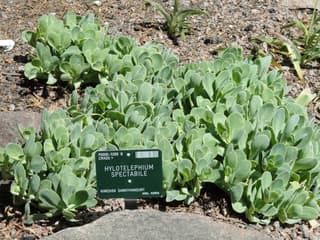
Sedum spectabile, commonly known as Showy Stonecrop or Ice Plant, is a hardy succulent perennial native to China and Korea. It produces clusters of star-shaped pink to red flowers from late summer through fall, making it one of the most ornamental sedums available. The fleshy blue-green leaves store water, enabling the plant to tolerate drought conditions with ease. It is particularly valued as a pollinator magnet, attracting butterflies, bees, and other beneficial insects when little else is in bloom.

Two-row Stonecrop
Sedum spurium
Sedum spurium (now botanically accepted as Phedimus spurius) is a low-growing, mat-forming succulent perennial in the Crassulaceae family, native to the rocky subalpine meadows of the Caucasus region (Georgia, northern Iran, and northeastern Turkey). Its trailing stems root as they spread, forming dense, evergreen mats of fleshy, opposite leaves that shift from green to deep burgundy in cooler months. Star-shaped flowers ranging from white to crimson appear in summer. Extremely drought-tolerant and low-maintenance, it is one of the most popular ground-cover sedums for rock gardens, green roofs, and sunny borders.
Chinese Stonecrop
Sedum tetractinum
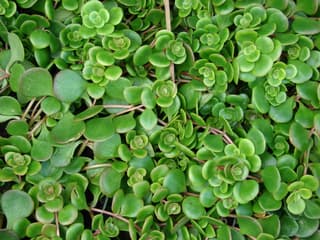
Sedum tetractinum is a low-growing, mat-forming succulent native to southeastern China, prized as a groundcover for its round, fleshy blue-green leaves that blush coppery-pink in strong sun. Small star-shaped white to pale pink flowers appear in summer above the dense foliage mat.
Silver Sedum
Sedum treleasei
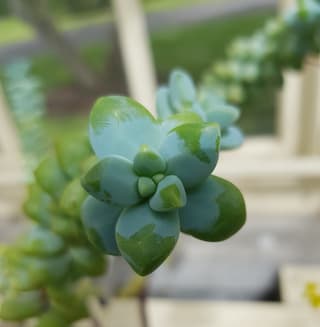
Sedum treleasei, commonly known as Silver Sedum or Blue Sedum, is a perennial succulent in the Crassulaceae family native to the Puebla region of Mexico. It forms tight rosettes of thick, fleshy, blue-gray leaves coated in a fine waxy layer (farina) that gives the plant its signature silvery sheen and helps reflect intense sunlight. Over time it develops short, branching stems that form small, compact clusters, making it a popular choice for rock gardens, containers, and succulent arrangements.
Resurrection plant
Selaginella lepidophylla
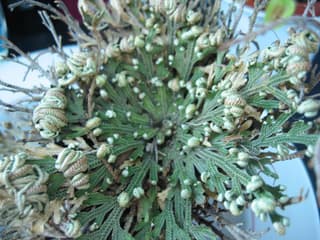
Selaginella lepidophylla is an extraordinary desert plant of the Selaginellaceae family, native to the Chihuahuan Desert region spanning the United States and Mexico. This small, fern-like plant reaches a maximum height of just 5 cm, featuring delicate green stems covered with tiny scale-like leaves arranged in spirals. The most remarkable characteristic of this resurrection plant is its extreme desiccation tolerance - it can lose up to 95% of its water content and remain dormant for years, reviving completely when exposed to moisture. During drought periods, the stems curl tightly into a compact grey-brown sphere; upon rehydration, the plant unfurls its fronds within hours, returning to vibrant green life. Multiple common names reflect its unique survival mechanism: Resurrection Plant, False Rose of Jericho, Stone Flower, and Dinosaur Plant. Unlike true ferns, it reproduces via spores rather than seeds. This ancient plant has captured human imagination for centuries as a living demonstration of nature's remarkable adaptability.

Night-blooming Cereus
Selenicereus
Selenicereus is a genus of epiphytic and climbing cacti native to Mexico, Central America, the Caribbean, and northern South America. Its flattened or angled stems climb trees and rocks using aerial roots, producing enormous, intensely fragrant flowers that bloom for a single night before wilting by dawn. Several species in the genus produce the fruit known as pitaya or dragon fruit.
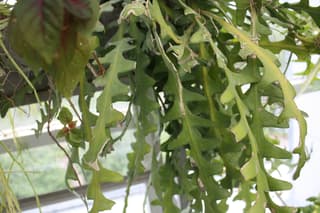
Ric Rac Cactus
Selenicereus anthonyanus
The ric rac cactus (Selenicereus anthonyanus) is an epiphytic jungle cactus native to the tropical forests of Chiapas, Mexico. Its flattened, deeply lobed stems zigzag like a fish skeleton -- earning it the nickname "fishbone cactus" -- making it a striking trailing or climbing houseplant. Unlike desert cacti, it thrives in humid, shaded conditions and produces large, fragrant flowers that open for a single night.
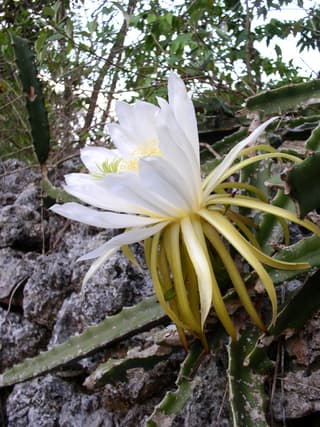
Strawberry Pear
Selenicereus triangularis
Selenicereus triangularis, commonly known as Strawberry Pear or Triangle Cactus, is a vigorous climbing cactus native to the Caribbean islands including Cuba, Haiti, Dominican Republic, and Puerto Rico. Its triangular stems can reach over 10 meters in length and produce spectacular large white flowers that bloom only at night during summer and fall. The edible red fruits, 2–5 cm long, are sweet, vitamin-rich, and resemble dragonfruit.
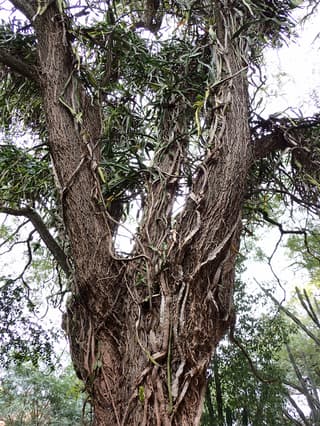
Dragon Fruit
Selenicereus undatus
Selenicereus undatus, popularly known as White Pitaya or Dragon Fruit, is a fast-growing epiphytic cactus native to Central and South America. It is characterized by its triangular, succulent stems that climb trees or supports. Its flowers are spectacular, large, and white, opening only at night, which earns it the name 'Queen of the Night'. The fruit is oval, with vibrant pink skin and green scales, containing a sweet white pulp dotted with small edible black seeds.
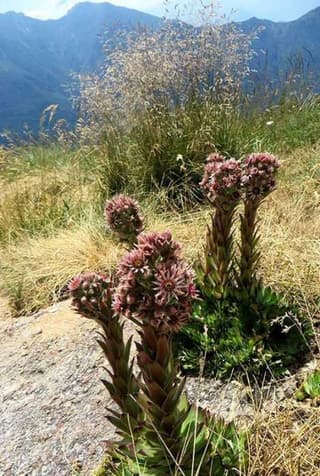
Hens and Chicks
Sempervivum
Sempervivum is a genus of approximately 40 species of hardy alpine succulents in the family Crassulaceae, native to the mountains of Europe and parts of Asia. They form tight, fleshy rosettes that continuously produce offsets ("chicks") around the mother plant ("hen"), creating dense spreading mats. Exceptionally cold-hardy, they tolerate temperatures as low as -34°C (-29°F) and survive in rocky, nutrient-poor soils.
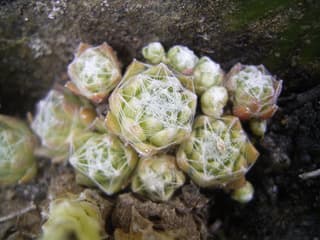
Cobweb Houseleek
Sempervivum arachnoideum
Sempervivum arachnoideum, the cobweb houseleek, is a compact alpine succulent whose tight rosettes are laced with fine white webbing, giving each cluster a spiderweb-like appearance. Native to the mountains of Europe, it is remarkably cold-hardy and spreads into dense mats via offsets ("chicks").
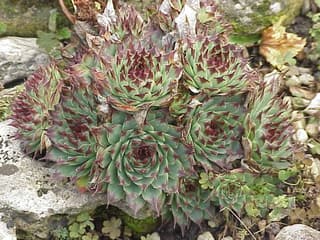
Limestone Houseleek
Sempervivum calcareum
Sempervivum calcareum is a perennial alpine succulent, highly cold-hardy. It forms compact rosettes of fleshy leaves, often featuring distinct reddish-purple tips. Native to the limestone regions of Southern Europe, it is extremely drought-tolerant and thrives in poor, well-drained soils. Its intense colors stand out in rock gardens and arid landscapes. It is an excellent choice for beginners.
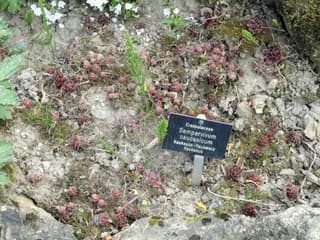
Caucasian Houseleek
Sempervivum caucasicum
Sempervivum caucasicum is a rosette-forming alpine succulent native to the Caucasus mountains of Georgia, Armenia, and Russia. It produces dense clusters of fleshy, pointed leaves arranged in tight rosettes, spreading via offsets to form low-growing mats. Extremely cold-hardy, it survives temperatures down to -34°C and thrives in rocky, well-draining soils with minimal care.
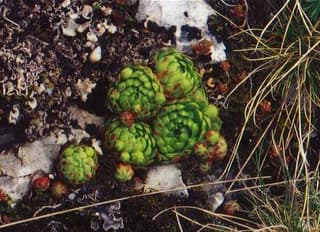
Globe Houseleek
Sempervivum globiferum
Sempervivum globiferum, commonly known as Globe Houseleek or Rolling Hen and Chicks, is a charming alpine succulent native to the mountains of Central and Eastern Europe. It forms tight, globe-shaped rosettes of fleshy green leaves that often blush red under stress. Unlike most sempervivums, its offsets naturally detach and roll away to root independently — giving rise to the delightful common name "Rollers". A monocarpic plant, each rosette dies after flowering but is quickly replaced by its many chicks.
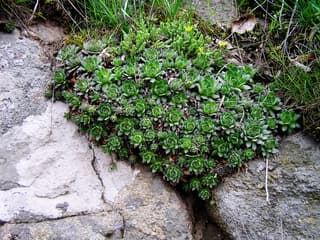
Russian Houseleek
Sempervivum ruthenicum
Sempervivum ruthenicum, the Russian houseleek, is a hardy evergreen succulent from the Crassulaceae family native to the rocky mountains and stony terrain of Eastern Europe and the Caucasus region. It forms low, mat-like rosettes of slightly hairy, pale green fleshy leaves tipped in pink, and sends up unusual yellow flower spikes in summer. Extremely drought- and cold-tolerant, it thrives on neglect in rock gardens, alpine troughs, and shallow containers.
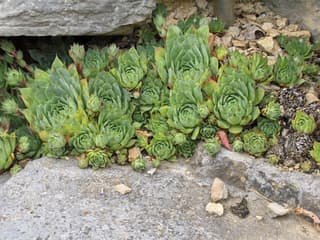
Common Houseleek
Sempervivum tectorum
Sempervivum tectorum is a hardy, evergreen succulent forming attractive rosettes of fleshy, blue-green leaves with reddish-purple tips. Native to European mountain regions including the Alps and Pyrenees, this resilient plant has been cultivated for centuries. The name "Sempervivum" means "live forever" in Latin, referring to its ability to produce numerous offsets. The species name "tectorum" means "of roofs," as Romans traditionally planted it on rooftops believing it protected buildings from lightning.
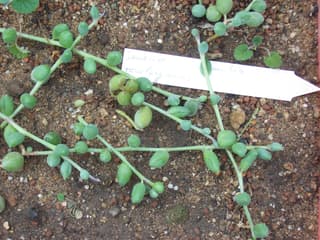
Senecio
Senecio
Senecio is one of the largest genera in the plant kingdom, with over 1,250 species in the Asteraceae family distributed worldwide. The genus includes popular ornamental succulents such as String of Pearls (S. rowleyanus), Blue Chalk Sticks (S. mandraliscae), and Dusty Miller (S. cineraria). Succulent species are prized for their drought tolerance, striking appearance, and adaptability to both indoor and outdoor settings.

Succulent Bush Senecio
Senecio barbertonicus
Senecio barbertonicus is an evergreen succulent shrub native to the Barberton region of South Africa, as well as Eswatini, Mozambique and eastern Zimbabwe, where it grows on rocky slopes at elevations up to 1,700 m. Its fleshy, light-green stems carry densely packed, cylindrical, finger-like leaves, and the plant forms a dense mounding bush that can reach 2 m (rarely 3 m) tall and wide. In winter it produces clusters of small, fragrant, golden-yellow daisy flowers at the branch tips that attract bees and butterflies.
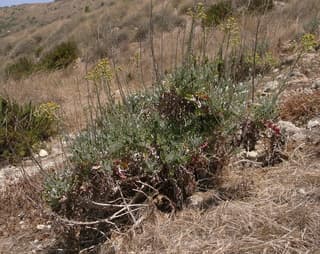
Dusty Miller
Senecio cineraria
Senecio cineraria, popularly known as Dusty Miller or Silver Ragwort, is a compact, mounding perennial prized for its velvety, silver-white, deeply lobed foliage rather than its small yellow daisy-like flowers. Native to the Mediterranean coast, it thrives in full sun and poor, sandy soil, making it a low-maintenance staple in borders, containers, and xeriscaped gardens. Its felted leaves reflect heat and resist deer and rabbit browsing, pairing beautifully as a season-long foil for brighter flowering companions.
Easy Care Easy Care
Our selection of 2320 easy easy care combines the characteristics of this category with reduced care needs. Perfect for beginners who love this category.
Why Choose Easy Easy Care?
Combining the beauty of easy care with easy difficulty level lets you enjoy this category without excessive maintenance worries. Each plant was selected to offer the best characteristics of the category at the care level you are looking for.