2320 Easy Easy Care | 2026 Guide - Page 12
Find 2320 easy easy care. Complete guide for your garden.
2320 Easy Care with easy level
Showing 397-432 of 2320
Yellow Oleander
Cascabela thevetia
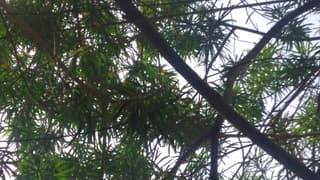
Yellow Oleander (Cascabela thevetia, syn. Thevetia peruviana) is an evergreen tropical shrub or small tree native to Mexico and Central America, now cultivated worldwide as an ornamental for its glossy, willow-like foliage and fragrant, funnel-shaped yellow to apricot flowers that bloom from summer through fall. WARNING: every part of this plant — leaves, flowers, stems, sap, and especially the seeds — contains potent cardiac glycosides (thevetin A and B, peruvoside, neriifolin) and is SEVERELY TOXIC to humans, cats, and dogs if ingested, potentially causing life-threatening heart arrhythmias. Keep away from children and pets, and always wear gloves when handling it — the sap can also irritate skin.
Golden shower tree
Cassia fistula
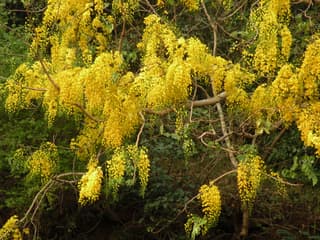
The golden shower tree (Cassia fistula) is a deciduous tree in the Fabaceae family, native to South Asia. It reaches 10 to 15 m in height and is famous for its spectacular hanging clusters of golden-yellow flowers that appear in spring and summer. After flowering, it produces long, dark brown cylindrical pods. It is the national tree of Thailand and one of the most prized tropical ornamental species in the world.

Casuarina
Casuarina equisetifolia
Casuarina equisetifolia is a fast-growing tree native to Australia, Southeast Asia, and the Pacific Islands, now widely naturalized in tropical and subtropical coastal regions worldwide. Despite its conifer-like appearance, it is an angiosperm: its thin, jointed, horsetail-like branches replace true leaves (which are reduced to scales) and perform photosynthesis, drastically reducing water loss through evapotranspiration. It can reach 15 to 40 meters in height, with a straight trunk and rough, fissured grayish to brownish bark. Its roots form a symbiosis with Frankia bacteria, fixing atmospheric nitrogen and improving poor soils. It is extremely tolerant of salinity, strong winds, and sandy soils, making it one of the most used species globally for dune stabilization and coastal erosion control.
Southern Catalpa
Catalpa bignonioides
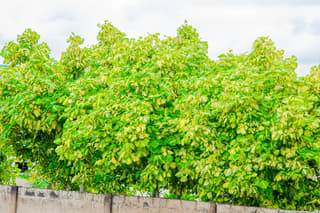
Catalpa bignonioides, commonly known as the Southern Catalpa or Indian Bean Tree, is a fast-growing deciduous tree native to the southeastern United States, particularly the lower Mississippi Valley region of Alabama, Mississippi, Georgia, and Florida. Celebrated for its dramatic ornamental qualities, it produces enormous heart-shaped leaves up to 30 cm across and spectacular clusters of trumpet-shaped white flowers with yellow and purple markings in late spring to early summer. The tree reaches a mature height of 12–18 metres with a broad, irregular crown spanning 10–12 metres, making it an impressive shade tree for large gardens and parks. Its most distinctive feature — besides the showy flowers — is the production of long, slender seed pods resembling cigars or beans, which hang from the branches well into winter and give rise to several of its common names. Catalpa bignonioides has been widely cultivated across Europe and North America since the 18th century. It thrives in full sun to partial shade and tolerates a wide range of soil conditions, including clay and periodically waterlogged soils. The species is notably drought-tolerant once established and hardy in USDA zones 5–9, making it adaptable to many temperate climates.
Northern Catalpa
Catalpa speciosa
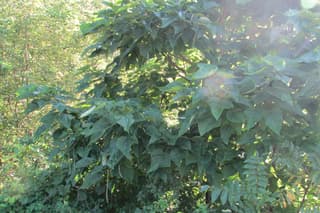
Northern Catalpa (Catalpa speciosa) is a large, fast-growing deciduous tree native to the central eastern United States. It is renowned for its showy white bell-shaped flowers with purple and yellow markings in late spring, and its distinctive long cigar-shaped seedpods that persist through winter. Widely planted as a shade and ornamental tree in parks, large gardens, and urban streetscapes, it is valued for its adaptability to a wide range of soil and climate conditions.
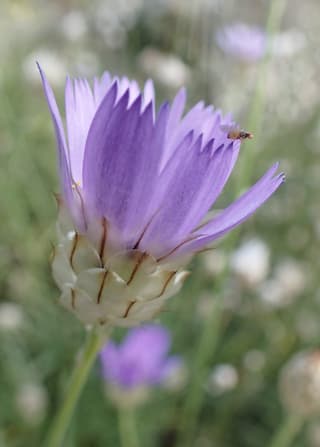
Cupid's dart
Catananche caerulea
Catananche caerulea, commonly known as Cupid's dart, is a short-lived perennial ornamental plant belonging to the Asteraceae family. It is native to the western Mediterranean, Southern Europe (Spain, Portugal, France, Italy), and North Africa (Morocco, Algeria, Tunisia). Its grayish-green, narrow leaves form a basal rosette and are covered with fine, downy hairs. Growing 30–60 cm tall, its branched stems are topped with papery, bluish-purple (rarely white) flower heads with dark centers. These bloom from early summer to late autumn, decorating the garden and attracting butterflies. They remain decorative even when dried, making them a popular choice for dried flower arrangements.
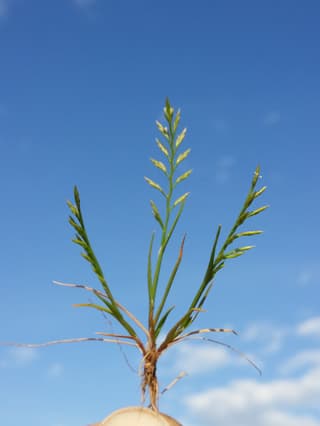
Fern-grass
Catapodium rigidum
Catapodium rigidum, known as fern-grass, is a small and elegant annual grass native to the Mediterranean region and Western Europe. Its stems are stiff and branched, creating a geometric appearance reminiscent of small fern fronds. It is a pioneer plant that thrives in poor soils, rock crevices, and coastal dunes, being extremely resistant to drought and heat.
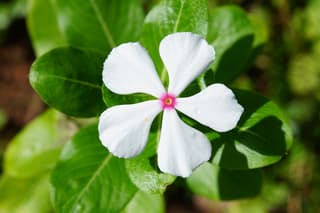
Madagascar periwinkle
Catharanthus roseus
Catharanthus roseus, commonly known as the Madagascar periwinkle, is a hardy evergreen subshrub. It features glossy, oval-shaped dark green leaves with a pale midrib and produces abundant five-petaled flowers. While native to Madagascar, it has become a staple in tropical and subtropical gardens worldwide due to its heat tolerance and continuous blooming habit.
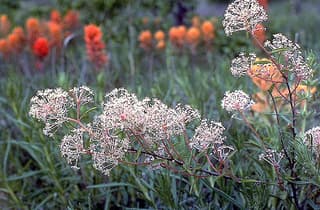
Inland Jersey Tea
Ceanothus herbaceus
Inland Jersey Tea (Ceanothus herbaceus) is a compact, deciduous shrub native to prairies, rocky glades, and sandy hills across central and eastern North America. Growing 2–3 feet tall, it produces dense clusters of small white flowers in spring and early summer, attracting butterflies and native pollinators. Exceptionally drought-tolerant once established, it thrives in poor, well-drained soils and requires minimal care, making it ideal for native plant gardens and low-maintenance landscapes.
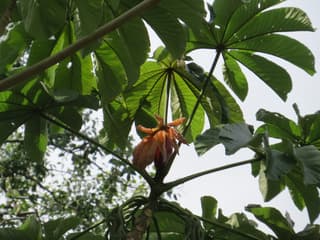
Glaziou's Cecropia
Cecropia glaziovii
Cecropia glaziovii, commonly known as Glaziou's Cecropia or Red Embauba, is a fast-growing pioneer tree native to the Brazilian Atlantic Forest. It is characterized by large lobed leaves that are green on top and silvery-white below, and reddish new growth that gives it its Portuguese common name. It can reach up to 16 meters in height within a decade, making it one of the fastest-growing trees in the Atlantic Forest.

Trumpet Tree
Cecropia pachystachya
The trumpet tree (Cecropia pachystachya) is a fast-growing pioneer tree native to South America, belonging to the Urticaceae family. Known for its umbrella-shaped canopy, it reaches 6 to 15 meters in height. Its large, deeply lobed leaves are dark green above and silvery below, giving the tree a distinctive two-toned look. The hollow, jointed stem is inhabited by Azteca ants in a classic mutualistic relationship: the tree provides shelter and Mullerian food bodies, while the ants defend it against herbivores and smothering vines. It rapidly colonizes forest gaps, edges, and disturbed land, making it a key species in ecological restoration, and its leaves have a long history of use in traditional herbal medicine.
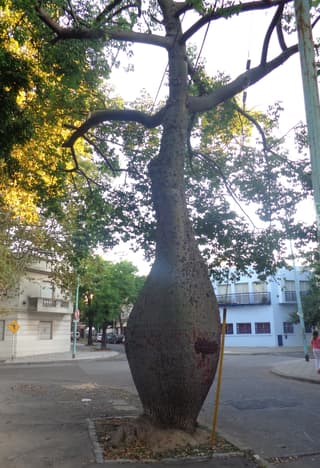
Silk Floss Tree
Ceiba speciosa
The Silk Floss Tree (Ceiba speciosa) is a majestic deciduous tree native to South America, celebrated for its bottle-shaped green trunk covered in conical spines, stunning pink flowers, and seed pods filled with silky kapok fiber. Widely planted as an ornamental in parks, avenues, and public gardens across Brazil, Argentina, and beyond.
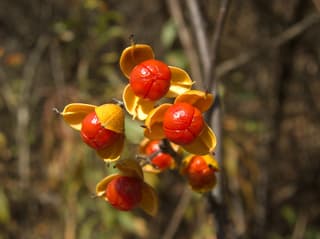
Oriental Bittersweet
Celastrus orbiculatus
Celastrus orbiculatus, commonly known as Oriental bittersweet or Asian bittersweet, is a deciduous woody vine native to East Asia. It grows vigorously, reaching up to 60 feet in length, twining around and girdling native trees with its spiraling stems. Its ornamental yellow-orange capsules with bright red seeds are highly attractive in autumn but are toxic to humans, dogs, and cats. It is considered a highly invasive species in North America and other regions outside its native range.
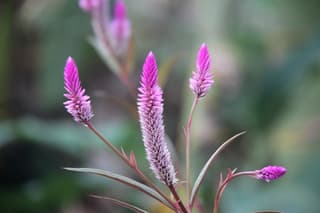
Cockscomb
Celosia
Celosia is a genus of tropical annual and perennial plants in the Amaranthaceae family, renowned for their striking inflorescences shaped like cockscomb crests, feathery plumes, or wheat-like spikes. Native to tropical Africa, Asia, and the Americas, it is widely grown as an ornamental plant in gardens, borders, and containers.
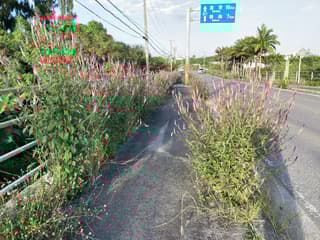
Cockscomb
Celosia argentea
Cockscomb (Celosia argentea) is a tropical ornamental plant native to tropical Africa and Asia, celebrated for its striking inflorescences in shades of red, orange, gold, pink, purple, and cream. Belonging to the Amaranthaceae family, it comes in three main forms: cristata (sculptural crested), plumosa (velvety feathery plumes), and spicata (elegant conical spikes). It is grown as an annual in temperate climates and as a short-lived perennial in tropical regions. Beyond its ornamental value, its young leaves are edible with a flavor similar to spinach.
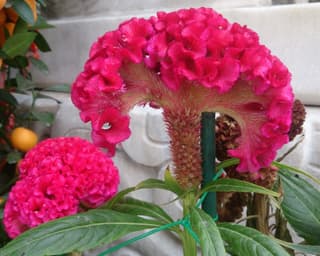
Celosia
Celosia argentea var. cristata
Celosia argentea var. cristata (cockscomb) is an annual or short-lived perennial ornamental plant belonging to the Amaranthaceae family, believed to originate from India, tropical Asia, and Africa. Its distinctive, velvety, wavy inflorescence, resembling a rooster's comb or a brain, can bloom in shades of red, yellow, orange, pink, and burgundy. In traditional gardens of India, Burma, and China, it was cultivated as a sacred plant near temples, which contributed to its survival. The plant grows 30-60 cm tall, develops quickly, and its flowers retain their shape and color for a long time, even when dried.
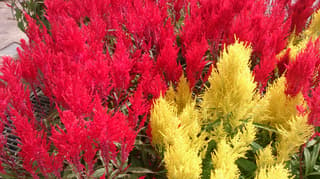
Plumed Cockscomb
Celosia argentea var. plumosa
Celosia argentea var. plumosa, commonly known as Plumed Celosia, is a vibrant annual plant distinguished by its plume- or flame-shaped inflorescences. Its intense colors and velvety texture make it a favorite for summer gardens and borders. Although primarily treated as an ornamental, it is a hardy plant that blooms abundantly in full sun.
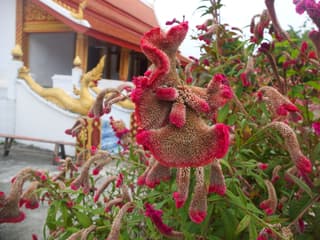
Crested Cockscomb
Celosia cristata
Celosia cristata, commonly known as Crested Cockscomb, is a tropical annual ornamental plant celebrated for its unique velvety, brain-like crested flower heads. Available in vivid shades of red, pink, orange, yellow, and purple, it brings bold color to gardens, borders, and containers.
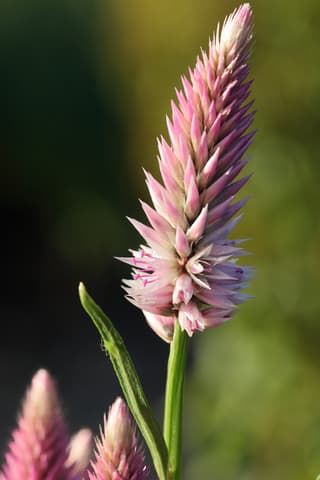
Wheat Celosia
Celosia spicata
Celosia spicata, commonly known as Wheat Celosia, is a tropical annual native to Asia and Africa. Its slender, wheat-like flower spikes in shades of pink, purple, and red — often developing a beautiful metallic silver sheen — make it one of the most distinctive ornamental flowers for gardens and cut flower arrangements.
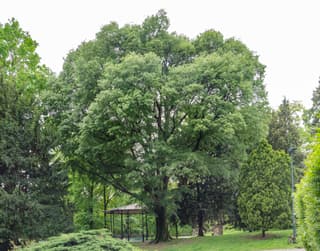
European Nettle Tree
Celtis australis
The European nettle tree (Celtis australis) is a large, long-lived deciduous shade tree native to southern Europe, North Africa, and western Asia. Prized for its elegant vase-shaped canopy, rough gray bark, and serrated dark-green leaves, it thrives in Mediterranean climates and tolerates heat, drought, wind, and urban pollution once established. Small greenish flowers appear in spring, followed by pea-sized drupes that ripen from orange to dark purple-black in autumn and are edible, with a sweet date-like flavor. The species is a classic street and park tree across southern Europe.
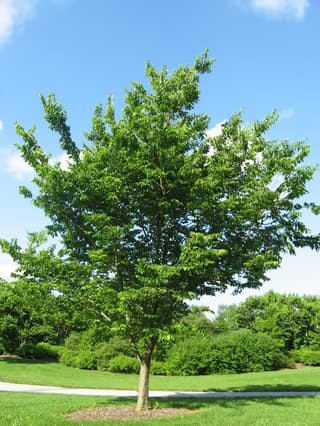
Common hackberry
Celtis occidentalis
Celtis occidentalis is a tough, medium-to-large deciduous tree native to central and eastern North America, reaching 12-18 m. It is prized as a resilient urban and shade tree, with distinctive warty, corky gray bark, arching branches and small edible purple drupes relished by birds.
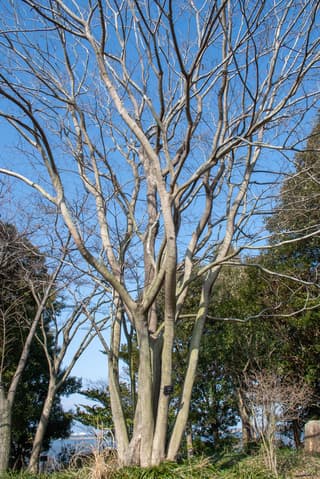
Chinese Hackberry
Celtis sinensis
Celtis sinensis is a fast-growing deciduous tree in the hemp family, native to East Asia (China, Japan and Korea). It usually reaches 12 to 20 m in height with a similar spread, forming a broad rounded crown with glossy, toothed leaves that turn yellow-brown in autumn. Tiny greenish flowers appear in the leaf axils in spring, followed by small orange-to-red-brown drupes that are edible and loved by birds. It tolerates drought, wind, urban conditions and poor soils, and is widely planted as a shade tree, in parks and as bonsai. It also serves as a larval host plant for hackberry butterflies.
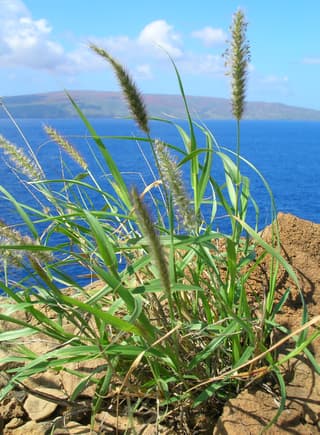
Sandbur
Cenchrus
Cenchrus is a genus of grasses in the family Poaceae, commonly known as sandbur, buffelgrass, or fountaingrass. It includes ornamental species such as crimson fountaingrass (Cenchrus setaceus) and forage grasses such as buffelgrass (Cenchrus ciliaris), widely used in pastures across arid and semi-arid regions. The genus is characterized by dense clumps of fine foliage, plume-like inflorescences, and bur-like seed heads with spines that cling to fur and clothing for dispersal.
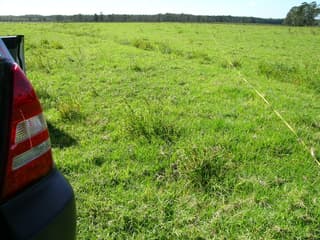
Kikuyu Grass
Cenchrus clandestinus
Kikuyu Grass (Cenchrus clandestinus) is a vigorous, fast-growing perennial grass native to the highland regions of East Africa. It is widely used as a lawn, pasture, and ground cover grass in tropical, subtropical, and warm temperate climates worldwide, including Australia, New Zealand, South Africa, and California. The plant spreads aggressively through an extensive network of rhizomes and stolons, forming dense, hard-wearing mats that recover quickly from mowing, grazing, and foot traffic. Its drought tolerance, adaptability to various soil types, and rapid establishment make it one of the most popular turf grasses globally.
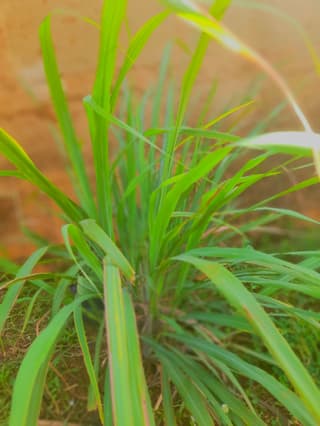
Elephant Grass
Cenchrus purpureus
Elephant Grass (Cenchrus purpureus, formerly Pennisetum purpureum) is a giant perennial grass native to tropical Africa. One of the most productive grasses in the world, it can reach up to 7 meters in height, forming dense bamboo-like clumps. Widely cultivated as a forage crop, biomass source, and for erosion control across tropical and subtropical regions.
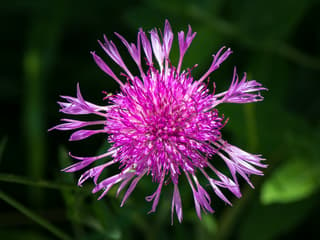
Knapweed / Cornflower
Centaurea
Centaurea is a large and diverse genus of over 700 herbaceous flowering plants in the family Asteraceae, native primarily to the Mediterranean basin, the Middle East, and broader Eurasia. The genus spans annuals, biennials, and perennials — from the beloved annual cornflower (C. cyanus) with its iconic blue blooms to robust perennial knapweeds that thrive in meadows and prairies. Flowers are characterized by a distinctive frilly outer ring of ray florets surrounding a dense central disc, appearing in shades of blue, purple, pink, white, yellow, and red. They are celebrated as excellent pollinator plants, attracting bees, butterflies, and hoverflies. Hardy, drought-tolerant, and low-maintenance, Centaurea species are widely grown in cottage gardens, wildflower meadows, and herbaceous borders.
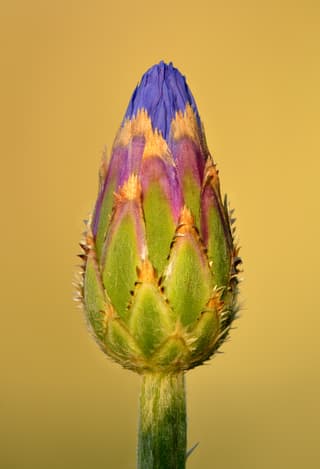
Cornflower
Centaurea cyanus
Centaurea cyanus, commonly known as the Cornflower or Bachelor's Button, is an iconic annual wildflower native to Europe. Famous for its vivid blue blooms, it has long been a staple of cottage gardens and wildflower meadows. Once a common sight in grain fields across Europe, it is Germany's de facto national flower, symbolizing resilience and unity. Its edible petals make it a popular garnish in culinary applications.
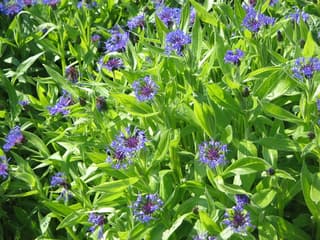
perennial cornflower
Centaurea montana
Centaurea montana, commonly known as Mountain Bluet or Perennial Cornflower, is a robust, clump-forming perennial. It features distinctive fringed, spider-like flower heads, most famously in a deep violet-blue, though cultivars exist in white and pink. Its lance-shaped leaves are covered in fine silvery hairs when young, giving the foliage a soft, grey-green appearance. It is highly valued in cottage gardens for its hardiness and ability to attract pollinators.
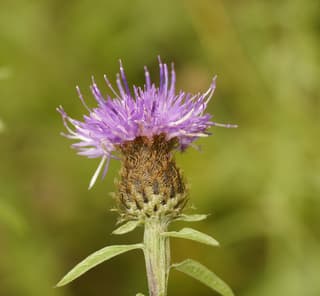
Common knapweed
Centaurea nigra
Common knapweed (Centaurea nigra) is a hardy herbaceous perennial wildflower native to Europe, prized for its thistle-like purple flowerheads and exceptional value to pollinators such as bees and butterflies. It grows upright to about 1 m tall, blooming from June to September in meadows, verges and wildlife gardens.
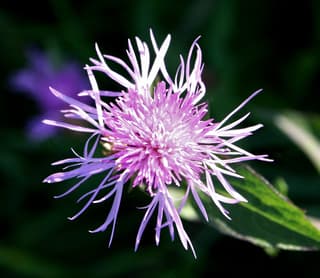
Tyrol Knapweed
Centaurea nigrescens
Centaurea nigrescens is a hardy perennial wildflower in the daisy family (Asteraceae), native to the mountain meadows of Central and Southeastern Europe. Its erect, branching stems bear thistle-like purplish-pink flower heads with distinctively dark, fringed bracts from summer into fall. Though prized in wildflower and pollinator gardens for its tough, low-maintenance nature, it has also naturalized widely outside its native range and is regulated as a noxious weed in parts of North America, so check local regulations before planting.
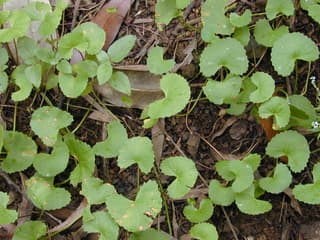
Gotu Kola
Centella asiatica
Gotu kola is a creeping perennial herb in the Apiaceae family, native to the wetlands of South and Southeast Asia. It produces long creeping stolons that root at the nodes, quickly covering moist soil. The leaves are kidney-shaped to coin-shaped with scalloped margins, and the plant bears tiny whitish to pinkish flowers in the summer. It is considered one of the most significant medicinal herbs in traditional Ayurvedic and Chinese medicine.
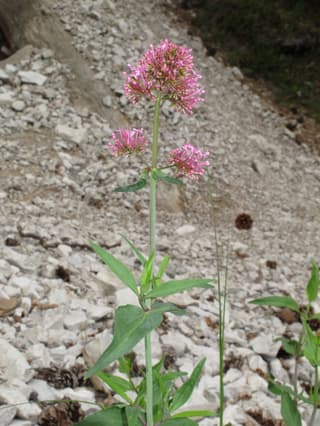
Red Valerian
Centranthus ruber
Red Valerian (Centranthus ruber) is a perennial plant from the Caprifoliaceae family, originally native to the Mediterranean region. With its vibrant red, pink, or white flower panicles and an upright, bushy growth habit reaching up to 90 cm in height, it is a true eye-catcher in any garden. The plant is extremely robust, drought-tolerant, and thrives particularly well in sunny, calcareous locations. Its long flowering period from spring to autumn, as well as its attractiveness to butterflies and bees, make it a valuable addition to any wildlife garden. Once established, it is nearly maintenance-free and overwinters effortlessly in temperate climates.
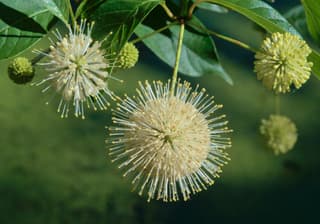
Buttonbush
Cephalanthus occidentalis
The Common Buttonbush (Cephalanthus occidentalis) is a deciduous wetland shrub native to eastern North America, where it naturally grows along lakeshores, marshes, and streams. From June to August, it produces distinctive, spherical flower heads composed of small, white to cream-colored, fragrant tubular flowers that resemble pincushions and attract butterflies, hummingbirds, and bees. The shrub typically reaches 5 to 8 feet in height and width, featuring glossy, dark green opposite leaves. Because it tolerates flooding and standing water, it is ideal for rain gardens, pond edges, and moist depressions.
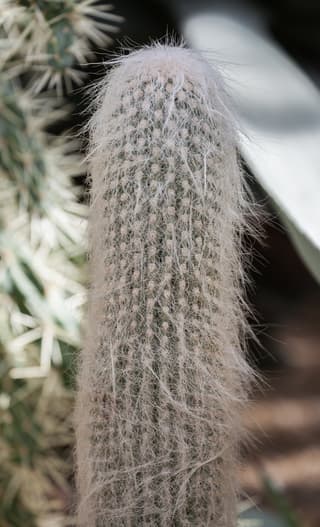
Old Man Cactus
Cephalocereus senilis
Cephalocereus senilis, the Old Man Cactus, is a slow-growing columnar cactus native to the mountains of northeastern Mexico. It is famous for the long, shaggy coat of white hair-like spines that cloaks its stem, shielding the plant from intense sun and cold. In the wild it can eventually tower many meters tall over a century or more, but as a container plant it stays a compact, sculptural, and remarkably low-maintenance houseplant.
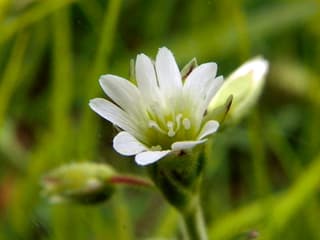
Common mouse-ear chickweed
Cerastium fontanum
Cerastium fontanum, commonly known as mouse-ear chickweed, is a low-growing, mat-forming perennial herb. It is easily identified by its small, hairy, oval leaves and tiny white flowers with five petals that are so deeply notched they appear as ten. It is a resilient species often found in lawns, meadows, and disturbed soils across temperate regions.
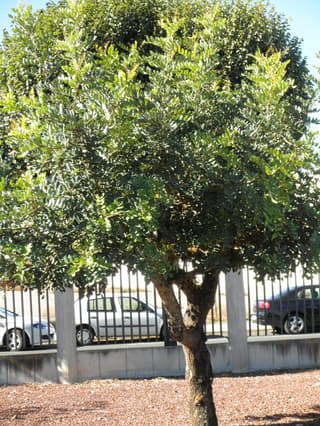
Carob Tree
Ceratonia siliqua
The carob tree (Ceratonia siliqua) is an evergreen Mediterranean tree in the legume family, prized for its sweet, edible seed pods used as a chocolate substitute. Extremely drought-tolerant and long-lived, it thrives in poor, rocky soils and can reach up to 15 m tall.
Easy Care Easy Care
Our selection of 2320 easy easy care combines the characteristics of this category with reduced care needs. Perfect for beginners who love this category.
Why Choose Easy Easy Care?
Combining the beauty of easy care with easy difficulty level lets you enjoy this category without excessive maintenance worries. Each plant was selected to offer the best characteristics of the category at the care level you are looking for.