Fabaceae
Japanese Clover (Kummerowia striata)
Kummerowia striata
This tough annual thrives in full sun and poor, sandy-to-clay soils with almost no intervention, making it essentially a plant-and-forget ground cover or forage crop. It tolerates drought once established but grows best with occasional moisture, and it self-sows prolifically from seed each year rather than persisting as a perennial.
Every 7 days
Bright indirect
° - °C
% - %
Categories
What is Japanese Clover?
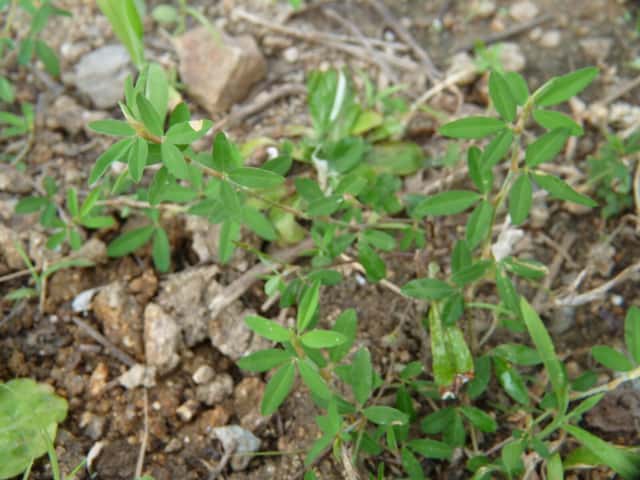
Japanese Clover (Kummerowia striata) is a easy-care plant from the Fabaceae family. Japanese clover (Kummerowia striata) is a low-growing, prostrate annual legume in the pea family, native to China and Japan and now widely naturalized across the eastern and central United States. It forms wiry, branching mats 5-40 cm tall with small trifoliate leaves whose leaflets show distinctive...
Japanese Clover grows up to 40cm, spread of 60cm, watering every 7 days. It is not suitable for indoor environments and safe for pets.
Unlike many tropical plants, Japanese Clover tolerates watering mistakes. Best for beginners. Unlike many popular species, Japanese Clover is safe to keep around pets.
How to Care for Japanese Clover?
TLDR: Japanese Clover needs Bright indirect, watering every 7 days, and temperatures between 15-30°C with 40-70% humidity.
How Often Should You Water Japanese Clover?
Water lightly to keep soil evenly moist while seedlings establish; once mature, it needs little supplemental watering and tolerates dry spells well.
How Much Light Does Japanese Clover Need?
Give it full sun for the densest growth and best flowering, though it will still grow, more sparsely, in light shade.
What Is the Best Soil for Japanese Clover?
It adapts to sandy, loamy, or clay soils, including compacted or infertile ground, and prefers a pH from mildly acidic to mildly alkaline (roughly 4.5-8.0).
What Pot Should You Use for Japanese Clover?
It is grown almost exclusively in open ground rather than containers; if raised in a nursery flat or wide, shallow container for cover-crop trials, use a well-draining mix and a container with generous drainage holes.
What Is Japanese Clover and Where Does It Come From?
Japanese clover (Kummerowia striata) is a low-growing, prostrate annual legume in the pea family, native to China and Japan and now widely naturalized across the eastern and central United States. It forms wiry, branching mats 5-40 cm tall with small trifoliate leaves whose leaflets show distinctive parallel veins angled toward the leaf margin. From midsummer into fall it produces tiny pink-to-purple, pea-like flowers with a white upper petal, followed by single-seeded pods. As a nitrogen-fixing legume it enriches poor, compacted soils and is valued as livestock forage, erosion control cover, and wildlife food, though it can also behave as a weedy colonizer of disturbed ground and thin turf.
How to Propagate Japanese Clover?
Seed sowing
No transplanting is needed since the plant establishes quickly and reseeds itself; it does not tolerate root disturbance well as a seedling.
- 1 Pre-soak seeds in warm water for about 12 hours to soften the seed coat
- 2 Sow directly in situ in mid-spring once soil has warmed
- 3 Rake seed lightly into loosened, sunny soil at a shallow depth
- 4 Keep soil consistently moist until germination
- 5 Thin seedlings if overcrowded; established plants self-sow readily thereafter
Materials needed:
How Big Does Japanese Clover Grow?
TLDR: Japanese Clover can reach up to 40cm tall with Fast growth rate.
Max height
40cm
Spread
60cm
Growth rate
Fast
Foliage
Deciduous
Plant Uses
Ground Cover
Soil coverage
Edible
Can be consumed
Medicinal
Medicinal properties
Medicinal Uses
- Whole plant used in traditional Chinese medicine as a diuretic
- Used traditionally to help reduce fever
- Decoctions used traditionally to treat diarrhea and dysentery
- Traditional preparations used for general physical debility
Culinary Uses
- Seeds cooked and ground into a protein-rich meal used for making bread
- Young shoots and leaves eaten cooked as a potherb
Is your plant showing symptoms?
Click on the symptom to discover possible causes:
Meaning & Symbolism
As a resilient, ground-hugging legume that colonizes disturbed and depleted soil, Japanese clover is often associated informally with toughness, humility, and quiet soil renewal rather than any formal cultural symbolism.
Fun Facts
Japanese clover produces two kinds of flowers: showy open flowers pollinated by insects, and tiny closed, self-pollinating flowers that guarantee seed set even without pollinators.
It was first documented in North America near Charleston in the 1840s and later spread widely as a forage and erosion-control crop.
Game birds and songbirds rely heavily on its abundant small seeds as an autumn food source.
Despite being a common lawn weed today, it was deliberately introduced and promoted as pasture forage in the southeastern United States.
Frequently asked questions
Is Japanese clover the same as true clover?
Does Japanese clover need fertilizer?
Is Japanese clover invasive?
How do I control Japanese clover in a lawn?
Compare with similar plants
| Attribute | Difficulty | Light | Watering | Pet Safe |
|---|---|---|---|---|
| Field Maple | Easy | Bright indirect | 14d | ✓ |
| Silver Birch | Easy | Direct sun | 14d | ✓ |
| Common Blanketflower | Easy | Direct sun | 10d | ✓ |
| Cushion Bush | Easy | Direct sun | 14d | ✓ |





