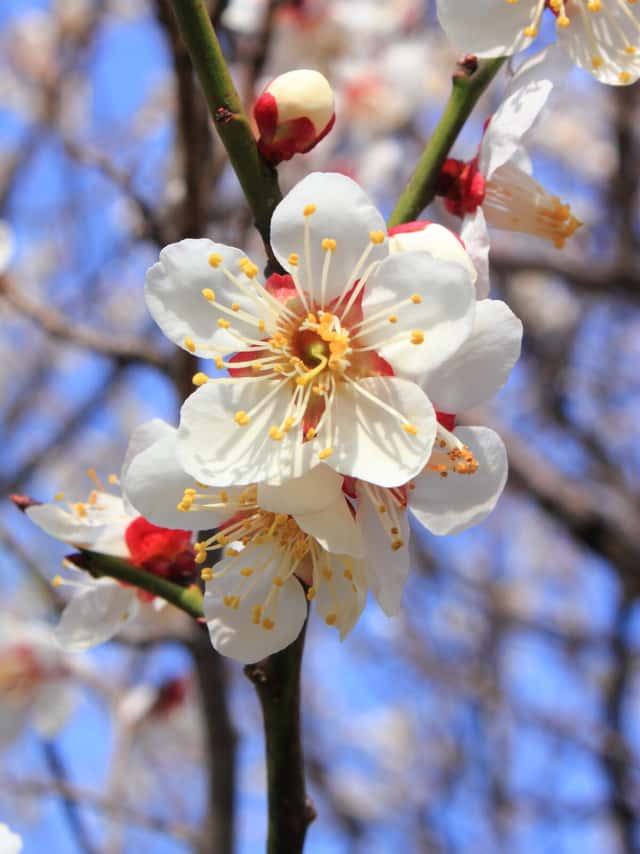
Rosaceae
Japanese apricot (ume): Edible Plant
Prunus mume
Plant in full sun with fertile, well-drained, slightly acidic soil. Water deeply and regularly while establishing, then let the top of the soil dry between waterings; good drainage is essential since waterlogged roots are the tree's biggest threat. Prune right after flowering, since it blooms on old wood.
Every 7 days
Bright indirect
° - °C
% - %
Categories
What is Japanese apricot (ume)?
Japanese apricot (ume) (Prunus mume) is a medium-care plant from the Rosaceae family. A small deciduous tree in the rose family prized for its intensely fragrant flowers that open on bare branches in late winter, well before the leaves emerge. Native to China and long cultivated in Japan and Korea, it produces sour, apricot-like fruit used in foods such as umeboshi and ume liqueur.
Japanese apricot (ume) grows up to 6.0m, spread of 600cm, watering every 7 days. It is not suitable for indoor environments and not safe for pets.
Without precautions, ingestion can cause irritation in pets. Keep out of reach of cats and dogs.
How to Care for Japanese apricot (ume)?
TLDR: Japanese apricot (ume) needs Bright indirect, watering every 7 days, and temperatures between 15-30°C with 40-70% humidity.
How Often Should You Water Japanese apricot (ume)?
Water deeply once a week during establishment and dry spells; established trees are moderately drought tolerant but need steady moisture while flowers and fruit are forming.
How Much Light Does Japanese apricot (ume) Need?
Give it full sun (6+ hours of direct light) for the heaviest bloom; light afternoon shade is tolerated in hot climates but reduces flowering.
What Is the Best Soil for Japanese apricot (ume)?
Use rich, loamy, well-drained soil with a slightly acidic pH (around 5.5-6.5); avoid heavy clay or soggy spots that invite root rot.
What Pot Should You Use for Japanese apricot (ume)?
For container or bonsai culture, use a wide, well-draining unglazed or bonsai pot with excellent drainage holes to prevent waterlogged roots.
Care Schedule
Fertilize
Every 180 days
Misting
Every 3 days
Rotate
Every 7 days
Repot
Every 365 days
What Is Japanese apricot (ume) and Where Does It Come From?
A small deciduous tree in the rose family prized for its intensely fragrant flowers that open on bare branches in late winter, well before the leaves emerge. Native to China and long cultivated in Japan and Korea, it produces sour, apricot-like fruit used in foods such as umeboshi and ume liqueur.
How to Propagate Japanese apricot (ume)?
Chip budding or whip-and-tongue grafting
Most commercial Prunus mume are propagated by grafting onto Prunus mume rootstock specifically, since other rootstocks can cause delayed graft incompatibility.
- 1 Select healthy Prunus mume rootstock (avoid other Prunus species to prevent graft incompatibility)
- 2 Take scion wood from a desired cultivar in late winter/early spring
- 3 Make matching cuts on rootstock and scion using chip budding or whip-and-tongue technique
- 4 Bind the graft union firmly with grafting tape
- 5 Keep protected from extreme temperature swings until the union heals
Materials needed:
Softwood cutting
Success rates are variable (roughly 20-50%); bottom heat and humidity domes improve results.
- 1 Take 4-6 inch softwood cuttings shortly after flowering
- 2 Remove lower leaves and dip cut end in rooting hormone
- 3 Insert into a 50/50 perlite-peat mix
- 4 Keep consistently moist and in bright, indirect light until roots form
Materials needed:
Seed propagation (stratified pit)
Seedlings will not come true to a named cultivar, so seed propagation is best for rootstock or naturalized trees.
- 1 Extract seed pit from ripe fruit and clean off pulp
- 2 Mix pit with moist vermiculite at roughly 1:1 ratio
- 3 Refrigerate (cold stratify) for 90-120 days
- 4 Sow outdoors in spring or start indoors after stratification
Materials needed:
How Big Does Japanese apricot (ume) Grow?
TLDR: Japanese apricot (ume) can reach up to 6.0m tall with Fast growth rate.
Max height
6.0m
Spread
6.0m
Growth rate
Fast
Foliage
Deciduous
Warning: Toxic Plant
This plant can be toxic if ingested. Keep out of reach of:
Plant Uses
Ornamental
Great for decoration
Edible
Can be consumed
Medicinal Uses
- Fruit extract used traditionally for digestive and anti-inflammatory purposes
- Umeboshi (pickled fruit) used in traditional East Asian remedies for fatigue and digestion
Culinary Uses
- Umeboshi (salted pickled plums)
- Umeshu (plum liqueur)
- Ume syrup and juice
- Preserves and sauces
Is your plant showing symptoms?
Click on the symptom to discover possible causes:
What Diseases Commonly Affect Japanese apricot (ume)?
TLDR: Japanese apricot (ume) is susceptible to 5 known diseases. Monitor regularly for early detection.
Bacterial Canker
Serious bacterial disease affecting stone fruits and tomatoes caused by Pseudomonas syringae or Clavibacter michiganensis. Creates sunken lesions that ooze sap.
Brown Rot
Monilinia is a genus of ascomycete fungi that causes blossom blight and brown rot in fruit trees. It spreads most rapidly in cool, wet weather, particularly during the bloom period. Symptoms include flowers that turn brown and remain attached to the shoots, small tan spots on fruit that expand into gray-beige spore rings (sporodochia), twig dieback, and 'mummified' fruit that shrivels and often persists on the tree. It primarily affects stone fruits (peach, nectarine, apricot, plum, cherry) but can also infect pome fruits such as apple and pear.
Peach Leaf Curl
Taphrina deformans is a fungal disease that primarily affects peaches and nectarines (commonly known as peach leaf curl). The fungus overwinters on twigs and in bud scales, infecting young leaves during damp, cool weather in early spring. It is characterized by thickened, puckered, red-to-yellow discolored, and severely curled leaves. Shoots may become distorted and leaves may drop prematurely; fruits can also develop spots or deformities. Apricots and almonds can occasionally be affected, though less frequently.
Aphids
Aphids are small, soft-bodied, pear-shaped insects (1/16 to 1/8 inch long) that feed by sucking nutrient-rich sap from plants. They reproduce rapidly and can quickly weaken plants, causing distorted growth and transmitting plant viruses. Aphids come in various colors including green, black, red, yellow, brown, and gray. They secrete honeydew, a sticky substance that attracts ants and encourages sooty mold growth.
Meaning & Symbolism
In China and Japan the ume blossom is one of the 'Three Friends of Winter,' prized for flowering on bare branches while snow may still linger. It symbolizes perseverance, hope, and renewal - beauty and resilience appearing before conditions seem favorable.
Compare with similar plants
| Attribute | Difficulty | Light | Watering | Pet Safe |
|---|---|---|---|---|
| Dark Fieldcap | Medium | Low light | 2d | ⚠️ |
| Azalea | Medium | Partial shade | 3d | ⚠️ |
| Muriel's Bamboo | Medium | Partial shade | 3d | ✓ |
| Bougainvillea | Medium | Direct sun | 7d | ⚠️ |




