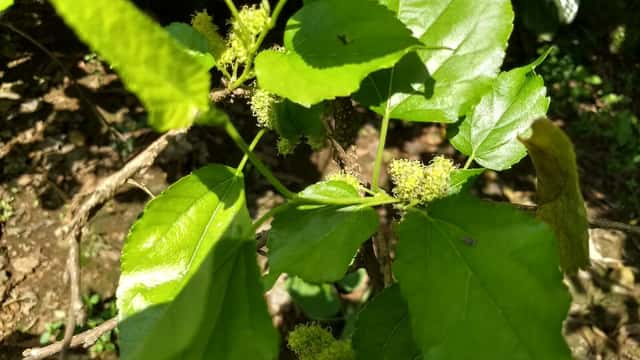
Moraceae
Indian Mulberry (Morus indica)
Morus indica
Grow in full sun in fertile, well-drained loamy soil with pH 5.5 to 7.0. Water regularly without waterlogging and feed with organic matter. Regular pruning encourages fresh shoots and foliage.
Every 7 days
Bright indirect
10° - 38°C
% - %
Categories
What is Indian Mulberry?
Indian Mulberry (Morus indica) is a easy-care plant from the Moraceae family. Morus indica is a shrub or small tree in the Moraceae family, native to the temperate and sub-tropical Himalayas and Indochina and cultivated in India, China, Japan and East Africa. Its leaves feed silkworms and its berries are edible.
Indian Mulberry grows up to 6.0m, watering every 7 days, 10°C – 38°C. It is not suitable for indoor environments and safe for pets.
Unlike many tropical plants, Indian Mulberry tolerates watering mistakes. Best for beginners. Unlike many popular species, Indian Mulberry is safe to keep around pets.
How to Care for Indian Mulberry?
TLDR: Indian Mulberry needs Bright indirect, watering every 7 days, and temperatures between 10-38°C with 40-70% humidity.
How Often Should You Water Indian Mulberry?
Keep the soil evenly moist but not waterlogged; water more often in dry spells and for young plants.
How Much Light Does Indian Mulberry Need?
Needs at least 6 hours of direct sun daily; tolerates partial shade with reduced yield.
What Is the Best Soil for Indian Mulberry?
Prefers deep, fertile, well-drained loam enriched with compost.
Care Schedule
Fertilize
Every 90 days
Misting
Every 3 days
Rotate
Every 7 days
Repot
Every 365 days
What Is Indian Mulberry and Where Does It Come From?
Morus indica is a shrub or small tree in the Moraceae family, native to the temperate and sub-tropical Himalayas and Indochina and cultivated in India, China, Japan and East Africa. Its leaves feed silkworms and its berries are edible.
How to Propagate Indian Mulberry?
Stem cutting
Use clean tools and keep the medium lightly moist.
- 1 Cut a healthy mature stem 20 to 25 cm long with several buds
- 2 Remove the lower leaves
- 3 Insert half the cutting into moist, well-draining mix
- 4 Keep moist and lit until rooted
Materials needed:
How Big Does Indian Mulberry Grow?
TLDR: Indian Mulberry can reach up to 6.0m tall with Fast growth rate.
Max height
6.0m
Growth rate
Fast
Plant Uses
Edible
Can be consumed
Medicinal
Medicinal properties
Is your plant showing symptoms?
Click on the symptom to discover possible causes:
What Diseases Commonly Affect Indian Mulberry?
TLDR: Indian Mulberry is susceptible to 6 known diseases. Monitor regularly for early detection.
Cercospora Leaf Spot
Cercospora leaf spot is a common fungal disease caused by Cercospora species that affects many plant types, particularly beets, roses, and leafy vegetables. The disease thrives in warm, humid conditions and can cause significant defoliation, reducing plant vigor and yield. It spreads rapidly through water splash, wind, and contaminated tools.
Powdery Mildew
Powdery mildew is a common fungal disease caused by various fungi species including Erysiphe, Podosphaera, Oïdium, and Leveillula. It affects over 10,000 plant species worldwide. The disease thrives in warm, dry climates with high humidity and appears as a distinctive white powdery coating on plant surfaces.
Root Rot
Root rot is a serious fungal disease that affects the root system of plants, causing them to decay and die. It is primarily caused by overwatering, poor drainage, or soil-borne fungi such as Pythium, Phytophthora, Rhizoctonia, and Fusarium. The disease thrives in waterlogged conditions where roots are deprived of oxygen, making them susceptible to fungal infection.
Root-Knot Nematodes
Root-knot nematodes (Meloidogyne species) are microscopic roundworms that parasitize plant roots, causing characteristic galls or knots. These soil-borne pests are among the most economically damaging plant pathogens worldwide, affecting a wide range of ornamental and edible plants. The nematodes inject enzymes into root cells, causing abnormal swelling and disrupting water and nutrient uptake.
Fun Facts
Its leaves are the main food of silkworms in Indian sericulture.
It is native to the Himalayas and Indochina.
Frequent pruning stimulates fresh leaf production.
Frequently asked questions
How much sun does Indian mulberry need?
How do I water Morus indica?
What soil is best?
What diseases affect mulberry?
Compare with similar plants
| Attribute | Difficulty | Light | Watering | Pet Safe |
|---|---|---|---|---|
| Field Maple | Easy | Bright indirect | 14d | ✓ |
| Silver Birch | Easy | Direct sun | 14d | ✓ |
| Common Blanketflower | Easy | Direct sun | 10d | ✓ |
| Cushion Bush | Easy | Direct sun | 14d | ✓ |





