Salicaceae
Grey Poplar (Populus × canescens)
Populus × canescens
An easy, very fast-growing tree for large gardens, parks, windbreaks and wet ground. Give it full sun and moist, fertile soil; it tolerates waterlogging, short floods, compacted soil, sea wind and road salt, but is very sensitive to drought, so young trees need regular watering. It is hardy to about -29 C. Its shallow, wide-spreading roots sucker freely and can damage drains and foundations: plant it at least 40 m from buildings, especially on clay. Prune only if needed, in late summer, to limit canker infections.
Every 7 days
Direct sun
-29° - °C
% - %
Categories
What is Grey Poplar?
Grey Poplar (Populus × canescens) is a easy-care plant from the Salicaceae family. Populus × canescens, the grey poplar, is a natural, fertile hybrid between the white poplar (Populus alba) and the common aspen (Populus tremula), in the willow family (Salicaceae). It grows wild where its parents meet, from north-western Europe to the plains of the Urals, and does best in the lowla...
Grey Poplar grows up to 30.0m, spread of 1500cm, watering every 7 days. It is not suitable for indoor environments and safe for pets.
Unlike many tropical plants, Grey Poplar tolerates watering mistakes. Best for beginners. Unlike many popular species, Grey Poplar is safe to keep around pets.
How to Care for Grey Poplar?
TLDR: Grey Poplar needs Direct sun, watering every 7 days, and temperatures between -29-30°C with 40-70% humidity.
How Often Should You Water Grey Poplar?
Water young trees about once a week during their first two or three growing seasons, more often in hot, dry spells, soaking the whole root zone. Established trees rely on a regular water supply from the ground and suffer quickly in drought; on dry sites, keep watering deeply in summer. Wet or occasionally flooded soil is not a problem.
How Much Light Does Grey Poplar Need?
Full sun. Young trees tolerate a little shade for their first years, but growth slows sharply; adult trees need full light. Even light also helps the trunk grow straight, as the grey poplar bends strongly toward the light.
What Is the Best Soil for Grey Poplar?
Prefers deep, moist, nutrient-rich loam. It also grows on clay, sand and chalky soil, and tolerates poorer, drier ground, but not peaty or very acid soils. It copes well with waterlogged and compacted soils as long as water supply stays regular.
What Pot Should You Use for Grey Poplar?
Not suited to pots in the long term: it is a very large tree with an extensive root system. A young tree can stay a year or two in a large, deep container with drainage holes before planting out.
What Is Grey Poplar and Where Does It Come From?
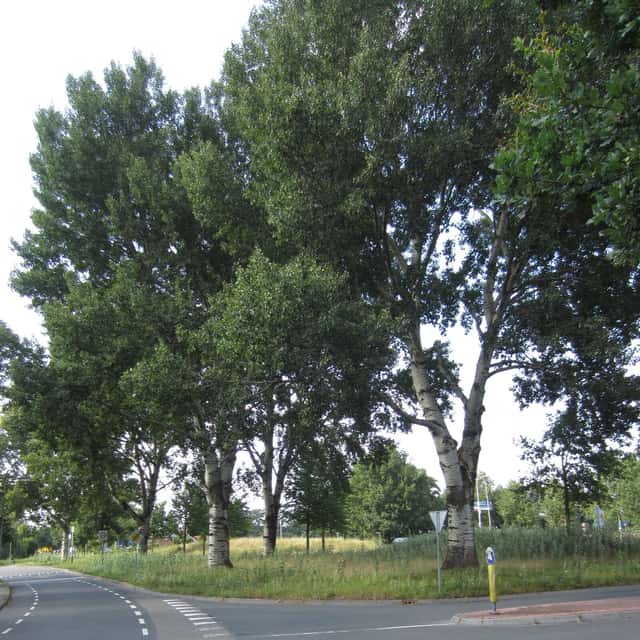
Populus × canescens, the grey poplar, is a natural, fertile hybrid between the white poplar (Populus alba) and the common aspen (Populus tremula), in the willow family (Salicaceae). It grows wild where its parents meet, from north-western Europe to the plains of the Urals, and does best in the lowlands of western Europe, often by ponds, marshes and river banks. It shows strong hybrid vigour: usually 20-25 m tall, it can pass 30 m and reach 40 m on the best sites, with a trunk over 1.5 m across, larger than either parent. The bark is light grey-green to almost white, marked with horizontal bands. The leaves are triangular to oval, 5-12 cm long, glossy dark green above and covered with a thin grey down beneath, with wavy, coarsely toothed edges that are much less lobed than those of the white poplar. In early spring, before the leaves, male trees carry red catkins; females, much rarer, carry green catkins. Most trees in cultivation are male.
How to Propagate Grey Poplar?
Root suckers
The grey poplar suckers freely from its shallow roots, which is how it spreads in nature. Avoid compacting or wounding the root zone of the parent tree.
- 1 In late autumn or winter, while the tree is dormant, choose a vigorous sucker growing from the roots
- 2 Dig around it and cut the connecting root, keeping as much of its own root system as possible
- 3 Replant it straight away at the same depth in moist, fertile soil
- 4 Water thoroughly and keep the soil moist through the first summer
Materials needed:
Hardwood cuttings
Unlike many poplars, the grey poplar roots poorly from cuttings and needs specific techniques; root suckers are much more reliable.
- 1 In winter, cut 20-25 cm lengths of healthy one-year-old wood
- 2 Dip the base in rooting hormone
- 3 Insert two-thirds of the cutting into moist, well-drained soil or a deep pot
- 4 Keep the soil moist and transplant once well rooted the following autumn
Materials needed:
How Big Does Grey Poplar Grow?
TLDR: Grey Poplar can reach up to 30.0m tall with Fast growth rate.
Max height
30.0m
Spread
15.0m
Growth rate
Fast
Foliage
Deciduous
Plant Uses
Ornamental
Great for decoration
Is your plant showing symptoms?
Click on the symptom to discover possible causes:
What Diseases Commonly Affect Grey Poplar?
TLDR: Grey Poplar is susceptible to 5 known diseases. Monitor regularly for early detection.
Willow Anthracnose
Rust
Rust is a common fungal disease caused by fungi in the order Pucciniales that affects a wide variety of plants. The disease gets its name from the characteristic orange, yellow, or reddish-brown pustules that appear on leaves, resembling metal rust. This obligate fungal parasite requires living plants to survive and can cause significant economic losses in agricultural crops.
Canker
Canker is a disease caused by various fungi and bacteria that create necrotic, sunken areas on bark of branches, stems, and trunks. Pathogens enter through wounds and natural openings, especially when plants are stressed. Canker can gradually weaken or kill branches by disrupting water and nutrient flow.
Bacterial Canker
Serious bacterial disease affecting stone fruits and tomatoes caused by Pseudomonas syringae or Clavibacter michiganensis. Creates sunken lesions that ooze sap.
Fun Facts
It is a hybrid of white poplar and aspen, yet it often grows bigger than both parents.
About 90% of grey poplars are male, so the tree spreads mainly by root suckers rather than seed.
Its seeds stay viable for at most about four weeks.
It was first described in 1789 as a variety of white poplar and only later recognised as a hybrid.
Frequently asked questions
How fast does grey poplar grow?
How far from a house should I plant a grey poplar?
Does grey poplar tolerate wet soil?
Is grey poplar toxic?
What diseases affect grey poplar?
Compare with similar plants
| Attribute | Difficulty | Light | Watering | Pet Safe |
|---|---|---|---|---|
| Field Maple | Easy | Bright indirect | 14d | ✓ |
| Iberian Houseleek | Easy | Direct sun | 14d | ✓ |
| Silver Birch | Easy | Direct sun | 14d | ✓ |
| Common Blanketflower | Easy | Direct sun | 10d | ✓ |