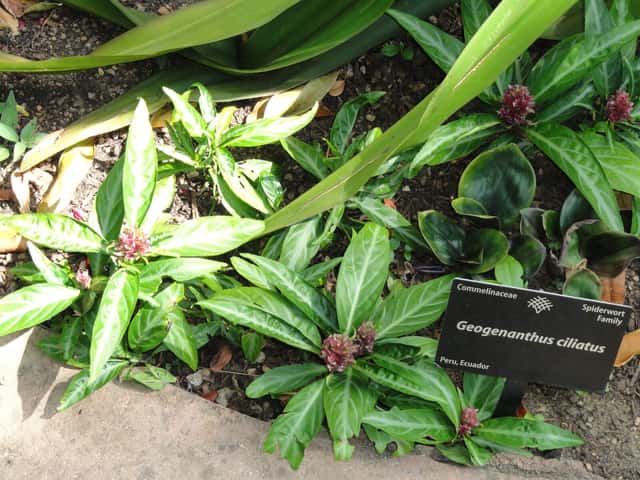
Commelinaceae
Geogenanthus Ciliatus (Geo Plant) Care Guide
Geogenanthus ciliatus
Geogenanthus ciliatus needs bright, filtered, indirect light and consistently moist (never bone-dry) rich organic soil to thrive. It demands high humidity, ideally 60% or above, and warm, stable temperatures away from cold drafts. Regular but careful watering and monthly feeding during the growing season keep its dramatic foliage lush.
Every 5 days
Partial shade
16° - 27°C
60% - 85%
Categories
What is Geo Plant?
Geo Plant (Geogenanthus ciliatus) is a medium-care plant from the Commelinaceae family. Geogenanthus ciliatus is a low-growing, rhizomatous herb from the Commelinaceae family, native to the rainforest understory of Peru, Ecuador, and Colombia. Its thick, fleshy stems carry glossy, deeply textured leaves in dark green to near-purple tones, sometimes patterned with darker mottling. Small...
Geo Plant grows up to 25cm, spread of 60cm, watering every 5 days, 16°C – 27°C, 60–85% humidity. It is suitable for indoor environments and safe for pets.
Unlike many popular species, Geo Plant is safe to keep around pets. Without adequate drainage, root rot can develop within 10 days.
How to Care for Geo Plant?
TLDR: Geo Plant needs Partial shade, watering every 5 days, and temperatures between 16-27°C with 60-85% humidity.
How Often Should You Water Geo Plant?
Keep the soil evenly moist at all times, watering as soon as the top inch begins to dry; never let it dry out completely, but avoid waterlogging which quickly leads to root rot.
How Much Light Does Geo Plant Need?
Provide bright, indirect or filtered light similar to a rainforest floor; direct sun scorches and fades the dark foliage, while too little light dulls its coloring.
What Is the Best Soil for Geo Plant?
Use a rich, well-draining organic mix, such as peat or coco coir blended with perlite and orchid bark, to hold moisture without waterlogging the roots.
What Pot Should You Use for Geo Plant?
A plastic or glazed ceramic pot with good drainage holes helps retain the constant moisture this plant needs, and pairing it with a humidity tray or enclosed terrarium setup is ideal.
Care Schedule
Fertilize
Every 30 days
Misting
Every 1 days
Repot
Every 365 days
What Is Geo Plant and Where Does It Come From?
Geogenanthus ciliatus is a low-growing, rhizomatous herb from the Commelinaceae family, native to the rainforest understory of Peru, Ecuador, and Colombia. Its thick, fleshy stems carry glossy, deeply textured leaves in dark green to near-purple tones, sometimes patterned with darker mottling. Small three-petaled purple flowers occasionally appear on mature plants but are rarely seen in cultivation. As an understory dweller adapted to filtered light and constant humidity, it makes a striking but demanding terrarium or humidity-cabinet specimen. Its compact, spreading habit and dramatic foliage color make it popular among collectors of rare aroids and Commelinaceae relatives.
How to Propagate Geo Plant?
Stem Cutting
Consistent humidity and warmth speed rooting; avoid direct sun on fresh cuttings.
- 1 Select a healthy stem section with at least one node and a few leaves.
- 2 Cut cleanly below a node using a sterilized blade.
- 3 Place the cutting in moist, well-draining organic mix or water.
- 4 Maintain high humidity around the cutting with a plastic cover or propagation box.
- 5 Keep warm and in bright indirect light until roots establish, then pot on.
Materials needed:
Rhizome Division
Ensure each division has healthy roots and at least one growing point before separating.
- 1 Remove the plant from its pot and gently loosen the root ball.
- 2 Locate natural divisions along the tuberous rhizome with attached roots and shoots.
- 3 Separate sections carefully with a clean knife.
- 4 Pot each division into fresh, moist organic mix.
- 5 Keep warm, humid, and in indirect light until new growth appears.
Materials needed:
How Big Does Geo Plant Grow?
TLDR: Geo Plant can reach up to 25cm tall with Slow growth rate.
Max height
25cm
Spread
60cm
Growth rate
Slow
Foliage
Evergreen
Plant Uses
Ornamental
Great for decoration
Is your plant showing symptoms?
Click on the symptom to discover possible causes:
What Diseases Commonly Affect Geo Plant?
TLDR: Geo Plant is susceptible to 5 known diseases. Monitor regularly for early detection.
Root Rot
Root rot is a serious fungal disease that affects the root system of plants, causing them to decay and die. It is primarily caused by overwatering, poor drainage, or soil-borne fungi such as Pythium, Phytophthora, Rhizoctonia, and Fusarium. The disease thrives in waterlogged conditions where roots are deprived of oxygen, making them susceptible to fungal infection.
Spider Mites
Spider mites are tiny arachnids (less than 1/20 inch long) related to spiders and ticks that feed on plant sap. They thrive in hot, dry conditions and can cause significant damage to ornamental and vegetable plants. During severe infestations, crop losses can reach 14% or higher as these pests disrupt vital plant processes including photosynthesis, carbon dioxide absorption, and transpiration.
Mealybugs
Mealybugs are small, soft-bodied insects covered with a white, waxy, cottony material. They are common pests of houseplants and outdoor plants in mild climates. These sap-sucking insects feed on plant tissue, causing damage, stunted growth, and can lead to plant death if left untreated. They produce sticky honeydew which attracts sooty mold.
Thrips
Thrips are tiny cigar-shaped insects (1/25-inch long) that damage plants by sucking plant juices and scraping at fruits, flowers, and leaves. With over 6,000 species and rapid reproduction (lifecycle as short as 14 days), they can quickly infest plants and transmit viruses like tomato spotted wilt virus.
Meaning & Symbolism
As a rare rainforest-floor foliage plant, Geogenanthus ciliatus is often associated with resilience and hidden beauty, thriving unseen beneath the forest canopy.
Fun Facts
Geogenanthus ciliatus belongs to the same family as Tradescantia and Wandering Jew plants.
Its genus name Geogenanthus roughly translates to 'earth-born flower,' referencing its low, ground-hugging growth habit.
The plant's deep purple-toned leaves are an adaptation to capture limited light on the shaded rainforest floor.
It is closely related to the popular seersucker plant (Geogenanthus poeppigii), sharing its puckered leaf texture.
Frequently asked questions
Is Geogenanthus ciliatus toxic to pets?
Why are the leaves of my Geo Plant browning?
Does Geogenanthus ciliatus need direct sunlight?
How often should I water my Geo Plant?
Compare with similar plants
| Attribute | Difficulty | Light | Watering | Pet Safe |
|---|---|---|---|---|
| Dark Fieldcap | Medium | Low light | 2d | ⚠️ |
| Azalea | Medium | Partial shade | 3d | ⚠️ |
| Muriel's Bamboo | Medium | Partial shade | 3d | ✓ |
| Bougainvillea | Medium | Direct sun | 7d | ⚠️ |




