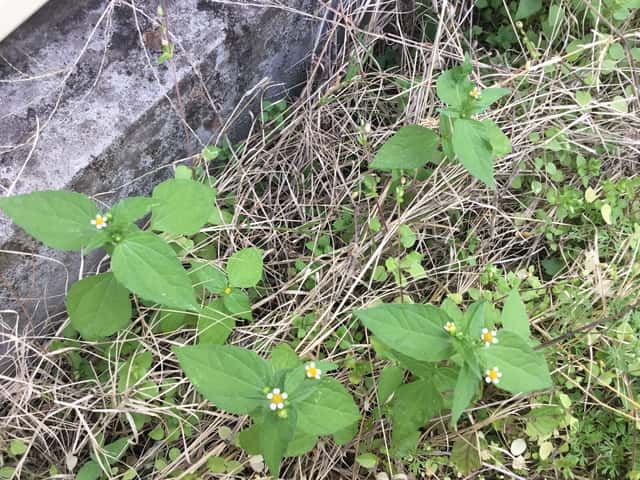
Asteraceae
Gallant soldier: Edible Plant
Galinsoga parviflora
It is a very low-maintenance plant that grows on its own in disturbed, fertile soils. It prefers full sun but tolerates partial shade, appreciates soil rich in organic matter and constant moisture, and does not require fertilization or pruning; one only needs to control its expansion, as it reseeds itself very easily.
Every 3 days
Bright indirect
10° - 35°C
40% - 75%
Categories
What is Gallant soldier?
Gallant soldier (Galinsoga parviflora) is a easy-care plant from the Asteraceae family. Galinsoga parviflora is an annual herb in the Asteraceae family, native to South and Central America and now naturalized worldwide as a weed in gardens, crops, and disturbed soils. It reaches between 30 and 75 cm in height, featuring opposite leaves with serrated edges and small flowers with 3 to 8...
Gallant soldier grows up to 75cm, spread of 40cm, watering every 3 days, 10°C – 35°C, 40–75% humidity. It is not suitable for indoor environments and safe for pets.
Unlike many tropical plants, Gallant soldier tolerates watering mistakes. Best for beginners. Unlike many popular species, Gallant soldier is safe to keep around pets.
How to Care for Gallant soldier?
TLDR: Gallant soldier needs Bright indirect, watering every 3 days, and temperatures between 10-35°C with 40-75% humidity.
How Often Should You Water Gallant soldier?
Keep the substrate moist but well-drained. Excess water or waterlogging can cause root rot, while prolonged drought stunts its growth and triggers early flowering.
How Much Light Does Gallant soldier Need?
It grows best in full sun, although it tolerates partial shade without issue; in very hot climates, it appreciates some shade during the hottest hours of the day.
What Is the Best Soil for Gallant soldier?
It adapts to sandy, clayey, or loamy soils, but develops best in fertile earth rich in organic matter with good drainage; it thrives especially in disturbed or recently cultivated soils.
What Pot Should You Use for Gallant soldier?
Being a fast-growing weed with a shallow root system, it is not typically grown in decorative pots; if kept in a container for culinary purposes, a wide, shallow pot with good drainage is sufficient.
What Is Gallant soldier and Where Does It Come From?
Galinsoga parviflora is an annual herb in the Asteraceae family, native to South and Central America and now naturalized worldwide as a weed in gardens, crops, and disturbed soils. It reaches between 30 and 75 cm in height, featuring opposite leaves with serrated edges and small flowers with 3 to 8 white petals surrounding a yellow central disk. It is a very fast grower, completing its life cycle in just 50 days and producing thousands of seeds per plant. Despite being considered a weed, it is entirely edible and used as a culinary and medicinal herb in various cultures, most notably in Colombia (guascas for ajiaco).
How Big Does Gallant soldier Grow?
TLDR: Gallant soldier can reach up to 75cm tall with Fast growth rate.
Max height
75cm
Spread
40cm
Growth rate
Fast
Foliage
Deciduous
Plant Uses
Edible
Can be consumed
Medicinal
Medicinal properties
Medicinal Uses
- Traditional topical use to soothe nettle stings
- Plant juice traditionally used to help coagulate minor wounds
- Fresh leaf poultices for skin irritations and conditions
- Preliminary studies report anti-inflammatory and antioxidant activity
Culinary Uses
- Fresh leaves in raw salads
- Essential ingredient (guascas) in Colombian ajiaco
- Cooked leaves and stems as a leafy vegetable, sautéed or in soups
- Flowers used for tea-like infusions
- Dried leaves used as a seasoning
Is your plant showing symptoms?
Click on the symptom to discover possible causes:
What Diseases Commonly Affect Gallant soldier?
TLDR: Gallant soldier is susceptible to 8 known diseases. Monitor regularly for early detection.
Aphids
Aphids are small, soft-bodied, pear-shaped insects (1/16 to 1/8 inch long) that feed by sucking nutrient-rich sap from plants. They reproduce rapidly and can quickly weaken plants, causing distorted growth and transmitting plant viruses. Aphids come in various colors including green, black, red, yellow, brown, and gray. They secrete honeydew, a sticky substance that attracts ants and encourages sooty mold growth.
Spider Mites
Spider mites are tiny arachnids (less than 1/20 inch long) related to spiders and ticks that feed on plant sap. They thrive in hot, dry conditions and can cause significant damage to ornamental and vegetable plants. During severe infestations, crop losses can reach 14% or higher as these pests disrupt vital plant processes including photosynthesis, carbon dioxide absorption, and transpiration.
Root Rot
Root rot is a serious fungal disease that affects the root system of plants, causing them to decay and die. It is primarily caused by overwatering, poor drainage, or soil-borne fungi such as Pythium, Phytophthora, Rhizoctonia, and Fusarium. The disease thrives in waterlogged conditions where roots are deprived of oxygen, making them susceptible to fungal infection.
Leafminers
Leafminers are the larvae of various insects including flies, moths, sawflies, and beetles that tunnel between leaf surfaces, creating distinctive serpentine trails or blotchy patches. While primarily cosmetic, severe infestations can weaken plants by reducing photosynthesis capacity and making them susceptible to secondary infections.
Compare with similar plants
| Attribute | Difficulty | Light | Watering | Pet Safe |
|---|---|---|---|---|
| Field Maple | Easy | Bright indirect | 14d | ✓ |
| Silver Birch | Easy | Direct sun | 14d | ✓ |
| Common Blanketflower | Easy | Direct sun | 10d | ✓ |
| Cushion Bush | Easy | Direct sun | 14d | ✓ |





