Orchidaceae
Four-season orchid (Cymbidium ensifolium)
Cymbidium ensifolium
Give bright light without harsh direct sun, a free-draining orchid mix and generous watering while it grows, with less water in winter. It is not frost hardy: keep it above 5 °C. A drop between day and night temperatures and a summer outdoors in dappled shade help it flower. Feed every 2 weeks in spring and summer. It is more heat tolerant than other Chinese cymbidiums. Wear gloves when handling: the RHS lists it as a skin allergen.
Every 7 days
Partial shade
5° - 30°C
40% - 60%
Categories
What is Four-season orchid?
Four-season orchid (Cymbidium ensifolium) is a medium-care plant from the Orchidaceae family. Cymbidium ensifolium is a terrestrial orchid from Asia, ranging from southern China and Japan to Vietnam, Laos, Cambodia, Sumatra and Java, where it grows in humid upland forests from sea level to 1,500 m, in soil kept damp by mist or on mossy limestone. It forms clumps of small pseudobulbs with nar...
Four-season orchid grows up to 60cm, spread of 60cm, watering every 7 days, 5°C – 30°C, 40–60% humidity. It is suitable for indoor environments and safe for pets.
Unlike many popular species, Four-season orchid is safe to keep around pets. Without adequate drainage, root rot can develop within 14 days.
How to Care for Four-season orchid?
TLDR: Four-season orchid needs Partial shade, watering every 7 days, and temperatures between 5-30°C with 40-60% humidity.
How Often Should You Water Four-season orchid?
Water thoroughly when the mix is almost dry, usually about once a week in warm weather, and let all excess drain away. In autumn and winter water less often, but don't let it dry out completely. Soggy mix rots the roots; rainwater or filtered water is best.
How Much Light Does Four-season orchid Need?
Bright, filtered light such as dappled shade or a window with morning sun only. Strong midday sun scorches the leaves. Dark green leaves mean too little light; yellowish leaves, too much.
What Is the Best Soil for Four-season orchid?
A loose, free-draining terrestrial orchid mix: fine bark with coir, sphagnum moss or coarse grit. Never use ordinary garden soil.
What Pot Should You Use for Four-season orchid?
A tall plastic or ceramic pot with plenty of drainage holes, only a little larger than the clump, since the roots are long and thick.
Care Schedule
Fertilize
Every 14 days
Repot
Every 730 days
What Is Four-season orchid and Where Does It Come From?
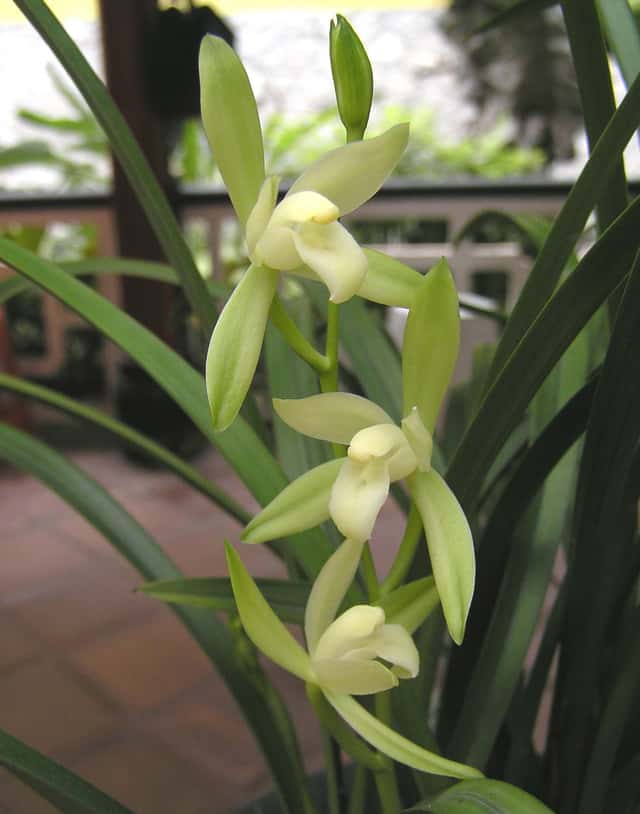
Cymbidium ensifolium is a terrestrial orchid from Asia, ranging from southern China and Japan to Vietnam, Laos, Cambodia, Sumatra and Java, where it grows in humid upland forests from sea level to 1,500 m, in soil kept damp by mist or on mossy limestone. It forms clumps of small pseudobulbs with narrow, arching, sword-shaped leaves up to 60 cm long. In summer and autumn it sends up upright 20-35 cm spikes with up to 13 flowers about 6 cm across, pale yellowish-green streaked or spotted dark red, with a strong sweet scent likened to narcissus. Because it can bloom several times a year it is known as the four-season orchid. It has been grown in China for centuries as one of the classic "lan" orchids, with many named forms in different colours and with variegated leaves.
How to Propagate Four-season orchid?
Division
Sterilise tools between plants to avoid spreading Cymbidium mosaic virus.
- 1 In early spring, after flowering, take the plant out of its pot
- 2 Split the clump into pieces with at least 3 pseudobulbs each
- 3 Trim dead roots with sterilised scissors
- 4 Repot in fresh mix and water sparingly until new roots appear
Materials needed:
How Big Does Four-season orchid Grow?
TLDR: Four-season orchid can reach up to 60cm tall with Medium growth rate.
Max height
60cm
Spread
60cm
Foliage
Evergreen
Warning: Toxic Plant
This plant can be toxic if ingested. Keep out of reach of:
Plant Uses
Ornamental
Great for decoration
Aromatic
Pleasant fragrance
Is your plant showing symptoms?
Click on the symptom to discover possible causes:
What Diseases Commonly Affect Four-season orchid?
TLDR: Four-season orchid is susceptible to 6 known diseases. Monitor regularly for early detection.
Aphids
Aphids are small, soft-bodied, pear-shaped insects (1/16 to 1/8 inch long) that feed by sucking nutrient-rich sap from plants. They reproduce rapidly and can quickly weaken plants, causing distorted growth and transmitting plant viruses. Aphids come in various colors including green, black, red, yellow, brown, and gray. They secrete honeydew, a sticky substance that attracts ants and encourages sooty mold growth.
Spider Mites
Spider mites are tiny arachnids (less than 1/20 inch long) related to spiders and ticks that feed on plant sap. They thrive in hot, dry conditions and can cause significant damage to ornamental and vegetable plants. During severe infestations, crop losses can reach 14% or higher as these pests disrupt vital plant processes including photosynthesis, carbon dioxide absorption, and transpiration.
Scale Insects
Scale insects are small sap-sucking pests that appear as brown, shell-like bumps on plant stems and leaves. There are over 25 species, divided into armored (hard) and unarmored (soft) scales. They feed by piercing plant tissue and extracting sap, which weakens the plant and can lead to yellowing, stunted growth, and even death if left untreated. They also excrete honeydew, which attracts ants and promotes sooty mold growth.
Mealybugs
Mealybugs are small, soft-bodied insects covered with a white, waxy, cottony material. They are common pests of houseplants and outdoor plants in mild climates. These sap-sucking insects feed on plant tissue, causing damage, stunted growth, and can lead to plant death if left untreated. They produce sticky honeydew which attracts sooty mold.
Meaning & Symbolism
In China it is one of the classic "lan" orchids, grown for centuries for its fragrance and associated with elegance, refinement and integrity.
Fun Facts
It is one of the longest-cultivated orchids, with centuries of history in China
Its scent is often compared to narcissus
In the wild it grows from sea level up to 1,500 m
Frequently asked questions
Why is it called the four-season orchid?
Is it cold hardy?
How often should I water it?
How do I propagate it?
Compare with similar plants
| Attribute | Difficulty | Light | Watering | Pet Safe |
|---|---|---|---|---|
| Dark Fieldcap | Medium | Low light | 2d | ⚠️ |
| Azalea | Medium | Partial shade | 3d | ⚠️ |
| Muriel's Bamboo | Medium | Partial shade | 3d | ✓ |
| Bougainvillea | Medium | Direct sun | 7d | ⚠️ |