Arecaceae
Footstool Palm: Fast Growing
Saribus rotundifolius
Place in a very bright location, protected from scorching direct sun for young plants. Keep the substrate moist but never waterlogged, allowing the top third of the soil to dry out between waterings (approximately once a week). It thrives in high humidity and warmth, with a minimum temperature of 50°F (10°C). Apply a palm-specific fertilizer during the growing season and repot in spring every 2 years.
Every 7 days
Bright indirect
10° - 30°C
% - %
Categories
What is Footstool Palm?
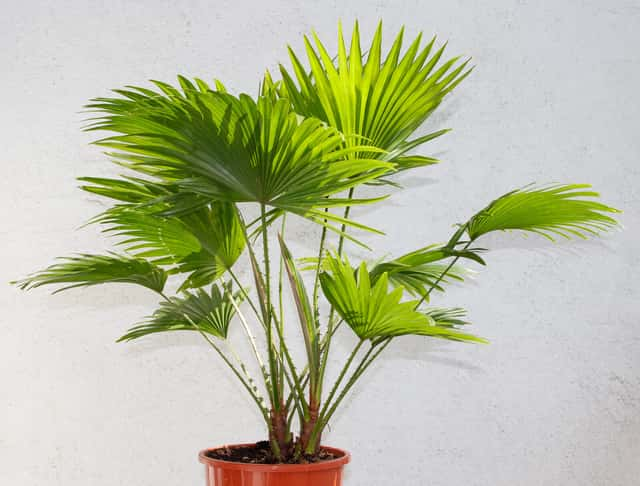
Footstool Palm (Saribus rotundifolius) is a easy-care plant from the Arecaceae family. The Footstool Palm (Saribus rotundifolius, formerly Livistona rotundifolia) is native to Southeast Asia (Malaysia, Indonesia, Philippines). Its solitary, smooth, brown trunk, marked with leaf-scar rings, can reach up to 80 feet in the wild, though it remains much smaller in containers. Its nearly ci...
Footstool Palm grows up to 24.0m, watering every 7 days, 10°C – 30°C. It is suitable for indoor environments and safe for pets.
Unlike many tropical plants, Footstool Palm tolerates watering mistakes. Best for beginners. Unlike many popular species, Footstool Palm is safe to keep around pets. Without adequate drainage, root rot can develop within 14 days.
How to Care for Footstool Palm?
TLDR: Footstool Palm needs Bright indirect, watering every 7 days, and temperatures between 10-30°C with 40-70% humidity.
How Often Should You Water Footstool Palm?
Water approximately once a week when the top third of the substrate is dry. Avoid waterlogged soil which causes root rot, and complete drying out which turns the fronds yellow.
How Much Light Does Footstool Palm Need?
Prefers bright, indirect light. Can tolerate full sun once mature in humid environments. Avoid dark locations.
What Is the Best Soil for Footstool Palm?
Use a rich, well-draining, and slightly acidic loamy potting mix, lightened with sand or perlite.
What Pot Should You Use for Footstool Palm?
Pot with drainage holes, deep enough for its roots. Terracotta or heavy plastic is recommended for stability. Repot in spring every 2 years.
Care Schedule
Fertilize
Every 30 days
Misting
Every 30 days
Repot
Every 730 days
What Is Footstool Palm and Where Does It Come From?
The Footstool Palm (Saribus rotundifolius, formerly Livistona rotundifolia) is native to Southeast Asia (Malaysia, Indonesia, Philippines). Its solitary, smooth, brown trunk, marked with leaf-scar rings, can reach up to 80 feet in the wild, though it remains much smaller in containers. Its nearly circular fan-shaped leaves measure about 5 feet wide on young specimens. It bears small yellow flowers in spring and summer, followed by round fruits 0.6 to 0.8 inches in diameter that turn from red to black when ripe. It is one of the fastest-growing palms, popular both as a bright indoor plant and in tropical gardens.
How to Propagate Footstool Palm?
Seed Sowing
Fresh seeds germinate well. Constant heat accelerates the germination process.
- 1 Sow fresh seeds in a light, well-draining seed-starting mix.
- 2 Keep the seedlings warm and moist, away from direct sunlight.
- 3 Wait for germination, which usually occurs in less than 2 months if seeds are fresh and kept warm.
- 4 Transplant each seedling into an individual pot once it is robust enough.
Materials needed:
How Big Does Footstool Palm Grow?
TLDR: Footstool Palm can reach up to 24.0m tall with Fast growth rate.
Max height
24.0m
Growth rate
Fast
Foliage
Evergreen
Plant Uses
Ornamental
Great for decoration
Is your plant showing symptoms?
Click on the symptom to discover possible causes:
What Diseases Commonly Affect Footstool Palm?
TLDR: Footstool Palm is susceptible to 9 known diseases. Monitor regularly for early detection.
Spider Mites
Spider mites are tiny arachnids (less than 1/20 inch long) related to spiders and ticks that feed on plant sap. They thrive in hot, dry conditions and can cause significant damage to ornamental and vegetable plants. During severe infestations, crop losses can reach 14% or higher as these pests disrupt vital plant processes including photosynthesis, carbon dioxide absorption, and transpiration.
Mealybugs
Mealybugs are small, soft-bodied insects covered with a white, waxy, cottony material. They are common pests of houseplants and outdoor plants in mild climates. These sap-sucking insects feed on plant tissue, causing damage, stunted growth, and can lead to plant death if left untreated. They produce sticky honeydew which attracts sooty mold.
Scale Insects
Scale insects are small sap-sucking pests that appear as brown, shell-like bumps on plant stems and leaves. There are over 25 species, divided into armored (hard) and unarmored (soft) scales. They feed by piercing plant tissue and extracting sap, which weakens the plant and can lead to yellowing, stunted growth, and even death if left untreated. They also excrete honeydew, which attracts ants and promotes sooty mold growth.
Thrips
Thrips are tiny cigar-shaped insects (1/25-inch long) that damage plants by sucking plant juices and scraping at fruits, flowers, and leaves. With over 6,000 species and rapid reproduction (lifecycle as short as 14 days), they can quickly infest plants and transmit viruses like tomato spotted wilt virus.
Compare with similar plants
| Attribute | Difficulty | Light | Watering | Pet Safe |
|---|---|---|---|---|
| Field Maple | Easy | Bright indirect | 14d | ✓ |
| Iberian Houseleek | Easy | Direct sun | 14d | ✓ |
| Silver Birch | Easy | Direct sun | 14d | ✓ |
| Common Blanketflower | Easy | Direct sun | 10d | ✓ |





