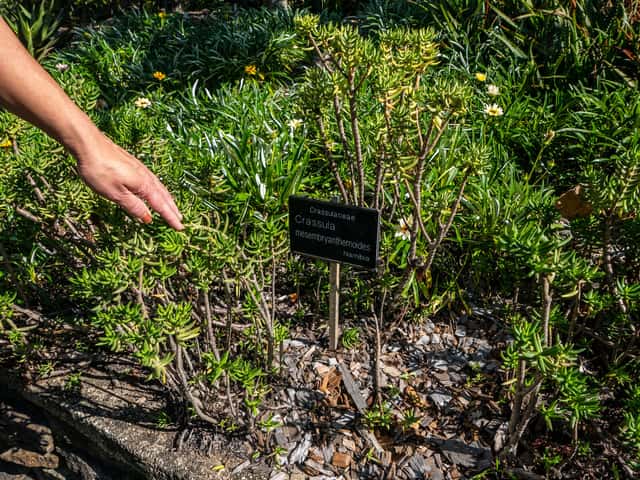
Crassulaceae
Crassula mesembryanthemoides
Crassula mesembryanthemoides
A low-maintenance succulent for pots, rock gardens and dry beds. It wants plenty of light, gritty fast-draining soil and infrequent water. It comes from a winter-rainfall area and tends to rest in hot, dry summers. It does not like frost.
Every 10 days
Bright indirect
0° - °C
% - %
Categories
What is Crassula mesembryanthemoides?
Crassula mesembryanthemoides (Crassula mesembryanthemoides) is a easy-care plant from the Crassulaceae family. A small succulent shrub from the south-eastern Cape Province of South Africa, where it grows in stony grassland from 50 to 1,500 m. It forms a branching clump 20 to 40 cm tall, with pointed apple-green leaves covered in silvery hairs that give a velvety look. With age the stems thicken, turn reddish...
Crassula mesembryanthemoides grows up to 40cm, spread of 50cm, watering every 10 days. It is suitable for indoor environments and safe for pets.
Unlike many tropical plants, Crassula mesembryanthemoides tolerates watering mistakes. Best for beginners. Unlike many popular species, Crassula mesembryanthemoides is safe to keep around pets. Without adequate drainage, root rot can develop within 20 days.
How to Care for Crassula mesembryanthemoides?
TLDR: Crassula mesembryanthemoides needs Bright indirect, watering every 10 days, and temperatures between 0-30°C with 40-70% humidity.
How Often Should You Water Crassula mesembryanthemoides?
Water only when the mix is completely dry. In hot summer weather, when growth stops, water even less. Soggy roots lead to rot.
How Much Light Does Crassula mesembryanthemoides Need?
Full sun to dappled light. In midsummer, shade it from harsh afternoon sun, which can scorch the leaves.
What Is the Best Soil for Crassula mesembryanthemoides?
Lean, gritty, well-drained mix: cactus soil with plenty of coarse sand or fine gravel.
What Pot Should You Use for Crassula mesembryanthemoides?
A small, shallow terracotta pot with drainage holes; it also suits an open terrarium.
What Is Crassula mesembryanthemoides and Where Does It Come From?
A small succulent shrub from the south-eastern Cape Province of South Africa, where it grows in stony grassland from 50 to 1,500 m. It forms a branching clump 20 to 40 cm tall, with pointed apple-green leaves covered in silvery hairs that give a velvety look. With age the stems thicken, turn reddish-brown and the bark peels. The small flowers come in branched clusters, and sources differ on colour: white, cream, pale yellow or pinkish.
How to Propagate Crassula mesembryanthemoides?
Tip cutting
Tips that drop off the plant on their own also root where they land.
- 1 In late summer, cut 5-8 cm stem tips
- 2 Let the cut ends dry for 1-2 days
- 3 Insert into dry succulent mix
- 4 Water lightly after a week and keep in bright light
Materials needed:
Seed
The seed is tiny: do not bury it.
- 1 In spring, scatter seed on fine, moist mix without covering it
- 2 Keep at 18-24 °C in light and humidity
- 3 Wait for germination, which takes 1-3 months
- 4 Prick out seedlings once they are sturdy
Materials needed:
How Big Does Crassula mesembryanthemoides Grow?
TLDR: Crassula mesembryanthemoides can reach up to 40cm tall with Medium growth rate.
Max height
40cm
Spread
50cm
Foliage
Evergreen
Plant Uses
Ornamental
Great for decoration
Is your plant showing symptoms?
Click on the symptom to discover possible causes:
What Diseases Commonly Affect Crassula mesembryanthemoides?
TLDR: Crassula mesembryanthemoides is susceptible to 2 known diseases. Monitor regularly for early detection.
Root Rot
Root rot is a serious fungal disease that affects the root system of plants, causing them to decay and die. It is primarily caused by overwatering, poor drainage, or soil-borne fungi such as Pythium, Phytophthora, Rhizoctonia, and Fusarium. The disease thrives in waterlogged conditions where roots are deprived of oxygen, making them susceptible to fungal infection.
Mealybugs
Mealybugs are small, soft-bodied insects covered with a white, waxy, cottony material. They are common pests of houseplants and outdoor plants in mild climates. These sap-sucking insects feed on plant tissue, causing damage, stunted growth, and can lead to plant death if left untreated. They produce sticky honeydew which attracts sooty mold.
Fun Facts
Its name compares it to the mesembs (Mesembryanthemum), another group of South African succulents.
The bark on older stems peels away in strips.
It comes from a winter-rainfall region, so it tends to pause in summer.
Frequently asked questions
How often should I water Crassula mesembryanthemoides?
Is it frost hardy?
Why are the leaves hairy?
How do I propagate it?
Compare with similar plants
| Attribute | Difficulty | Light | Watering | Pet Safe |
|---|---|---|---|---|
| Field Maple | Easy | Bright indirect | 14d | ✓ |
| Iberian Houseleek | Easy | Direct sun | 14d | ✓ |
| Silver Birch | Easy | Direct sun | 14d | ✓ |
| Common Blanketflower | Easy | Direct sun | 10d | ✓ |





