Crassulaceae
Cotyledon (Genus)
Cotyledon
Easy succulents that need plenty of light and fast-draining soil. Water sparingly: wait until the mix is completely dry, and water even less in winter. In low light they stretch, and standing water rots the roots. Some handle light frost. All parts are toxic, so keep them away from children and pets.
Every 14 days
Bright indirect
-4° - °C
% - %
Categories
What is Cotyledon?
Cotyledon (Cotyledon) is a easy-care plant from the Crassulaceae family. Cotyledon is a genus of succulent plants in the family Crassulaceae, the same family as jade plant and kalanchoe. It has about 10 to 20 species, almost all from southern Africa, with a few in the drier parts of the rest of the continent up to the Arabian Peninsula. They are small shrubs with fleshy,...
Cotyledon grows up to 1.3m, watering every 14 days. It is suitable for indoor environments and not safe for pets.
Unlike many tropical plants, Cotyledon tolerates watering mistakes. Best for beginners. Without precautions, ingestion can cause irritation in pets. Keep out of reach of cats and dogs. Without adequate drainage, root rot can develop within 28 days.
How to Care for Cotyledon?
TLDR: Cotyledon needs Bright indirect, watering every 14 days, and temperatures between -4-30°C with 40-70% humidity.
How Often Should You Water Cotyledon?
Water about every 2 weeks in spring and summer, only when the mix is dry. In winter, water once a month or less. Water the soil, not the leaves, so you don't wash off the white powder.
How Much Light Does Cotyledon Need?
Full sun or bright part shade. Indoors, the brightest window in the house. In the dark the stems stretch and flop.
What Is the Best Soil for Cotyledon?
Cactus and succulent mix with coarse sand or grit. A good blend is 2 parts grit to 1 part compost.
What Pot Should You Use for Cotyledon?
A clay pot with a drainage hole, which helps the soil dry faster. For large species, use a heavy pot, since the fleshy stems tip over light ones.
What Is Cotyledon and Where Does It Come From?
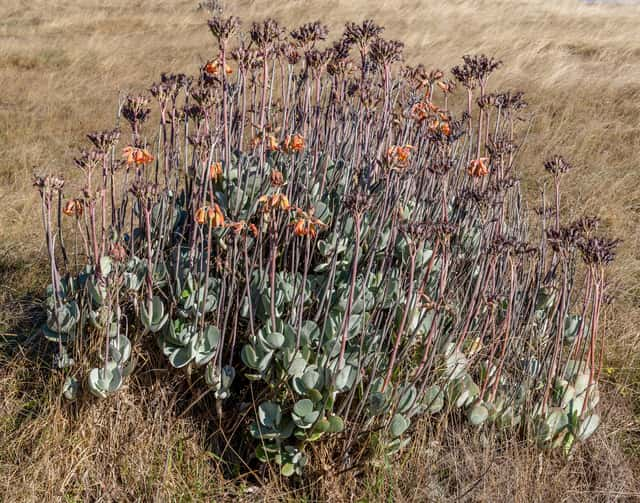
Cotyledon is a genus of succulent plants in the family Crassulaceae, the same family as jade plant and kalanchoe. It has about 10 to 20 species, almost all from southern Africa, with a few in the drier parts of the rest of the continent up to the Arabian Peninsula. They are small shrubs with fleshy, brittle stems and thick, opposite, evergreen leaves that vary a lot: round and covered in white powder in pig's ear (Cotyledon orbiculata), hairy in bear's paw (Cotyledon tomentosa), wavy in others. The flowers are hanging tubes in orange, red, yellow or pink at the top of long stalks. Size ranges from about 30 cm to over 1 m, depending on the species.
How to Propagate Cotyledon?
Tip cutting
This is the fastest method. Keep the cutting fairly dry so it doesn't rot.
- 1 Cut an 8-10 cm shoot tip with a clean knife
- 2 Let the cut dry in the shade for 2-3 days until it calluses
- 3 Plant in dry sandy mix
- 4 Water lightly only after a week and keep in bright light
Materials needed:
Seed
The biggest risk is too much water in the first weeks.
- 1 Scatter the tiny seeds on moist sandy mix
- 2 Don't cover them, just press lightly
- 3 Keep moist but not soggy, in bright light
- 4 Transplant when seedlings reach 2-4 cm
Materials needed:
How Big Does Cotyledon Grow?
TLDR: Cotyledon can reach up to 1.3m tall with Medium growth rate.
Max height
1.3m
Growth rate
Medium
Foliage
Evergreen
Warning: Toxic Plant
This plant can be toxic if ingested. Keep out of reach of:
Plant Uses
Ornamental
Great for decoration
Is your plant showing symptoms?
Click on the symptom to discover possible causes:
What Diseases Commonly Affect Cotyledon?
TLDR: Cotyledon is susceptible to 3 known diseases. Monitor regularly for early detection.
Mealybugs
Mealybugs are small, soft-bodied insects covered with a white, waxy, cottony material. They are common pests of houseplants and outdoor plants in mild climates. These sap-sucking insects feed on plant tissue, causing damage, stunted growth, and can lead to plant death if left untreated. They produce sticky honeydew which attracts sooty mold.
Root Rot
Root rot is a serious fungal disease that affects the root system of plants, causing them to decay and die. It is primarily caused by overwatering, poor drainage, or soil-borne fungi such as Pythium, Phytophthora, Rhizoctonia, and Fusarium. The disease thrives in waterlogged conditions where roots are deprived of oxygen, making them susceptible to fungal infection.
Slugs and Snails
Slugs and snails are mollusks that feed on plant tissue, causing irregular holes in leaves and damage to young seedlings. They are most active at night and in moist conditions, leaving characteristic silvery slime trails. These pests can quickly devastate gardens, especially during wet seasons.
Fun Facts
The name comes from the Greek kotyledon, a cup-shaped hollow, after the concave leaves of some species.
Until the 1960s the genus had about 150 species; many were moved to Tylecodon, Adromischus and Dudleya.
The white powder on pig's ear leaves reflects sunlight and helps the plant lose less water.
Frequently asked questions
Why is my Cotyledon stretched and flopping?
Why are the leaves soft and falling off?
Is Cotyledon poisonous?
What is the white fluff on the leaves?
Compare with similar plants
| Attribute | Difficulty | Light | Watering | Pet Safe |
|---|---|---|---|---|
| Field Maple | Easy | Bright indirect | 14d | ✓ |
| Iberian Houseleek | Easy | Direct sun | 14d | ✓ |
| Silver Birch | Easy | Direct sun | 14d | ✓ |
| Common Blanketflower | Easy | Direct sun | 10d | ✓ |





