Fabaceae
Purple Coral Pea: Ground Cover Plant
Hardenbergia violacea
A tough, low-maintenance climber for full sun to part shade. Give it free-draining, slightly acidic soil, water regularly until established and then only occasionally as it is quite drought tolerant, and avoid high-phosphorus fertilizers since this legume fixes its own nitrogen. A light prune after flowering keeps it dense and tidy.
Every 10 days
Bright indirect
-5° - 35°C
40% - 70%
Categories
What is Purple Coral Pea?
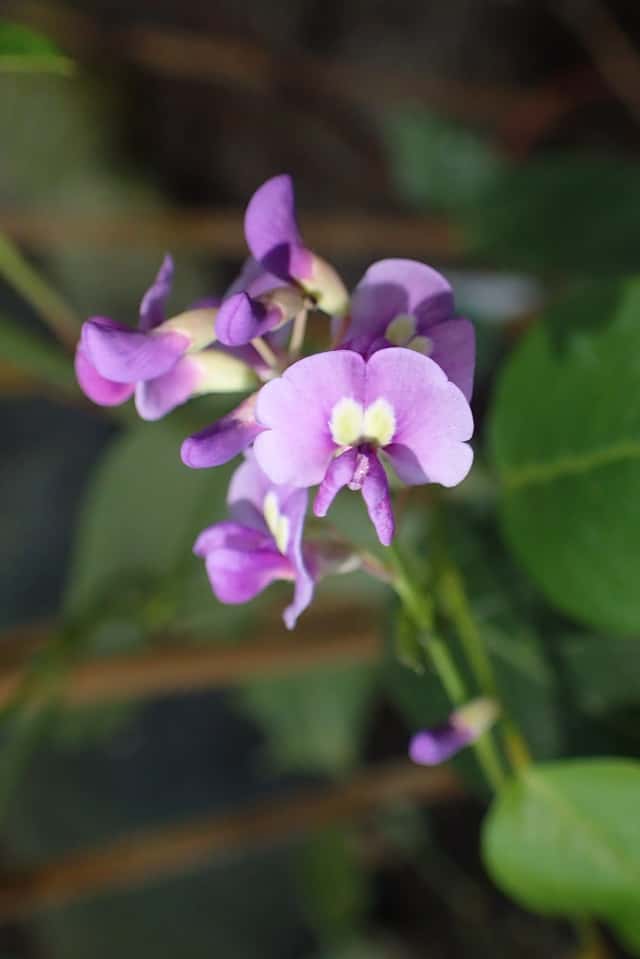
Purple Coral Pea (Hardenbergia violacea) is a easy-care plant from the Fabaceae family. Hardenbergia violacea is a woody, evergreen climbing vine native to eastern and southern Australia, prized for cascading sprays of pea-shaped purple to violet flowers that appear from late winter into spring. Its dark green, leathery lance-shaped leaves stay attractive year-round. Vigorous but well-...
Purple Coral Pea grows up to 3.0m, spread of 200cm, watering every 10 days, -5°C – 35°C, 40–70% humidity. It is not suitable for indoor environments and safe for pets.
Unlike many tropical plants, Purple Coral Pea tolerates watering mistakes. Best for beginners. Unlike many popular species, Purple Coral Pea is safe to keep around pets.
How to Care for Purple Coral Pea?
TLDR: Purple Coral Pea needs Bright indirect, watering every 10 days, and temperatures between -5-35°C with 40-70% humidity.
How Often Should You Water Purple Coral Pea?
Water regularly through the first year to establish deep roots, letting the top few centimeters of soil dry between waterings. Once established it copes well with dry spells; soggy, poorly drained soil is the main cause of root rot.
How Much Light Does Purple Coral Pea Need?
Full sun gives the heaviest flowering, but it also grows well in part shade. Aim for at least four to six hours of direct light a day for a full mass of blooms.
What Is the Best Soil for Purple Coral Pea?
Plant in well-drained, mildly acidic soil around pH 5.5 to 7.0. It adapts to sand, loam or light clay as long as water does not pool at the roots; a raised bed or gentle slope helps drainage.
What Pot Should You Use for Purple Coral Pea?
Choose a deep, breathable pot such as terracotta with generous drainage holes to prevent waterlogging, and provide a trellis or support for the twining stems.
What Is Purple Coral Pea and Where Does It Come From?
Hardenbergia violacea is a woody, evergreen climbing vine native to eastern and southern Australia, prized for cascading sprays of pea-shaped purple to violet flowers that appear from late winter into spring. Its dark green, leathery lance-shaped leaves stay attractive year-round. Vigorous but well-behaved, it can be trained onto trellises and fences, allowed to scramble as a groundcover, or grown in large containers.
How to Propagate Purple Coral Pea?
Seed Sowing
- The hard seed coat needs scarification to absorb water.
- Sow once heavy frosts have passed.
- 1 Scarify
Pour near-boiling water over the seeds and soak 12 to 24 hours until they swell.
- 2 Sow
Plant the swollen seeds about 5 mm deep in a free-draining seed-raising mix.
- 3 Germinate
Keep warm and lightly moist in bright light until seedlings emerge, then grow on before transplanting.
Materials needed:
Semi-hardwood Cuttings
- Use firm current-season growth.
- Keep humidity high while rooting.
- 1 Take Cutting
Cut a 10 to 15 cm semi-hardwood stem just below a node and remove the lower leaves.
- 2 Treat and Insert
Dip the base in rooting hormone and insert into a free-draining mix.
- 3 Root
Keep warm, humid and lightly moist until roots form, then pot on.
Materials needed:
How Big Does Purple Coral Pea Grow?
TLDR: Purple Coral Pea can reach up to 3.0m tall with Fast growth rate.
Max height
3.0m
Spread
2.0m
Growth rate
Fast
Foliage
Evergreen
Plant Uses
Ornamental
Great for decoration
Ground Cover
Soil coverage
Medicinal Uses
- Leaves were traditionally brewed as a sarsaparilla-like herbal infusion by early Australian settlers
Culinary Uses
- The leaves have been steeped to make a mild refreshing tea, the origin of the common name false sarsaparilla
Is your plant showing symptoms?
Click on the symptom to discover possible causes:
What Diseases Commonly Affect Purple Coral Pea?
TLDR: Purple Coral Pea is susceptible to 6 known diseases. Monitor regularly for early detection.
Root Rot
Root rot is a serious fungal disease that affects the root system of plants, causing them to decay and die. It is primarily caused by overwatering, poor drainage, or soil-borne fungi such as Pythium, Phytophthora, Rhizoctonia, and Fusarium. The disease thrives in waterlogged conditions where roots are deprived of oxygen, making them susceptible to fungal infection.
Phytophthora Root Rot
Disease caused by fungus-like organisms (oomycetes) that live in soil and can survive for years. It affects roots, stem, and crown of plants, being especially severe in waterlogged or poorly drained soils. It is the second most common cause of root rot in trees and shrubs.
Aphids
Aphids are small, soft-bodied, pear-shaped insects (1/16 to 1/8 inch long) that feed by sucking nutrient-rich sap from plants. They reproduce rapidly and can quickly weaken plants, causing distorted growth and transmitting plant viruses. Aphids come in various colors including green, black, red, yellow, brown, and gray. They secrete honeydew, a sticky substance that attracts ants and encourages sooty mold growth.
Spider Mites
Spider mites are tiny arachnids (less than 1/20 inch long) related to spiders and ticks that feed on plant sap. They thrive in hot, dry conditions and can cause significant damage to ornamental and vegetable plants. During severe infestations, crop losses can reach 14% or higher as these pests disrupt vital plant processes including photosynthesis, carbon dioxide absorption, and transpiration.
Meaning & Symbolism
A cheerful herald of late winter and spring in its native Australia, the purple coral pea is associated with endurance, resilience and free-spirited, wandering growth.
Compare with similar plants
| Attribute | Difficulty | Light | Watering | Pet Safe |
|---|---|---|---|---|
| Field Maple | Easy | Bright indirect | 14d | ✓ |
| Silver Birch | Easy | Direct sun | 14d | ✓ |
| Common Blanketflower | Easy | Direct sun | 10d | ✓ |
| Cushion Bush | Easy | Direct sun | 14d | ✓ |





