Crassulaceae
Chinese jade: Low Water Needs
Sinocrassula yunnanensis
An easy, drought-tolerant succulent that wants strong light for its best color and plenty of drainage. Let the soil dry out completely between waterings, protect it from prolonged rain and from harsh midday sun above 30C, and it will reward you with tight, hairy rosettes that darken beautifully in cool weather.
Every 14 days
Bright indirect
-5° - 30°C
50% - 80%
Categories
What is Chinese jade?
Chinese jade (Sinocrassula yunnanensis) is a easy-care plant from the Crassulaceae family. Sinocrassula yunnanensis, or Chinese jade, is a small rosette-forming succulent native to the mountainous Yunnan province of China. Its spindle-shaped leaves are densely covered in fine soft hairs and shift from dark green in summer to deep chocolate-brown or red tones in cooler months. Plants multi...
Chinese jade grows up to 10cm, spread of 30cm, watering every 14 days, -5°C – 30°C, 50–80% humidity. It is suitable for indoor environments and safe for pets.
Unlike many tropical plants, Chinese jade tolerates watering mistakes. Best for beginners. Unlike many popular species, Chinese jade is safe to keep around pets. Without adequate drainage, root rot can develop within 28 days.
How to Care for Chinese jade?
TLDR: Chinese jade needs Bright indirect, watering every 14 days, and temperatures between -5-30°C with 50-80% humidity.
How Often Should You Water Chinese jade?
Water only once the potting mix has dried out completely, roughly every two weeks in spring and autumn, and less often in summer and winter. Always let excess water drain away fully -- soggy soil is the main cause of root rot in this species.
How Much Light Does Chinese jade Need?
Give it at least four hours of direct sun followed by bright light for the most compact growth and richest chocolate-red coloring. In very hot climates, filter or shade the plant during intense afternoon sun above 30C to prevent leaf burn; if grown indoors, place it in the brightest window available or under supplemental grow lights.
What Is the Best Soil for Chinese jade?
Plant in a fast-draining succulent or cactus mix, or blend your own from potting soil, coarse sand, and perlite or pumice in roughly equal parts. Adding a layer of gravel at the pot base helps water escape quickly and keeps roots from sitting wet.
What Pot Should You Use for Chinese jade?
An unglazed terracotta or clay pot with a drainage hole is ideal -- its porous walls let excess moisture evaporate quickly, which suits this rot-prone succulent far better than glazed ceramic or plastic.
What Is Chinese jade and Where Does It Come From?
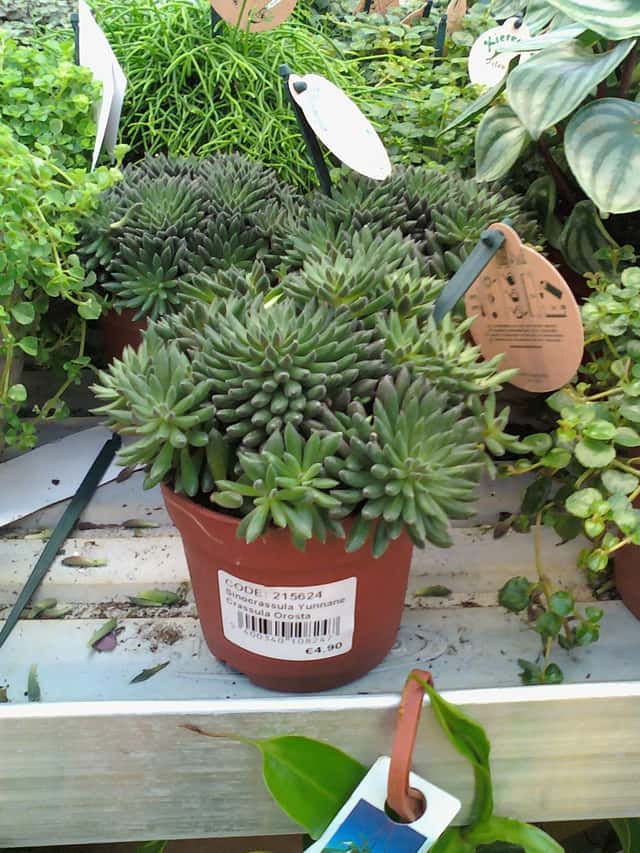
Sinocrassula yunnanensis, or Chinese jade, is a small rosette-forming succulent native to the mountainous Yunnan province of China. Its spindle-shaped leaves are densely covered in fine soft hairs and shift from dark green in summer to deep chocolate-brown or red tones in cooler months. Plants multiply readily by offsets, eventually forming dense clumps, and produce cream-to-white flowers on tall stalks; the flowering rosette itself dies back afterward.
How to Propagate Chinese jade?
How Big Does Chinese jade Grow?
TLDR: Chinese jade can reach up to 10cm tall with Medium growth rate.
Max height
10cm
Spread
30cm
Growth rate
Medium
Foliage
Evergreen
Plant Uses
Ornamental
Great for decoration
Is your plant showing symptoms?
Click on the symptom to discover possible causes:
What Diseases Commonly Affect Chinese jade?
TLDR: Chinese jade is susceptible to 6 known diseases. Monitor regularly for early detection.
Root Rot
Root rot is a serious fungal disease that affects the root system of plants, causing them to decay and die. It is primarily caused by overwatering, poor drainage, or soil-borne fungi such as Pythium, Phytophthora, Rhizoctonia, and Fusarium. The disease thrives in waterlogged conditions where roots are deprived of oxygen, making them susceptible to fungal infection.
Mealybugs
Mealybugs are small, soft-bodied insects covered with a white, waxy, cottony material. They are common pests of houseplants and outdoor plants in mild climates. These sap-sucking insects feed on plant tissue, causing damage, stunted growth, and can lead to plant death if left untreated. They produce sticky honeydew which attracts sooty mold.
Aphids
Aphids are small, soft-bodied, pear-shaped insects (1/16 to 1/8 inch long) that feed by sucking nutrient-rich sap from plants. They reproduce rapidly and can quickly weaken plants, causing distorted growth and transmitting plant viruses. Aphids come in various colors including green, black, red, yellow, brown, and gray. They secrete honeydew, a sticky substance that attracts ants and encourages sooty mold growth.
Spider Mites
Spider mites are tiny arachnids (less than 1/20 inch long) related to spiders and ticks that feed on plant sap. They thrive in hot, dry conditions and can cause significant damage to ornamental and vegetable plants. During severe infestations, crop losses can reach 14% or higher as these pests disrupt vital plant processes including photosynthesis, carbon dioxide absorption, and transpiration.
Meaning & Symbolism
Because it shifts from green to deep chocolate-red under stress and cold, Chinese Jade is often kept by succulent collectors as a small emblem of quiet resilience and seasonal transformation.
Compare with similar plants
| Attribute | Difficulty | Light | Watering | Pet Safe |
|---|---|---|---|---|
| Field Maple | Easy | Bright indirect | 14d | ✓ |
| Silver Birch | Easy | Direct sun | 14d | ✓ |
| Common Blanketflower | Easy | Direct sun | 10d | ✓ |
| Cushion Bush | Easy | Direct sun | 14d | ✓ |
Choose & Compare
Sources & References
- Sinocrassula Yunnanensis Care & Propagation - Succulent Growing Tips
- Sinocrassula Yunnanensis - Succulent Index
- Sinocrassula Yunnanensis Care & Propagation (Complete Guide) - Gardens Whisper
- How to Care for and Cultivate Sinocrassula yunnanensis - Succulent Zone
- Sinocrassula yunnanensis (Chinese Jade) - World of Succulents





