Orchidaceae
Charming Paphiopedilum (Paphiopedilum venustum)
Paphiopedilum venustum
Bright light without direct sun, such as an east-facing window. It has no pseudobulbs to store water, so it shouldn't stay dry for long: water when the mix is almost dry, using rainwater or demineralised water, about once a week. It likes 18 to 24 °C by day and 14 to 16 °C at night, with 50% to 70% humidity. Feed every two weeks from spring to autumn.
Every 7 days
Partial shade
14° - 25°C
50% - 70%
Categories
What is Charming Paphiopedilum?
Charming Paphiopedilum (Paphiopedilum venustum) is a medium-care plant from the Orchidaceae family. A ground-growing orchid from the eastern Himalaya: Nepal, north-east India, Bhutan, Bangladesh and southern China. It grows between 1,000 and 1,500 m at the foot of cliffs and in damp undergrowth near streams. The leaves, up to 25 cm long, are mottled dark and pale green on top and purple underneath...
Charming Paphiopedilum grows up to watering every 7 days, 14°C – 25°C, 50–70% humidity. It is suitable for indoor environments and safe for pets.
Unlike many popular species, Charming Paphiopedilum is safe to keep around pets. Without adequate drainage, root rot can develop within 14 days.
How to Care for Charming Paphiopedilum?
TLDR: Charming Paphiopedilum needs Partial shade, watering every 7 days, and temperatures between 14-25°C with 50-70% humidity.
How Often Should You Water Charming Paphiopedilum?
Water when the mix is nearly dry at the bottom of the pot, roughly once a week. Use rainwater or demineralised water. Don't leave water sitting in the crown or in the saucer, as it rots the centre.
How Much Light Does Charming Paphiopedilum Need?
Bright, filtered light, such as an east or north window. Direct sun scorches the leaves. Reddish leaf edges mean it's getting too much light.
What Is the Best Soil for Charming Paphiopedilum?
A fine bark mix with sphagnum moss and a little grit or crushed limestone. It likes a mix that holds a bit more moisture than other orchids get.
What Pot Should You Use for Charming Paphiopedilum?
A plastic pot with drainage holes, sized to the roots. Plastic holds a little more moisture, which this orchid likes.
Care Schedule
Fertilize
Every 14 days
What Is Charming Paphiopedilum and Where Does It Come From?
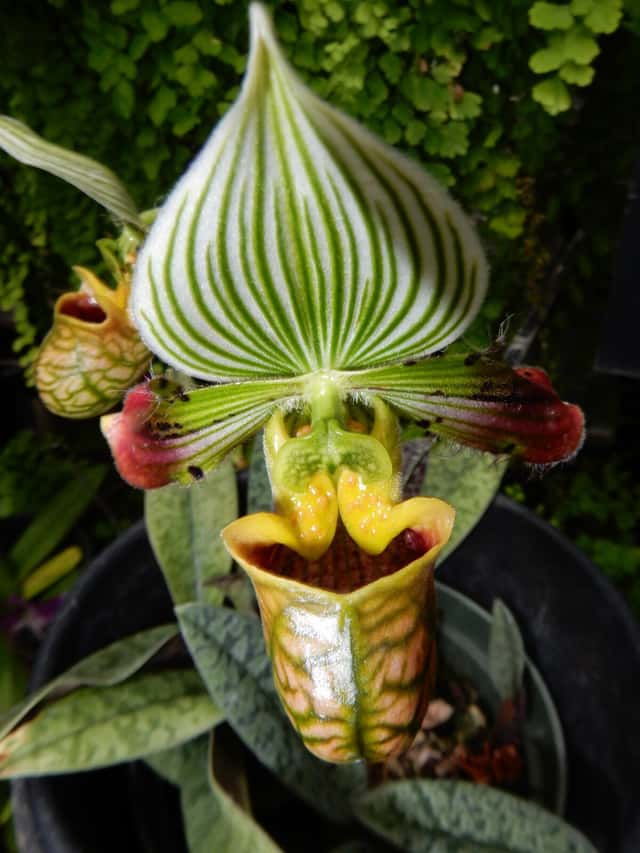
A ground-growing orchid from the eastern Himalaya: Nepal, north-east India, Bhutan, Bangladesh and southern China. It grows between 1,000 and 1,500 m at the foot of cliffs and in damp undergrowth near streams. The leaves, up to 25 cm long, are mottled dark and pale green on top and purple underneath, so it looks good even out of flower. From winter into spring it sends up a stem with a single flower about 8 cm across: a white top sepal striped green, green petals tipped rose-red with dark spots, and a green-veined pouch. Each flower can last up to six weeks.
How to Propagate Charming Paphiopedilum?
Division
Pieces that are too small struggle and take longer to flower. Use clean tools and keep it in bright shade after dividing.
- 1 Wait until the plant fills its pot and has finished flowering
- 2 Water the mix the day before
- 3 Take it out of the pot and gently loosen the roots
- 4 Split it into pieces with at least 3 rooted growths each
- 5 Repot in fresh mix and water lightly for the first few weeks
Materials needed:
How Big Does Charming Paphiopedilum Grow?
TLDR: Charming Paphiopedilum can reach up to ?cm tall with Medium growth rate.
Foliage
Evergreen
Plant Uses
Ornamental
Great for decoration
Is your plant showing symptoms?
Click on the symptom to discover possible causes:
What Diseases Commonly Affect Charming Paphiopedilum?
TLDR: Charming Paphiopedilum is susceptible to 3 known diseases. Monitor regularly for early detection.
Mealybugs
Mealybugs are small, soft-bodied insects covered with a white, waxy, cottony material. They are common pests of houseplants and outdoor plants in mild climates. These sap-sucking insects feed on plant tissue, causing damage, stunted growth, and can lead to plant death if left untreated. They produce sticky honeydew which attracts sooty mold.
Bacterial Soft Rot
Bacterial soft rot is a destructive plant disease caused primarily by bacteria from the genera Pectobacterium (formerly Erwinia) and Dickeya. These bacteria produce enzymes that break down plant cell walls, causing rapid and foul-smelling tissue decomposition. It mainly affects succulent tissues such as tubers, fruits, stems, and bulbs, being especially problematic in warm and humid conditions.
Sunburn (Sun Scorch)
Sunburn or sun scorch is an environmental condition that occurs when plants are exposed to intense, direct sunlight beyond their tolerance level. This causes the breakdown of chlorophyll in the leaves, resulting in bleached, dried, and damaged foliage. The damage can happen rapidly, sometimes within just a few hours of exposure.
Fun Facts
Venustum is Latin for charming.
The mottled leaves make it an attractive plant even when it's not in flower.
It reached Britain in 1816 and was first described in 1820 as Cypripedium venustum.
Frequently asked questions
How often should I water Paphiopedilum venustum?
Why did the centre of my plant rot?
Where should I put it?
When does it flower?
Compare with similar plants
| Attribute | Difficulty | Light | Watering | Pet Safe |
|---|---|---|---|---|
| Dark Fieldcap | Medium | Low light | 2d | ⚠️ |
| Azalea | Medium | Partial shade | 3d | ⚠️ |
| Muriel's Bamboo | Medium | Partial shade | 3d | ✓ |
| Bougainvillea | Medium | Direct sun | 7d | ⚠️ |