Cactaceae
Caribbean Tree Cactus (Consolea falcata)
Consolea falcata
An easy cactus to grow in warm climates or in a pot. Give it full sun or bright light with some direct sun, a very free-draining mix, and water during the warm season only after the soil has dried out completely. Keep it dry in winter and protect it from frost: it survives brief dips to about -2 C only when the soil is dry, and is safer kept above freezing. Rot from cold, wet soil is the main risk. Repot every other year in spring. Handle with gloves because of the glochids.
Every 14 days
Direct sun
-2° - °C
% - %
Categories
What is Caribbean Tree Cactus?
Caribbean Tree Cactus (Consolea falcata) is a easy-care plant from the Cactaceae family. Consolea falcata is a rare tree cactus from Hispaniola, in the prickly pear subfamily (Opuntioideae). In the wild it has been recorded from a single spot on the coast of north-western Haiti, near Port-de-Paix, where fewer than a dozen plants grew on bare limestone a few metres above the sea; that po...
Caribbean Tree Cactus grows up to 2.0m, watering every 14 days. It is suitable for indoor environments and safe for pets.
Unlike many tropical plants, Caribbean Tree Cactus tolerates watering mistakes. Best for beginners. Unlike many popular species, Caribbean Tree Cactus is safe to keep around pets. Without adequate drainage, root rot can develop within 28 days.
How to Care for Caribbean Tree Cactus?
TLDR: Caribbean Tree Cactus needs Direct sun, watering every 14 days, and temperatures between -2-30°C with 40-70% humidity.
How Often Should You Water Caribbean Tree Cactus?
From spring to early autumn, water thoroughly and then wait until the potting mix is completely dry before watering again, roughly every two weeks in warm weather. In winter, keep it almost dry. Avoid watering on cold, overcast or humid days, and never leave water standing in the saucer: the roots rot quickly when wet and cold.
How Much Light Does Caribbean Tree Cactus Need?
Full sun outdoors, or afternoon shade in very hot climates. Indoors, give it the brightest spot you have, ideally a window with several hours of direct sun. In low light the pads grow thin and pale and the plant leans.
What Is the Best Soil for Caribbean Tree Cactus?
Any soil works as long as it drains fast. In pots, use a cactus mix with plenty of grit, pumice or coarse sand. In the wild it grows on bare coastal limestone, so a slightly alkaline, mineral mix suits it well.
What Pot Should You Use for Caribbean Tree Cactus?
A heavy terracotta or clay pot with a large drainage hole. Terracotta dries out faster and its weight helps steady the tall, top-heavy stems.
Care Schedule
Repot
Every 730 days
What Is Caribbean Tree Cactus and Where Does It Come From?
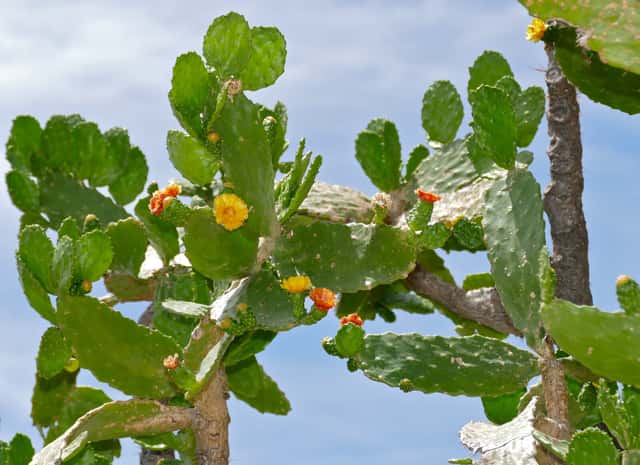
Consolea falcata is a rare tree cactus from Hispaniola, in the prickly pear subfamily (Opuntioideae). In the wild it has been recorded from a single spot on the coast of north-western Haiti, near Port-de-Paix, where fewer than a dozen plants grew on bare limestone a few metres above the sea; that population may have been lost in the 2008 floods, and the species is listed as Critically Endangered. It grows as a small tree or shrub 1.5-2 m tall with upright, very dark, glossy green arms. Its flat pads are long and narrow, up to 35 cm by 9 cm, and are often curved like a sickle, which gives the plant its name (from the Latin falx, sickle). Pads carry glochids and either no spines or a few yellowish to pale brown ones, 1-4 cm long. The flowers are red, up to 5 cm across. Like other Consolea, plants are usually male or female and are pollinated by hummingbirds.
How to Propagate Caribbean Tree Cactus?
Pad cuttings
Pads root easily in warm weather. Do not water a fresh cutting before the cut has callused, or it may rot. Use tongs or folded newspaper to hold the pad and avoid glochids.
- 1 Wearing thick gloves, cut or twist off a healthy pad at the joint
- 2 Leave the pad in a dry, shaded place for one to two weeks until the cut end calluses
- 3 Set the pad upright, a few centimetres deep, in dry, gritty cactus mix
- 4 Wait about a week, then water lightly and keep the mix just barely moist until new growth appears
Materials needed:
Seed
Seed is rarely available: plants are usually separately male or female, so fruit only forms when both sexes are grown together.
- 1 Sow fresh seed on the surface of a fine, sterile cactus mix
- 2 Cover lightly with fine grit
- 3 Keep warm and slightly moist in bright, indirect light
- 4 Move seedlings to individual pots once they are large enough to handle
Materials needed:
How Big Does Caribbean Tree Cactus Grow?
TLDR: Caribbean Tree Cactus can reach up to 2.0m tall with Medium growth rate.
Max height
2.0m
Foliage
Evergreen
Plant Uses
Ornamental
Great for decoration
Is your plant showing symptoms?
Click on the symptom to discover possible causes:
What Diseases Commonly Affect Caribbean Tree Cactus?
TLDR: Caribbean Tree Cactus is susceptible to 7 known diseases. Monitor regularly for early detection.
Root Rot
Root rot is a serious fungal disease that affects the root system of plants, causing them to decay and die. It is primarily caused by overwatering, poor drainage, or soil-borne fungi such as Pythium, Phytophthora, Rhizoctonia, and Fusarium. The disease thrives in waterlogged conditions where roots are deprived of oxygen, making them susceptible to fungal infection.
Crown Rot
Crown rot is a serious fungal disease that attacks the crown (base) of the plant where the stem meets the soil. It is caused by various fungal pathogens including Phytophthora, Fusarium, and Rhizoctonia. The disease thrives in waterlogged conditions and can quickly spread to kill the entire plant if not addressed promptly.
Fusarium Wilt
Fusarium is a soil-borne fungus that primarily attacks the roots and vascular tissues of plants. It enters through small wounds or stressed roots, is favored by warm temperatures and waterlogging, and then obstructs the flow of sap. Symptoms include yellowing, often on only one side of the plant, wilting even with moist soil, stunted growth, and, when cutting the stem, internal brown streaks. It frequently affects tomatoes, peppers, eggplants, basil, cucumbers, and zucchini, as well as ornamentals like carnations and cyclamen. In potted plants, it can manifest as root rot with a darkened crown.
Scale Insects
Scale insects are small sap-sucking pests that appear as brown, shell-like bumps on plant stems and leaves. There are over 25 species, divided into armored (hard) and unarmored (soft) scales. They feed by piercing plant tissue and extracting sap, which weakens the plant and can lead to yellowing, stunted growth, and even death if left untreated. They also excrete honeydew, which attracts ants and promotes sooty mold growth.
Fun Facts
Its name comes from the Latin falx, sickle, after the curved shape of its pads.
In the wild it was known from a single coastal site in Haiti with fewer than a dozen plants.
Consolea flowers are pollinated by hummingbirds.
Plants are usually separately male or female, so a single plant rarely sets fruit.
Frequently asked questions
How often should I water Consolea falcata?
Can Consolea falcata tolerate frost?
Can I grow Consolea falcata indoors?
Is Consolea falcata toxic?
What pests attack Consolea falcata?
Compare with similar plants
| Attribute | Difficulty | Light | Watering | Pet Safe |
|---|---|---|---|---|
| Field Maple | Easy | Bright indirect | 14d | ✓ |
| Iberian Houseleek | Easy | Direct sun | 14d | ✓ |
| Silver Birch | Easy | Direct sun | 14d | ✓ |
| Common Blanketflower | Easy | Direct sun | 10d | ✓ |
Choose & Compare
Sources & References
- Opuntia falcata (Consolea falcata) - LLIFLE Encyclopedia of Cacti
- Consolea falcata - Desert-Tropicals
- Consolea falcata (Ekman & Werderm.) F.M.Knuth - Plants of the World Online, Kew
- Consolea falcata - Recently Extinct Species (IUCN CR, refs Hoxey et al. 2023)
- Consolea - Wikipedia
- Consolea corallicola - Wikipedia (genus threats: Cactoblastis, scale, Fusarium crown rot)
- Consolea corallicola - Florida Native Plant Society (genus care, pad propagation)