Anacardiaceae
Atlantic Poison Oak (Toxicodendron pubescens)
Toxicodendron pubescens
Not a plant to grow: contact with any part causes severe dermatitis. In the wild it lives in dry, poor, sandy soil in sun or part shade. If it turns up on your land, never touch it unprotected and never burn it.
Every 14 days
Bright indirect
-15° - °C
% - %
Categories
What is Atlantic Poison Oak?
Atlantic Poison Oak (Toxicodendron pubescens) is a easy-care plant from the Anacardiaceae family. Atlantic poison oak (Toxicodendron pubescens) is an upright, deciduous shrub in the sumac family (Anacardiaceae), not a true oak. Native to the southeastern and central United States, it grows in open pine and oak woods, thickets and dry, sandy fields. It usually reaches 0.6-1.2 m and spreads by rhi...
Atlantic Poison Oak grows up to 1.2m, watering every 14 days. It is not suitable for indoor environments and safe for pets.
Unlike many tropical plants, Atlantic Poison Oak tolerates watering mistakes. Best for beginners. Unlike many popular species, Atlantic Poison Oak is safe to keep around pets.
How to Care for Atlantic Poison Oak?
TLDR: Atlantic Poison Oak needs Bright indirect, watering every 14 days, and temperatures between -15-30°C with 40-70% humidity.
How Often Should You Water Atlantic Poison Oak?
It needs no watering: a wild shrub of dry, sandy soils that lives on rainfall.
How Much Light Does Atlantic Poison Oak Need?
Grows in full sun or part shade in open woodland; it does not tolerate heavy shade.
What Is the Best Soil for Atlantic Poison Oak?
Found on coarse, poor, acidic sand with good drainage.
What Pot Should You Use for Atlantic Poison Oak?
Not suitable for pots or gardens.
What Is Atlantic Poison Oak and Where Does It Come From?
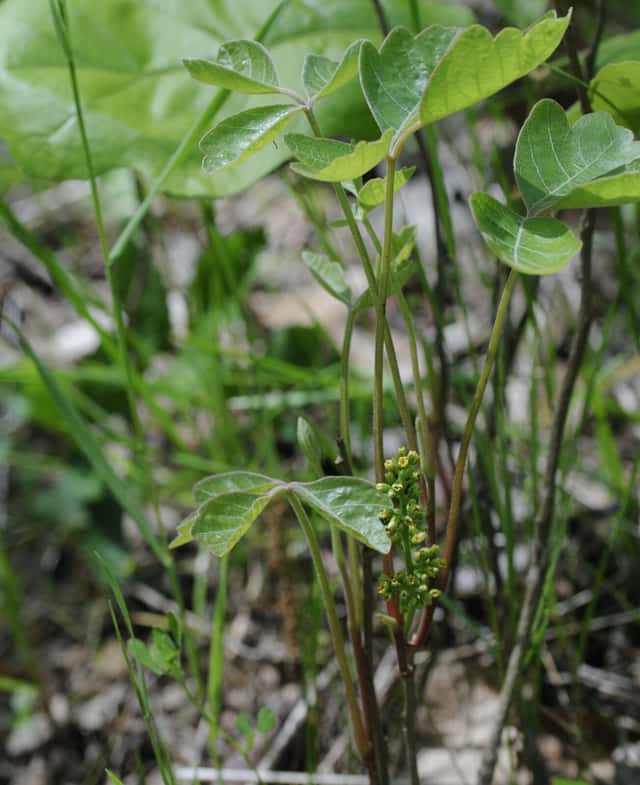
Atlantic poison oak (Toxicodendron pubescens) is an upright, deciduous shrub in the sumac family (Anacardiaceae), not a true oak. Native to the southeastern and central United States, it grows in open pine and oak woods, thickets and dry, sandy fields. It usually reaches 0.6-1.2 m and spreads by rhizomes into colonies. Each leaf has three lobed, oak-like leaflets that are hairy on both sides and turn orange-red in autumn. In spring it bears small clusters of yellow-green flowers, followed by whitish berries that birds eat. Every part of the plant contains urushiol, the same oil found in poison ivy, which causes strong contact dermatitis in most people.
How to Propagate Atlantic Poison Oak?
Seed (spread by birds)
This is how the plant reaches new ground. Never handle berries or stems without gloves.
- 1 Berries ripen from late summer into autumn
- 2 Birds eat the berries and drop the seeds elsewhere
- 3 Seeds germinate in spring
Materials needed:
Rhizomes
Pulling only the top growth does not work: it resprouts from the rhizomes. Dead stems and roots still carry urushiol.
- 1 Rhizomes run under the soil
- 2 New stems come up at intervals along them
- 3 Over time they form a colony
Materials needed:
How Big Does Atlantic Poison Oak Grow?
TLDR: Atlantic Poison Oak can reach up to 1.2m tall with Medium growth rate.
Max height
1.2m
Foliage
Deciduous
Warning: Toxic Plant
This plant can be toxic if ingested. Keep out of reach of:
Is your plant showing symptoms?
Click on the symptom to discover possible causes:
Fun Facts
Despite the name it is not an oak: it belongs to the same family as cashew and mango.
Urushiol stays active in dead stems and roots; herbarium specimens over 100 years old have caused reactions.
The genus name Toxicodendron comes from Greek for 'poison tree'.
Frequently asked questions
How do I identify Atlantic poison oak?
How is it different from poison ivy?
What should I do after touching it?
Can I burn it to get rid of it?
Is it dangerous to dogs and cats?
Compare with similar plants
| Attribute | Difficulty | Light | Watering | Pet Safe |
|---|---|---|---|---|
| Field Maple | Easy | Bright indirect | 14d | ✓ |
| Iberian Houseleek | Easy | Direct sun | 14d | ✓ |
| Silver Birch | Easy | Direct sun | 14d | ✓ |
| Common Blanketflower | Easy | Direct sun | 10d | ✓ |





