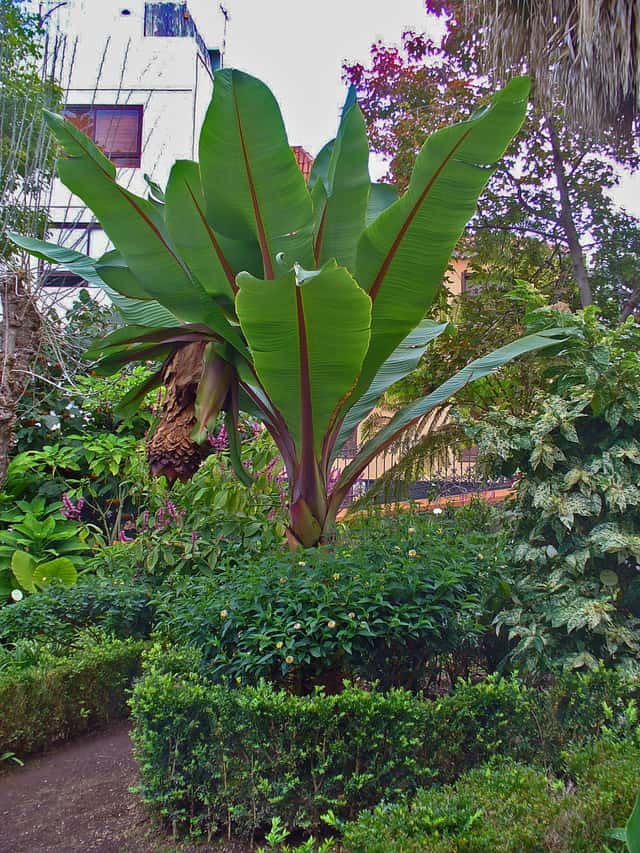
Musaceae
Abyssinian Banana (Ensete ventricosum)
Ensete ventricosum
Grow in full sun with rich, well-draining soil. Water abundantly during the growing season, reducing in winter. Fertilise every 14 days in active growth. Frost-tender: protect below 2°C.
Every 7 days
Direct sun
2° - 38°C
60% - 80%
Categories
What is Abyssinian Banana?
Abyssinian Banana (Ensete ventricosum) is a medium-care plant from the Musaceae family. Ensete ventricosum, commonly known as the Abyssinian Banana or False Banana, is a dramatic tropical plant in the Musaceae family, native to the highlands of East Africa and Ethiopia. It produces enormous paddle-like leaves up to 6 metres long with a distinctive reddish midrib, making it one of the m...
Abyssinian Banana grows up to 12.0m, spread of 400cm, watering every 7 days, 2°C – 38°C, 60–80% humidity. It is suitable for indoor environments and safe for pets.
Unlike many popular species, Abyssinian Banana is safe to keep around pets. Without adequate drainage, root rot can develop within 14 days.
How to Care for Abyssinian Banana?
TLDR: Abyssinian Banana needs Direct sun, watering every 7 days, and temperatures between 2-38°C with 60-80% humidity.
How Often Should You Water Abyssinian Banana?
Water deeply every 5–9 days during the growing season, keeping soil consistently moist but never waterlogged. Reduce watering significantly in winter. Overwatering is the number one cause of death.
How Much Light Does Abyssinian Banana Need?
Requires intense direct sunlight — minimum 6–8 hours daily. Indoors, place in the brightest possible location (south-facing window) or supplement with 12–14 hours of LED grow lights in winter.
What Is the Best Soil for Abyssinian Banana?
Use rich, fertile, well-draining soil amended with organic matter. Slightly acidic to neutral pH (5.5–7.0). Avoid compacted clay soils that retain moisture.
What Pot Should You Use for Abyssinian Banana?
Large terracotta or heavy-duty plastic pot with excellent drainage holes. Minimum 50L for mature specimens. In temperate climates, use containers for easy winter storage indoors.
Care Schedule
Fertilize
Every 14 days
Misting
Every 3 days
Repot
Every 730 days
What Is Abyssinian Banana and Where Does It Come From?
Ensete ventricosum, commonly known as the Abyssinian Banana or False Banana, is a dramatic tropical plant in the Musaceae family, native to the highlands of East Africa and Ethiopia. It produces enormous paddle-like leaves up to 6 metres long with a distinctive reddish midrib, making it one of the most striking specimen plants for large gardens and conservatories. Unlike true bananas, its fruits are inedible; instead, the pseudostem, corm, and inflorescence provide a fermented starch staple called kocho, feeding approximately 20 million Ethiopians for over 10,000 years.
How Big Does Abyssinian Banana Grow?
TLDR: Abyssinian Banana can reach up to 12.0m tall with Fast growth rate.
Max height
12.0m
Spread
4.0m
Growth rate
Fast
Foliage
Evergreen
Plant Uses
Ornamental
Great for decoration
Edible
Can be consumed
Medicinal
Medicinal properties
Medicinal Uses
- Traditional Ethiopian medicine uses the roots and pseudostem to treat stomach ailments and fever
Culinary Uses
- Kocho (fermented starch food from the pseudostem)
- Bulla (starch extracted from the corm)
- Leaves used as food wrapping and serving platters
Is your plant showing symptoms?
Click on the symptom to discover possible causes:
What Diseases Commonly Affect Abyssinian Banana?
TLDR: Abyssinian Banana is susceptible to 15 known diseases. Monitor regularly for early detection.
Root Rot
Root rot is a serious fungal disease that affects the root system of plants, causing them to decay and die. It is primarily caused by overwatering, poor drainage, or soil-borne fungi such as Pythium, Phytophthora, Rhizoctonia, and Fusarium. The disease thrives in waterlogged conditions where roots are deprived of oxygen, making them susceptible to fungal infection.
Phytophthora Root Rot
Disease caused by fungus-like organisms (oomycetes) that live in soil and can survive for years. It affects roots, stem, and crown of plants, being especially severe in waterlogged or poorly drained soils. It is the second most common cause of root rot in trees and shrubs.
Bacterial Wilt
Bacterial wilt is a fatal vascular disease caused by bacteria (Erwinia tracheiphila, Ralstonia solanacearum, Xanthomonas spp.) that infects the water-conducting tissue of plants. The bacteria multiply and block the flow of water and nutrients, causing rapid wilting and plant death within 1-2 weeks.
Fusarium Wilt
Fusarium wilt is a serious fungal disease caused by the soil-borne fungus Fusarium oxysporum. The fungus invades roots and blocks the water-conducting vessels (xylem) of the plant, causing progressive wilting and eventual death. Host-specific forms of the pathogen exist that attack different plant species.
Meaning & Symbolism
In Ethiopian culture, ensete is a symbol of abundance, resilience, and food security. Revered as the "tree against hunger," it sustains entire communities and is central to the traditions of more than 11 ethnic groups.
Fun Facts
It is monocarpic: it flowers only once after 2–10 years of growth, then dies
It feeds approximately 20 million people in Ethiopia as a subsistence staple crop
The tallest recorded specimen reached 13 metres (43 feet)
It does not produce suckers — propagation is exclusively by seed
Its leaves can reach 6 metres long and 1.5 metres wide
Frequently asked questions
Does the Abyssinian Banana produce edible bananas?
Can it be grown indoors?
Is it frost hardy?
Compare with similar plants
| Attribute | Difficulty | Light | Watering | Pet Safe |
|---|---|---|---|---|
| Dark Fieldcap | Medium | Low light | 2d | ⚠️ |
| Azalea | Medium | Partial shade | 3d | ⚠️ |
| Muriel's Bamboo | Medium | Partial shade | 3d | ✓ |
| Bougainvillea | Medium | Direct sun | 7d | ⚠️ |




