How to Fertilize Rosemary: When, How Much, and Which Fertilizer
How to fertilize rosemary in pots and in the ground: rosemary needs very little fertilizer. Learn the right timing in Brazil, doses, coffee grounds, lime, and signs of overfertilizing.
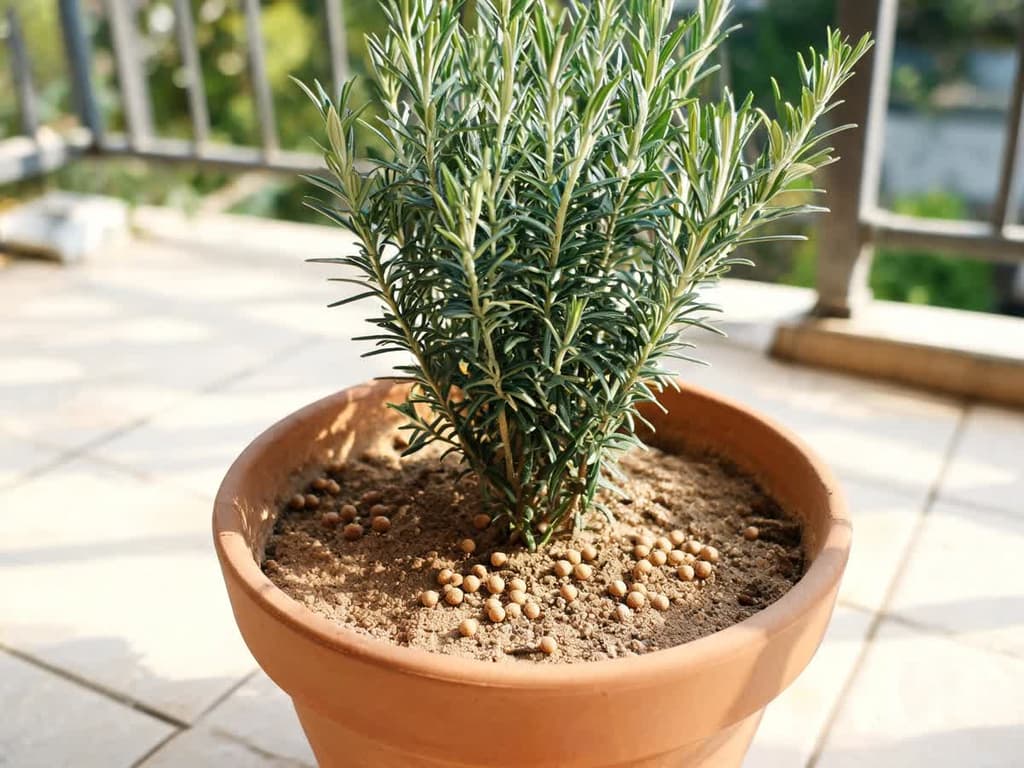
To fertilize rosemary, use little fertilizer. Rosemary planted in garden beds does not need fertilizer and thrives in poor soil (with few nutrients). This comes from the RHS, the Royal Horticultural Society in the United Kingdom. In pots, rosemary only needs fertilizer after spending more than 1 year in the same soil. In that case, a light dose of general-purpose fertilizer once a year is enough. Indoors, the other option is liquid fertilizer diluted to one-quarter the label strength, every 2 weeks.
The time to fertilize rosemary in Brazil runs from September to March, when the plant sprouts new shoots. In winter, from June to August, do not fertilize. Too much fertilizer burns leaf tips and roots.
Yellow rosemary or dry tips: does fertilizer help?
In most cases, no. Yellow leaves and dry tips on rosemary usually come from roots that are too wet, and fertilizer does not fix roots. NC State Extension points to excess water as the most common cause of death in rosemary. NC State Extension is the growing advisory service of North Carolina State University.
Before thinking about fertilizer, stick your finger 3 cm into the soil. If the soil is still wet 3 cm deep on the day you were going to water, the issue is too much water. Wait for the soil to dry out before watering again. According to the RHS, cold, waterlogged soil rots rosemary roots. The rot begins underground where you cannot see it:
Too much fertilizer also causes the same dry tips. The University of Maryland Extension describes excess fertilizer this way: leaf tips and margins turn brown or dry, lower leaves drop, and the plant wilts. Because of this, fertilizing rosemary that already has dry tips can make the problem worse. A plant without new growth also does not use the fertilizer it receives.
The pages on yellow leaves on rosemary and dry tips on rosemary separate the causes of each symptom. If the roots are white and firm and the soil dries out between waterings, fertilizer can help.
Does rosemary need fertilizer in pots and in the ground?
In the ground, rosemary roots explore a large volume of soil and find nutrients on their own. In a pot, the roots only have the soil that fits in it, and every watering flushes out part of the nutrients through the drainage hole. The RHS recommends fertilizer only for rosemary that has been in the same pot for more than 1 year.
Rosemary and lavender come from the Mediterranean, and the RHS also recommends poor soil for lavender.
Situation | Needs fertilizer? | What to do |
|---|---|---|
Rosemary in the ground, already established | No | Nothing. It thrives in poor soil (RHS). |
Rosemary repotted into fresh soil, including store-bought plants right after repotting | No, during the first year | Fresh soil provides nutrients. Wait 1 year. |
Potted plant with more than 1 year in the same soil | Yes, very little | A light feeding during the growing season. |
Indoor rosemary, in its pot for more than 1 year and producing new growth | Yes, diluted | Liquid fertilizer at one-quarter the label rate, every 2 weeks. |
Sick rosemary, with dark roots or no new growth | No | Fix watering and lighting first. |
When to fertilize rosemary in Brazil
Fertilize between September and March, only while the rosemary is sprouting new shoots. Iowa State University recommends fertilizing herbs from early spring to late summer and avoiding fertilizer in the winter. In Brazil, this runs from September to March.
The RHS and American universities write for the Northern Hemisphere, where the seasons are opposite to those in Brazil. The RHS single dose, in late spring or early summer, falls between November and January in Brazil.
In the South and mountainous regions where winters are cold, rosemary almost stops growing from June to August. The University of New Hampshire Extension notes that herbs grow very little in cold weather. During this phase, rosemary does not use fertilizer, and any leftover fertilizer stays in the potting soil as salt. The article on rosemary in winter shows how to protect potted plants during cold months.
How often to fertilize potted rosemary
Pick one of the two methods and do not combine both. Once a year and every 2 weeks sound very different, but the second method uses a much smaller dose.
Granular fertilizer, once a year. Sprinkle a little general-purpose granular fertilizer over the soil between November and January. This is the RHS recommendation for rosemary in the same pot for over 1 year. It works for pots on a balcony or in the yard.
Diluted liquid fertilizer, every 2 weeks. Use a general-purpose liquid fertilizer at one-quarter the label dose. Apply from September to March, only while there is new growth. It works for indoor rosemary in the same soil for over 1 year.
The second approach comes from extension services that write about indoor herbs. Penn State Extension recommends a low dose of water-soluble fertilizer every 2 weeks. Iowa State suggests light fertilization, using half or one-quarter the label strength. The University of New Hampshire Extension uses half strength, every 1 to 2 weeks, depending on growth.
None of these sources compared doses on rosemary. This guide uses one-quarter of the label rate, the lowest dose among the extensions, because it is the safest against overfertilizing. A German herb fertilizer manufacturer recommends fertilizing rosemary every week, from March to October (in Brazil, from September to April). This guide follows the RHS and university extensions, which do not sell fertilizer.
Which fertilizer to use on rosemary
Rosemary does not require specialized fertilizer. A general-purpose fertilizer containing the three main nutrients (nitrogen, phosphorus, and potassium) works well. The label displays these three nutrients as three numbers, the NPK ratio. The article on how to read fertilizer labels explains what each number means.
Both organic and synthetic fertilizers work, as long as you use the right dose. Organic compost and worm castings release nutrients slowly as they break down. Soluble synthetic fertilizer works fast and burns roots if overapplied. For indoor rosemary, read the ingredient list before buying. Penn State warns that some organic fertilizers carry a strong smell of fish or manure.
Does too much nitrogen reduce rosemary's scent?
No measurement in rosemary showed that excess nitrogen reduces aroma. Essential oil is the substance that gives rosemary its scent and flavor. In a field study published in 2023 by Ayoob and colleagues in Kashmir, rosemary received four nitrogen doses. The moderate dose produced the greatest growth, and the highest dose did not outperform the moderate one. The essential oil content in the leaves did not change with nitrogen.
Penn State warns that fertilizing herbs more frequently than every 2 weeks can harm aroma and flavor. The field study did not measure that loss in rosemary, but it also found no benefit from nitrogen above moderate levels. For that reason, this guide keeps Penn State's minimum 2-week interval. In studies, what changed essential oil quantity was light. The article on how much sun rosemary needs shows the essential oil loss measured in the shade.
Lime and coffee grounds for rosemary
Lime. pH measures soil acidity: the lower it is, the more acidic the soil. Lime is the powder that corrects acidic soil. The University of Maryland Extension indicates a pH between 6.5 and 7.0 for rosemary. NC State lists acidic soil, with a pH below 6.0, among those that rosemary accepts. Garden centers in Germany recommend mixing lime into rosemary soil, but neither extension directs you to do so. This guide follows the safer option: only add lime if a soil pH test reads below 6.5.
Coffee grounds. Coffee grounds are not always acidic. Researcher Linda Chalker-Scott from Washington State University gathered measurements of decomposing grounds. The pH ranged from 4.6 to 8.4 (summary published by the University of Arizona Extension). For rosemary, the problem with grounds is the thick layer, which compacts and blocks the passage of water and air.
Rosemary specifically needs soil that dries quickly. Do not spread coffee grounds over the potting soil. If you want to use grounds, mix them into compost at no more than 20% by volume, as Linda Chalker-Scott recommends.
Signs of too much and too little fertilizer in rosemary
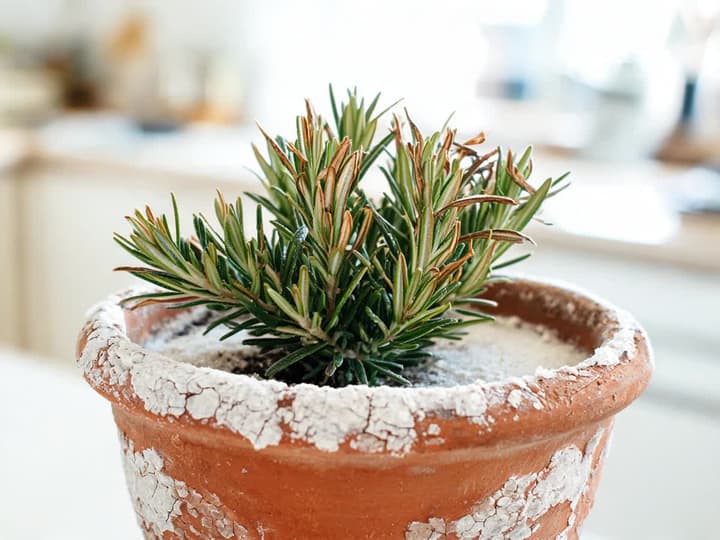
Dry tips and a white crust on the pot indicate too much fertilizer. Evenly yellowing lower leaves indicate a nitrogen deficiency.
What you see | Likely cause | What to do |
|---|---|---|
Dry or dark leaf tips and edges after fertilizing | Overfertilization (University of Maryland) | Stop fertilizing and flush the potting soil with clean water. |
White crust on the soil surface or on the outside of the terra-cotta pot | Accumulated fertilizer salts (University of Maryland) | Scrape off the crust and flush the potting soil. |
Branch collapsing at the soil level | Overfertilization or root rot | Take the rosemary out of its pot and check the roots: brown, mushy roots indicate rot. |
Lower leaves yellowing uniformly, thin branches, and slow growth | Nitrogen deficiency (Iowa State) | If the soil and roots are healthy and the pot is over 1 year old, apply a light dose. |
Yellow leaves with consistently wet soil | Overwatering | Space out waterings until the soil dries. |
When nitrogen is lacking, the plant pulls nitrogen from old leaves to new shoots, according to Iowa State. Because of this, nitrogen-deficiency yellowing starts on the lower leaves and is uniform, without spots. Rosemary newly repotted in fresh soil rarely lacks nitrogen.
To remove excess fertilizer, flush the pot with clean water using a volume at least equal to the size of the container, letting it drain freely through the bottom hole. Repeat a few times, as the University of Maryland advises, and wait for the soil to dry before watering again. The step-by-step guide on flushing accumulated salt from pots shows how much water to use based on pot size.
Supermarket rosemary: repot before fertilizing
Supermarket rosemary usually comes in a small, cramped pot with multiple seedlings together. Before fertilizing, move the plant into a pot with drainage holes, one size larger than the current one. The fresh soil already provides nutrients for the first year. For mature rosemary, the RHS recommends a pot at least 30 cm (12 inches) wide and deep.
After repotting rosemary, do not fertilize for 1 year. The complete rosemary care guide explains how to separate supermarket seedlings without losing the plant.
If you received a shrub with thin, needle-like leaves and are unsure whether it is rosemary, snap a photo with the Bloom app (available for iOS). The app displays the species name before you fertilize the plant or use it in cooking.
Frequently asked questions about fertilizing rosemary
Can I use worm castings to fertilize rosemary?
Yes. Worm castings are an organic fertilizer that releases nutrients slowly. Use worm castings only on rosemary that has been in the same soil for over 1 year. Spread a thin layer over the potting soil once a year, between November and January. Do not fill the pot with castings: according to the RHS, rosemary thrives in poor soil.
Can I fertilize rosemary in winter?
No. In winter, from June to August in Brazil, rosemary grows very little and does not use fertilizer. Leftover fertilizer stays in the potting soil as salt and can burn leaf tips and roots. Resume fertilizing in September, when rosemary sprouts new shoots.
Does foliar spray work on rosemary?
For routine feeding, no: leaves absorb very few nutrients, and soil applications are sufficient. Foliar fertilizer, sprayed onto foliage, is used to correct micronutrient deficiencies, which are nutrients the plant uses in tiny amounts. Healthy rosemary in the right pot does not need foliar feed.
How long after repotting can I fertilize rosemary?
Wait 1 year. Fresh potting soil already contains nutrients. The RHS only recommends fertilizer for rosemary that has spent over 1 year in the same soil. Fertilizing earlier stacks nutrients on top of nutrients and increases the risk of burning leaf tips.
Where to start
Check the soil and roots first: yellow rosemary or dry tips call for proper watering, not fertilizer. If the rosemary is healthy and has spent more than 1 year in the same potting soil, apply a single light dose of granular fertilizer. Do this between November and January. Indoors, use liquid fertilizer at one-quarter strength every 2 weeks from September to March. In the garden, do not fertilize. And if a spotted leaf looks like nothing on this page, a photo of the symptom helps pinpoint the cause.
Related articles
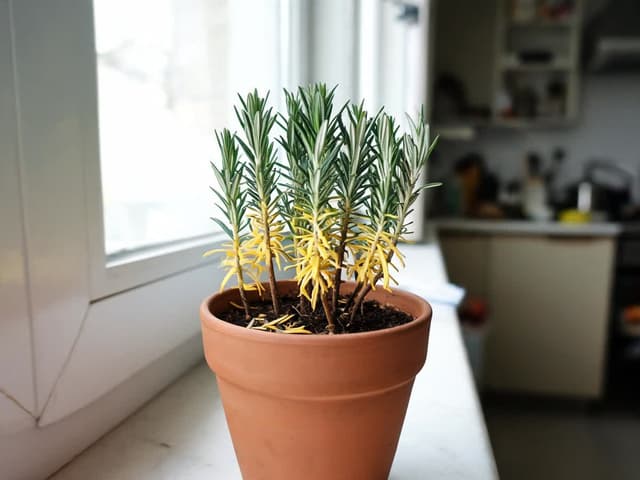
Rosemary Leaves Turning Yellow: Causes and Solutions
Rosemary with yellow leaves usually has overly wet roots. Check where the yellowing appears to see if it stems from wet roots, low light, spider mites, powdery mildew, or normal leaf shed, and learn how to save the plant.
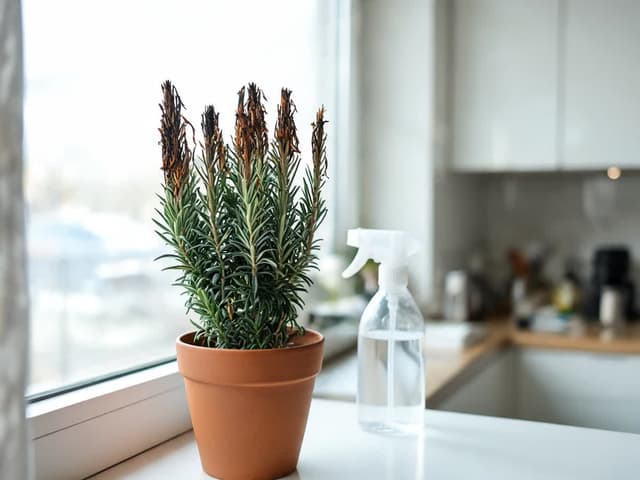
Is Your Rosemary Dying? How to Save Soap-Burned Rosemary
Rosemary with soap-burned leaves can usually be saved: the damage stays on the affected needles. Rinse the leaves, wait a week, scrape the stems, and prune only what is brown inside.
How to Propagate Rosemary: Choosing the Right Stem, Soil vs. Water, and How Long It Takes
Rosemary cuttings come from a new, non-flowering stem tip about 4 inches long. Plant it in soil mixed with sand, in a bright spot out of direct sun. Learn where to cut without harming the mother plant, whether water rooting is worth it, if rooting hormone is needed, and how long roots take.