Schefflera with Yellow Leaves: Which Leaf Turned Yellow and What to Do
A single lower leaf turning yellow at a time is just the schefflera shedding an old leaf. Many yellow leaves dropping, the whole plant turning light green in winter, or yellow speckles call for something else. Here is the one-minute test for each cause.
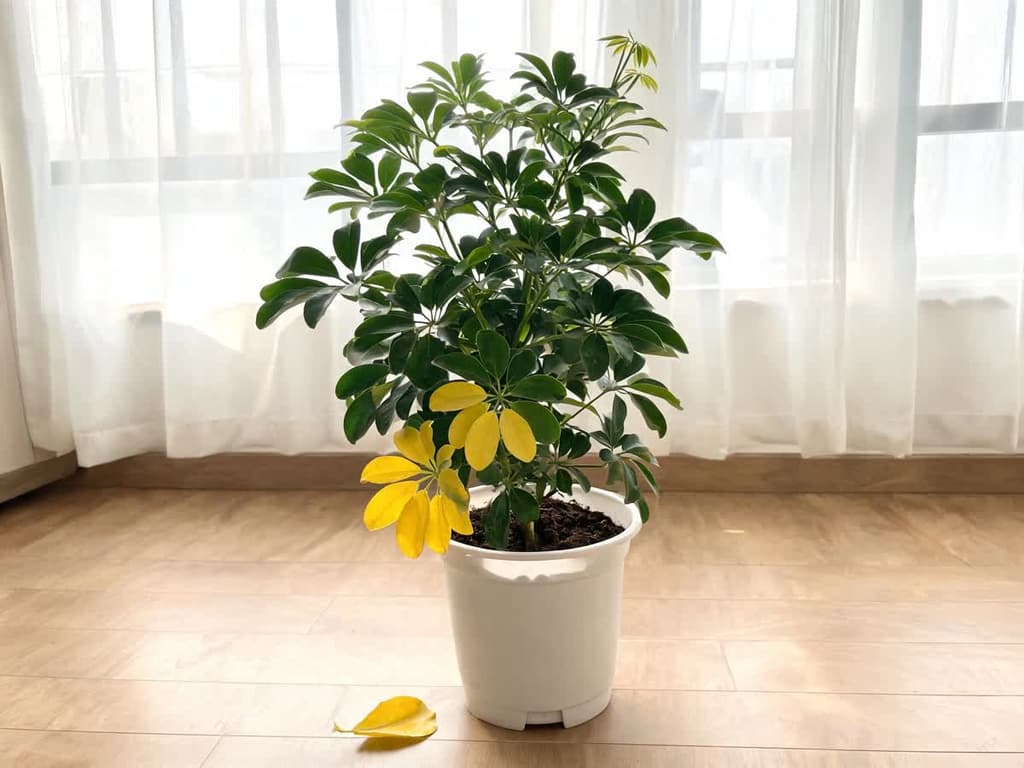
A schefflera with yellow leaves can be saved in most cases. If only one or two lower leaves turn yellow at a time and the top keeps pushing out new leaves, the plant is shedding old leaves. The schefflera, as it is also called, requires action when many leaves turn yellow and drop in the same week. It also requires action when the entire plant turns pale green or when yellow speckles appear on the leaf.
What decides the cause is which leaf turned yellow, the pattern of the yellowing, and what happened to the plant over the past few weeks.
Quick summary:
One or two old leaves turning yellow on a growing plant is normal leaf shedding (Iowa State Extension).
Wet soil and many yellow leaves dropping point to overwatering. NC State Extension warns that overly dry soil also causes schefflera leaves to drop.
An entire pale green plant in winter is cold soil, below 60 °F (15.5 °C). In this case, the color returns on its own about 2 weeks after the soil warms up (UF/IFAS).
Yellow speckles across the leaf indicate spider mites or bacterial leaf spot. The underside of the leaf shows which one it is.
A yellow or cream band that was already on the leaf when it opened belongs to the variegated variety, not a symptom.
Which schefflera you have
Two different plants share the name cheflera in Brazil, and in English both appear as "umbrella tree," with the potted one also called "umbrella plant." The potted one, more common indoors, is Heptapleurum arboricola: a shrub with 7 to 9 small leaves (the leaflets) attached in a circle at the end of each leaf stalk (NC State Extension). The other is Heptapleurum actinophyllum, with large, glossy leaves, which becomes a tree outdoors.
Both were moved to the genus Heptapleurum. The older name, Schefflera, is what still appears on store tags.
This guide applies to both and notes when a piece of information applies to only one. The dwarf umbrella tree also has variegated varieties, born with leaves splashed with yellow or cream. They have their own section below.
Schefflera with yellow leaves: diagnosis in a table
Look first at which leaf turned yellow, then at the yellow pattern, and only then adjust watering, location, or fertilizer.
What you see | Where it appears | One-minute test | Likely cause | What to do |
|---|---|---|---|---|
One or two completely yellow leaves at a time | Older leaves, at the bottom and in the interior | Are there fresh, green leaves emerging at the branch tips? | Natural leaf turnover (normal) | Nothing. Pick up the leaf when it drops |
Many yellow, limp leaves dropping | Lower leaves first, then the rest | Is the soil moist 3 cm (1.2 in) below the surface? | Overwatering, roots suffocating | Stop watering and inspect the roots |
Yellow, dry leaves dropping, soil hard | Entire plant | Is the soil dry all the way down and pulling away from the pot's edge? | Underwatering | Water until it runs out the drainage hole |
Heavy leaf drop in the weeks after bringing it home or moving rooms | Entire plant | Is the new spot darker or colder than the previous one? | Sudden shift in light or temperature | Move to a bright spot and wait for new leaves |
Entire plant turns pale green leaning toward yellow | All leaves, in winter | Does the potting mix get cold overnight, near glass or on a cold floor? | Cold soil (below 15.5 °C / 60 °F) | Move away from the glass and wait |
Leaves yellowing with thin, stretched stems | Any leaf | Is the space between leaves along the stem wide? | Low light | Move closer to a bright window |
Pale or yellowish speckles and fine webbing | Any leaf, mostly on the underside | If you tap the leaf over white paper, do tiny crawling specks fall off? | Spider mites | Treat as a pest |
Yellowish to beige 1 mm specks, no webbing | Any leaf; lower leaves may yellow completely | Does the back of the spot feel rough to the touch? | Bacterial leaf spot | Remove affected leaves and keep foliage dry |
Yellowed leaf with white fluff or brown bumps | Where the leaf stalk meets the stem, underside of leaf | Does the bump scrape off with a fingernail? Is the leaf sticky? | Scale or mealybugs | Treat as a pest |
New leaf with brown edges | New leaves | Is there a white crust on the soil or fertilizer piled on one side? | Fertilizer burn | Flush the soil with plenty of water |
Tall, spindly, pale-green plant with no spots | Entire plant | Has the plant gone months without fertilizer and shows no spots? | Lack of fertilizer | Resume fertilizing |
The rows on cold soil, bacterial leaf spot, salt, and fertilizer come from the University of Florida research note on schefflera production, RH-91-31 (UF/IFAS). The original page went offline and is preserved on the Internet Archive. The rows on relocation and leaf shedding come from Iowa State Extension.
Lower leaves turning yellow and dropping: when it is normal
The University of Wisconsin Extension explains that the plant gets rid of old leaves that no longer produce much and directs its energy toward new ones (Wisconsin Extension). On a schefflera, new leaves emerge at the tip of the branch, while the oldest leaves remain at the bottom and in the interior of the plant.
Iowa State considers it normal when only a few leaves drop, provided they are older interior leaves and the rest of the plant looks healthy. They advise not worrying in that situation.
The confirming test is to inspect branch tips. Are there new, green, firm leaves coming in? Is the yellowing limited to just one or two lower leaves? If so, do not alter watering or fertilizer.
Changing your watering routine because of a single old leaf often creates a real problem. Watering less, then more, and then less again leaves the root system alternating between drought and waterlogging for weeks.
In a palm tree, a normal old leaf turns yellow, dries out in a few days, and drops. The test is the same for both plants: yellowing only on old leaves, with new leaves emerging, is normal shedding.
Schefflera with too much or too little water: the finger test
The NC State Extension notes that schefflera leaves drop if the soil is too wet or too dry (NC State Extension). To find out which of the two mistakes occurred, look at the soil.
Insert your finger into the soil down to 3 cm (1.2 in) before deciding on any action:
Moist soil, yellow and limp leaves falling: overwatering. The roots suffocate and begin to rot. Withhold water until three-quarters of the potting mix dries out.
Soil dry all the way through, yellow and dry leaves: underwatering. Water slowly until liquid drains from the bottom hole, and discard any runoff collected in the saucer.
Check the cachepot as well. If it lacks a drainage hole, runoff pools at the base, leaving the roots submerged. Take the pot out of the cachepot 15 minutes after watering and pour out any standing water.
If the soil has stayed soggy for weeks, pull the plant from its pot and check the roots. Healthy roots are firm and pale. Rotted roots are dark and mushy, and their outer layer slides off in your hand:
Trim the rotted roots with clean shears and repot in fresh, well-draining soil, in a pot only slightly larger than the root ball. The general rule for watering and yellowing patterns, which applies to any potted plant, is in the guide to yellow leaves.
Schefflera losing leaves after moving
A wave of yellow leaves dropping in the weeks after bringing a plant home is a response to changing light levels. Iowa State Extension reports that a plant sheds leaves when moved quickly from a bright spot to a darker one. UF/IFAS notes that scheffleras are grown under 47% to 55% shade, receiving roughly 5,000 to 7,000 foot-candles (54,000 to 75,000 lux). That is far more light than reaches the center of an indoor living room.
Iowa State points to drafts as another cause of drop. Doors, windows, and hot or cold air vents make the temperature rise and fall near the plant. The gap between the window and the curtain changes drastically in temperature from day to night. NC State advises keeping large scheffleras away from cold drafts and hot air vents (NC State Extension).
What to do: place the plant near a bright window, with light filtered by a sheer curtain, away from doors and air conditioning. In Brazil, the brightest window faces north. After that, do not move the plant again. The leaves that have already turned yellow will drop, and recovery shows when new leaves emerge green.
Pale green schefflera in winter: cold soil
The schefflera turns completely light green, leaning toward yellow, when the potting soil cools below 15.5 °C (60 °F). Cold roots cannot absorb iron, manganese, copper, and zinc from the soil, even if they are present. It requires no treatment, according to the research note from UF/IFAS. The plant turns green again about 2 weeks after the soil exceeds 18 °C (65 °F) (UF/IFAS).
This is the only case in the chart where yellowed foliage turns green again. For that reason, fertilizing in winter to "fix the color" does nothing: the issue is root temperature.
In Brazil, winter runs from June to August. In the South and Southeast, the soil of a pot placed against glass or set on a cold floor can spend the night below 15.5 °C. Clemson Extension recommends nights above 15.5 °C (60 °F) for schefflera. It advises keeping the plant above 10 °C (50 °F) at all times, because severe cold leaves dead areas on the leaf a few days later (Clemson Extension). Dead spots from cold do not recover.
Move the pot away from the glass at night and place a wooden or cork trivet beneath it to isolate it from cold flooring. In cool weather, the plant drinks less: water only when three-quarters of the potting mix has dried out.
Yellow speckles on the leaf: spider mites, scale, or bacterial leaf spot
Twospotted spider mites, mealybugs, and armored scale can be a serious problem on the dwarf umbrella tree, according to NC State Extension. All three suck sap from the leaf. Bacterial leaf spot also starts with tiny yellow speckles, and its treatment is different.
Spider mites. The affected leaf begins to turn yellow or becomes stippled with light spots, according to UF/IFAS. Heavy infestations produce fine webbing, cause leaf drop, and can kill the plant. Webbing on the underside of the leaf is often mistaken for dust. Hold a white sheet of paper under the leaf and tap it a few times. If walking specks fall off, you have spider mites.
Scale and mealybugs. Mealybugs look like white cottony clumps where the leaf stem meets the main stem and on the underside of the leaf. Scale insects look like small, hard brown bumps stuck to the stem. Both leave the leaf sticky. Treatment for all three pests, with dosage and application intervals, is in the guide to indoor plant pests.
UF/IFAS notes that the umbrella tree (Heptapleurum actinophyllum) is one of the foliage houseplants most prone to pesticide damage. Before spraying the entire plant, test the product on a single leaf and monitor it for one day.
Bacterial leaf spot. The bacterium Xanthomonas causes tiny yellow to tan speckles, nearly all about 1 mm in size, scattered across the leaf. The edge of the lesion is raised, and the underside of the leaf takes on a corky appearance. When the attack is severe, the lower leaf turns entirely yellow and drops (UF/IFAS).
The same research note describes another bacterium, Pseudomonas, which primarily attacks leaf margins on dwarf umbrella trees. The lesion begins small with a water-soaked look, spreads quickly, and turns black. Against both bacterial pathogens, UF/IFAS reports that chemical sprays provide minimal benefit. What works is pruning off diseased leaves, directing water straight to the soil rather than the foliage, and avoiding misting the plant.
Variegated schefflera: natural yellow is not a disease
Variegated dwarf umbrella trees emerge with yellow or cream already on the leaf. NC State Extension lists these varieties as cultivars of the species rather than a problem: 'Gold Capella' has green leaves with yellow or gold, and 'Trinette' has green leaves with cream (NC State Extension).
The test is to compare emerging growth with mature foliage. On a variegated specimen, new leaves emerge from the bud already displaying sharp yellow or cream zones, remaining firm and glossy. With a problem, an initially green leaf gradually loses pigment following the patterns in the table, frequently softening or dropping off.
A variegated schefflera can also develop symptom-driven yellow leaves. When evaluating one, focus on the green portions of the leaf: if the green tissue fades, refer to the diagnostic table.
Schefflera fertilizer: deficiency versus excess
A tall, thin, pale green schefflera with no spots at all usually lacks fertilizer. UF/IFAS also describes the opposite: dark green, soft, and wilted leaves are a sign of too much fertilizer (UF/IFAS).
Excess fertilizer salts accumulating in the potting mix show up on NEW schefflera leaves as scorched brown margins, and they can destroy parts of the root system. The same report points out that this frequently occurs right under slow-release fertilizer granules heaped on one side of the container. On an anthurium with yellow leaves, fertilizer salts present differently: as brown tips on the lower foliage.
To leach out excess salts, water thoroughly in repeated cycles until the total water applied matches a depth of 5 to 10 cm (2 to 4 inches) over the soil surface. Let every bit drain out the bottom. Always scatter slow-release fertilizer evenly across the surface rather than dumping it in one spot.
Is the schefflera dead? The scratch test
A schefflera that has lost almost all its leaves can still be alive, and you can check in one minute. NC State Extension teaches two tests to tell if a tree is alive. They work for the schefflera, which has a woody stem (NC State Extension):
Scratch the stem. Using a fingernail or a knife edge, gently scratch the outer bark of a branch. Green tissue right under the surface means that section is alive.
Bend a thin branch. Live wood bends smoothly. A branch that snaps cleanly on the spot is dead.
Start testing at the branch tips and work your way downward. Sections showing green underneath will sprout again, while dead, dry wood can be pruned back to where green tissue starts.
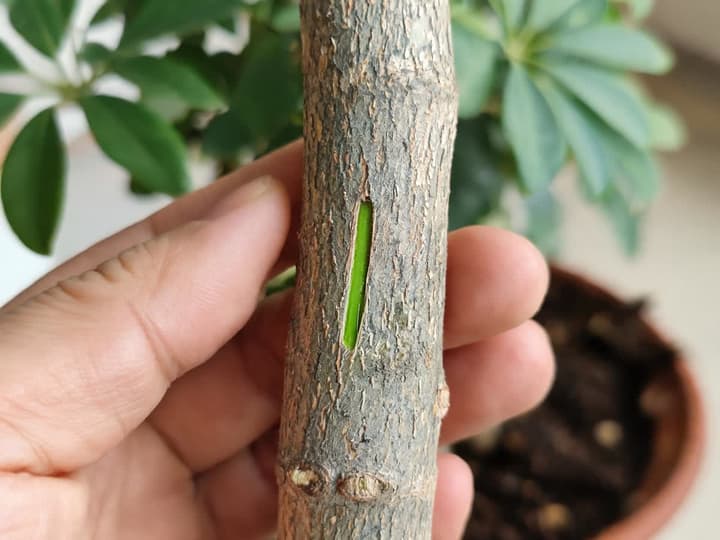
With a green stem, recovery comes down to addressing the root cause: light, watering, or cold from the table. Fresh leaves will only appear weeks after conditions are corrected.
Should I cut yellow leaves off a schefflera?
You can take off any leaf that is 100% yellow: outside of cold-soil recovery, it will not turn green again. Leaves retaining green portions still generate energy for the plant, so leave them in place. Give a completely yellow leaf a gentle tug; if it holds firm, slice the petiole flush with the main stem using clean pruning shears.
Leaves with bacterial spots are the exception: clip and discard them immediately, and wipe shears with rubbing alcohol before moving to another plant.
Pick up fallen leaves from the floor if you have a cat or dog at home. Schefflera is toxic to both. Chewing the leaves releases calcium oxalate crystals and causes intense oral irritation, drooling, difficulty swallowing, and vomiting (NC State Extension).
When your leaf symptoms do not fit the chart, a detailed close-up photo helps you compare against verified diagnoses. The photo diagnosis tool inside Bloom, included with the Premium plan, runs that comparison. And if you are not entirely sure the plant is a schefflera, start with the guide on what is wrong with your plant.
Frequently asked questions
Will a yellow schefflera leaf turn green again?
In most instances, no: leaves yellowed by watering issues, poor light, pests, or old age drop off and get replaced by new foliage. The exception is winter yellowing caused by chilled soil. According to UF/IFAS, the whole plant returns to green roughly 2 weeks after soil temps rise past 18 °C (65 °F), without any additional treatment.
How often should you water a schefflera?
Water whenever three-quarters of the potting medium dries out, not on a set calendar day. Pour slowly until water drains out the base holes, and empty the drip saucer. Intervals become shorter during summer and stretch out significantly during cold winter months.
What does an overwatered schefflera look like?
Many yellow, limp leaves dropping, starting with the bottom foliage, paired with soil that stays wet 3 cm (1.2 in) deep. The roots turn dark and mushy. Leaves wilt despite saturated soil because damaged roots can no longer pull up moisture.
How do you revive a dying schefflera?
Scratch the branch bark: if tissue underneath is green, the plant remains alive. Prune back brittle, dead stems to healthy green wood. Then resolve the issue using the table, providing bright indirect light, watering strictly when three-quarters of the soil is dry, and protecting it from cold. Fresh leaves will show up several weeks later.
What to do today for a schefflera with yellow leaves
Check the soil 3 cm (1.2 in) down and inspect the branch tips before altering your routine. Damp soil alongside widespread leaf drop signals watering troubles. A single yellowing lower leaf with fresh buds growing up top is normal leaf turnover. Fine speckling on foliage means checking the leaf undersides against a white sheet of paper.
Related articles
How to Care for a Maidenhair Fern: Light, Water, and Revival Tips
Learn how to care for a maidenhair fern indoors: bright indirect light, consistently moist soil, high humidity, and how to revive it if it dries out completely.
How to Propagate Spider Plants: Root the Pup Before Cutting
The safest spider plant cutting comes from a pup still attached to the mother plant: rest the plantlet on soil in a small pot, wait for roots to establish, and only then cut the stolon. Learn when the pup is ready, whether rooting in water is worth it, how to divide the clump, and why plants fail to produce babies.
Banana plant fertilizer: fertilizing potted and backyard plants
Banana plant fertilizer needs more potassium than nitrogen, in a 3-1-6 ratio. For a potted plant on a balcony, use the label dose in spring and summer. In the backyard, fertilize every 2 months, adjusting the amount by mat age. Learn the formula, timing in Brazil, and signs of deficiency or excess.