Rose Pests: How to Treat Aphids in Four Steps
Rose aphids attack buds and tender new shoot tips, so the damage is deformed flowers, not yellow leaves. Here is how to confirm them and what to do, from a water spray to neem oil.
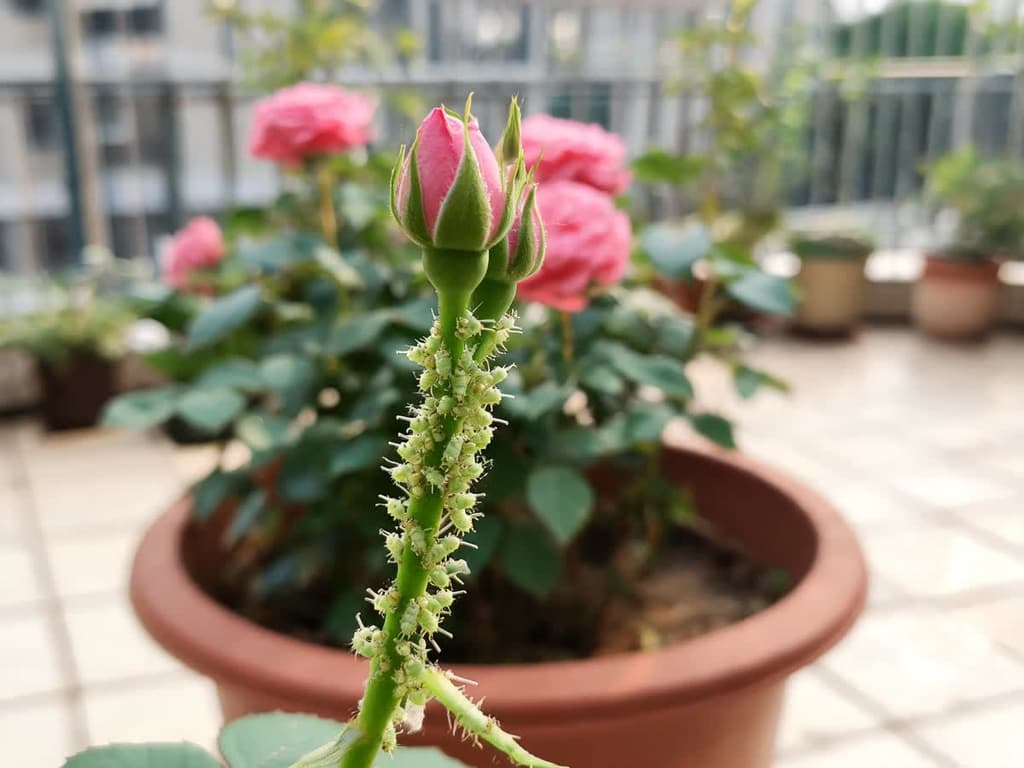
Among rose pests, aphids are the most common and the most alarming to see. Hundreds of green or pink insects cluster on the tip of fresh new shoots, appearing in just a few days. Aphids on roses ruin the bloom rather than the plant itself: an established bush will survive a heavy infestation and push out new growth.
What you decide now determines how much of this season's flowering you want to save. The right approach is to start with the gentlest method and only increase the intensity if that falls short.
Quick summary:
Rose aphids cluster at shoot tips and on closed buds. That is why a spray of water works: the target is completely exposed.
Leaves already deformed by aphids will not return to normal. Treating early is what protects buds that have not opened yet.
Insecticidal soap is not dish soap. Dish soap under strong sun burns rose foliage.
Broad-spectrum insecticides kill ladybugs and hoverflies alongside aphids, which often leads to a spider mite outbreak.
How to tell it is aphids on your rose and not another pest
The rose aphid is the species Macrosiphum rosae. They are soft-bodied, pear-shaped insects, about 3 mm long, green or pink, always clustered together. Clemson Extension describes the exact place where they settle: the new growth. That means the buds, young leaves, and tender new stems.
Three signs confirm the diagnosis without a magnifying glass. The first is location: clusters sit on the final 10 cm of the cane, never on older lower leaves. The second is honeydew, a sugary, sticky liquid secreted by aphids that leaves foliage feeling shiny and tacky to the touch. The third is sooty mold, a fine black fungus that grows on honeydew and wipes away with a damp cloth.
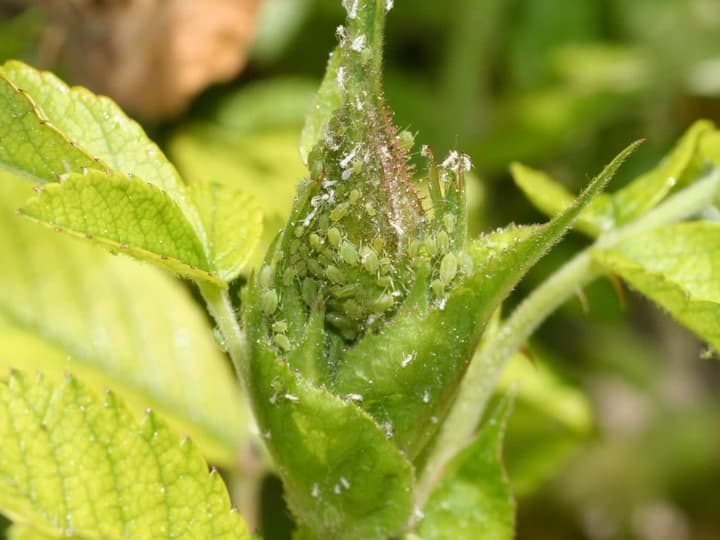
Ants running up and down the cane provide a fourth, indirect sign. They do not eat aphids: they harvest the honeydew.
What aphids actually ruin on a rose bush
The primary casualty of aphids is the flower. Under high populations, their feeding distorts buds and reduces the size and quantity of open blooms, according to Clemson Extension. New shoots grow crooked, and young foliage curls.
Leaves that emerge curled or twisted will not return to their normal shape after treatment; they stay that way on the plant until they drop. Treating today will not straighten damaged growth: it preserves unopened buds.
Aphids do not cause yellow leaves on roses. Yellowing stems from other factors, and some require opposing treatments. When diagnosing yellow rose leaves, look at two things: leaf position on the bush and any accompanying symptoms.
Is it worth treating, or can you do nothing?
In many cases, doing nothing is the right approach. The University of Maryland Extension is direct: aphid outbreaks do not always call for intervention, and outdoors nature usually resolves them on its own. Low populations cause minimal damage.
The window in which aphids are truly a problem is short. In California, the UC Statewide IPM Program records about six weeks in spring and early summer. After that, extreme heat causes the population to drop.
Three questions will make the decision for you. Is the rose blooming or about to bloom? Are clusters covering more than half of the new shoots? Do you see ladybugs, hoverfly larvae, or lacewing larvae on the plant? Hoverflies are striped flies that resemble small bees, and lacewings have delicate, transparent wings. If the first two answers are yes and the third is no, treat. Otherwise, watch the plant for a week before buying anything.
Rose aphid treatment, from gentlest to strongest
The four steps below build on each other. Only move up a step when the previous one fails to check the infestation after two attempts.
1. Strong water spray on the shoot tips. Use a hose nozzle with steady pressure and aim right at the clusters, including the undersides of young leaves. UC IPM recommends doing this early in the day so foliage dries before nightfall. Aphids knocked to the ground cannot climb back up. Repeat every two to three days as long as you spot clusters.
2. Prune heavily infested tips. When a cane is smothered from the bud down 15 cm, snip off that section and throw it in the trash, not the compost or garden bed. Clemson Extension includes trimming off infested tips as part of management. Limit this to two or three stems per bush: over-pruning removes the very blooms you are trying to save.
3. Insecticidal soap. This is a contact insecticide: it only kills aphids directly hit by droplets, with no residual effect once dry. Clemson Extension recommends a 1% to 2% concentration and advises repeating the application three times, spaced 5 to 7 days apart. Never spray in direct sunlight or above 32 °C (90 °F): apply in the late afternoon.
4. Neem oil. Use this when insecticidal soap did not hold up after three applications. Neem is also a contact insecticide and appears on the Clemson Extension product list for aphids on roses. Its active ingredient is azadirachtin, which degrades quickly on the leaf. According to the National Pesticide Information Center, its half-life is 1 to 2.5 days. Half-life is the time it takes for half of the product to break down.
Tighter schedules for insecticidal soap do exist, with two or three days between applications. This article follows Clemson Extension's 5 to 7 days, which is the published recommendation for roses. Its list of active ingredients is for the United States, and in Brazil, agricultural pesticides are registered by the Ministry of Agriculture. Check the label before buying to see if the product indicates use in home gardens, and follow the dosage on the Brazilian packaging.
Insecticidal soap is not dish soap
Commercial insecticidal soaps are made of potassium salts of fatty acids, which is stated on the label. They kill by suffocation and by stripping away the protective wax coating on the insect's body.
Dish detergent is a different matter. Clemson Extension notes that powdered dish detergents and all laundry detergents are too harsh for the plant. The additives they contain are to blame. The same page goes beyond powdered detergent. It states that some soaps and detergents are poor insecticides, and that the additives in these products can be phytotoxic. Phytotoxic means it damages plant tissue.
Penn State Extension has an entire page on home remedies, listing four problems. They do not come with instructions for use, they may not work, they can harm people, animals, and plants, and their use may be illegal. Regarding dish soap, the text is specific: spraying plants with a detergent-based recipe on a sunny day can burn the plant.
If you decide to use insecticidal soap, spot test first. Clemson recommends spraying a single cane and waiting 24 hours to watch for damage before treating the entire shrub.
Can you treat roses with cats or dogs around?
Yes, with two precautions. Insecticidal soap and neem oil are contact sprays without residual activity. When used according to the label, they carry low toxicity to people, pets, and pollinators.
The word "natural" on a label does not mean harmless to cats. The National Pesticide Information Center documents cases where neem was applied directly to cats for flea control. Reactions included excessive salivation, tremors, impaired movement, and convulsions, with some fatalities. Most animals recovered within 1 to 5 days. These instances involved direct application onto the animal, not a cat walking past a treated bush.
Spray in the late afternoon and keep cats and dogs away from the planting bed until foliage is dry to the touch. Late afternoon applications also reduce pollinator exposure, which Clemson recommends for any spraying on flowering plants.
Why aphids return after a water spray
Aphids returning several days after being sprayed off is normal behavior for this pest. Female aphids give birth to live young without mating, and in summer warmth a single generation completes in just one to two weeks. A handful of survivors will rebuild the colony within days.
Ants speed up this return. University of Maryland Extension describes ants herding aphids like livestock, patrolling the colony and defending it against predators. A practical tactic is to knock off the ants first with water or by shaking the branch before tackling the aphids.
Aphids do not target roses exclusively: they attack vegetables, shrubs, vines, and houseplants, always targeting soft new growth. The complete pest lifecycle is explained in our guide to aphids on plants.
The ladybugs you do not need to buy
Ladybugs work for free, and buying them is usually wasted money. Clemson Extension cautions against buying them. Commercially sold ladybugs are collected while overwintering; they arrive disoriented and quickly fly off in search of a new hibernation spot. The effective route is attracting beneficials already in your area.
Attracting them means, in practice, not killing them. UC IPM lists parasitic wasps, ladybugs, soldier beetles, and syrphid flies as natural enemies of rose aphids. All of them perish under broad-spectrum insecticides, which target many insect species simultaneously.
Broad-spectrum treatments carry a measurable cost. UC IPM notes that applications of carbaryl or pyrethroids frequently trigger a surge in spider mite numbers. The spray eliminates natural mite predators. You fix today's aphids only to purchase next month's spider mites.
When you are unsure what bug is on your plant, a photo solves it faster than any written description. Bloom identifies plants from photos, and disease diagnosis via image is included in Premium. The app is available on iPhone. To address the issue by symptom rather than pest, start with what is wrong with my plant.
When aphids appear on roses in Brazil
The six peak weeks fall in spring, which in Brazil runs from September to November. Strong rose budding occurs during this period, and aphids depend on it. The heat from December to February brings the population down, and the cold from June to August halts new growth in the South and Southeast.
The month of the year predicts less than the condition of the plant. UC IPM notes that aphids prefer fast-growing tissue, such as buds and shoots. The monitoring that works is based on events, not months. Check the tips of the canes the week after every pruning and every fertilization. Both trigger new growth.
In northern and northeastern Brazil, where roses do not drop their leaves in winter, there is no off-season. Inspection there is a year-round task tied directly to flushes of new growth.
Too much nitrogen fertilizer triggers this out-of-season flushing. Excess fertilizer produces tender, succulent growth, which is precisely the tissue aphids seek. Application rates and timing for each type of rose are covered in our guide on how to care for roses.
Other rose pests in one minute
Aphids account for most cases, but four other pests appear on roses in Brazil. Each has a sign that sets it apart from the rest.
Pest | Identifying sign | Where to look |
|---|---|---|
Two-spotted spider mite | Light stippling on the upper leaf surface and fine webbing | Underside of the leaf, in hot and dry weather |
Thrips | Streaked or brown-flecked petals, distorted flowers | Inside open blossoms |
Scale | Immobile, crusty bumps, white or brown, no visible legs | Woody canes and branch crotches |
Vaquinha beetle | Round holes chewed into petals of open flowers | On open blooms during warm days |
Two-spotted spider mites are most often confused with aphids, yet they are significantly smaller: about 0.5 mm (1/50 of an inch), according to Clemson Extension. They do not form visible clusters and do not secrete honeydew. Treatment also differs: UC IPM warns that broad-spectrum insecticides cause spider mite populations to flare rather than drop. Our guide on spider mites outlines complete management.
Thrips are yellowish-brown insects under 1.6 mm long with fringed wings, and they feed on flowers rather than leaves. UC IPM notes that damage is most severe on pale, fragrant roses grown in crowded plantings. Scale insects stand out for their immobility, resembling hard scabs encrusted on the cane.
The cucurbit beetle is the beetle that bores holes into the open flower. The most common species in Brazil is Diabrotica speciosa. Embrapa describes the adult as green, 5 to 7 mm long, with three oval yellow spots on each forewing. Pick them off by hand, one by one, right on the flower.
Miniature roses sold in small pots often arrive from the greenhouse carrying pests. Check new shoot tips and isolate newly purchased pots away from other plants for one to two weeks. This is the quarantine window outlined in indoor plant pests. Patio olive trees face similar challenges with scale and thrips: see olive tree pests.
Frequently asked questions
What is the most effective product for rose aphids?
There is no single magic spray. For light infestations, a blast of water solves the issue at zero cost. For moderate numbers, Clemson Extension recommends a 1% to 2% insecticidal soap spray, repeated three times at 5- to 7-day intervals. Neem oil serves as the next step if soap does not hold them back.
Does vinegar kill aphids?
No university extension recommends using vinegar against aphids. Vinegar is acetic acid, used commercially as an herbicide, and it damages the tissue of any plant it coats. On roses, the risk of scorching foliage and buds far outweighs any benefit.
How do you get rid of rose aphids for good?
You do not eliminate them permanently. Aphids return with every new growth flush because they rely on soft, tender tissue to feed. In warm weather, a generation matures in one to two weeks. The realistic goal is keeping numbers low during the six-week spring peak.
Is this treatment safe for cats?
Insecticidal soap and neem oil show low toxicity to pets when applied according to the label. Keep cats away from garden beds until foliage has dried completely to the touch. Neem applied directly onto an animal's coat is an entirely different issue and has caused severe reactions in cats.
What to do right now
Head out to your rose bush and check the last 10 cm of three canes. If you see clusters of green or pink bugs on the buds, blast them with water tomorrow morning and repeat two days later. If after two rounds the clusters reappear at the same size, step up to a 1% or 2% insecticidal soap spray. Apply in the late afternoon, three times, with 5 to 7 days between treatments.
Leave ladybugs alone throughout the entire process. Soap and neem cease activity as soon as they dry, allowing beneficial predators to keep hunting aphids undisturbed afterward.
Related articles
How to Care for a Maidenhair Fern: Light, Water, and Revival Tips
Learn how to care for a maidenhair fern indoors: bright indirect light, consistently moist soil, high humidity, and how to revive it if it dries out completely.
How to Propagate Spider Plants: Root the Pup Before Cutting
The safest spider plant cutting comes from a pup still attached to the mother plant: rest the plantlet on soil in a small pot, wait for roots to establish, and only then cut the stolon. Learn when the pup is ready, whether rooting in water is worth it, how to divide the clump, and why plants fail to produce babies.
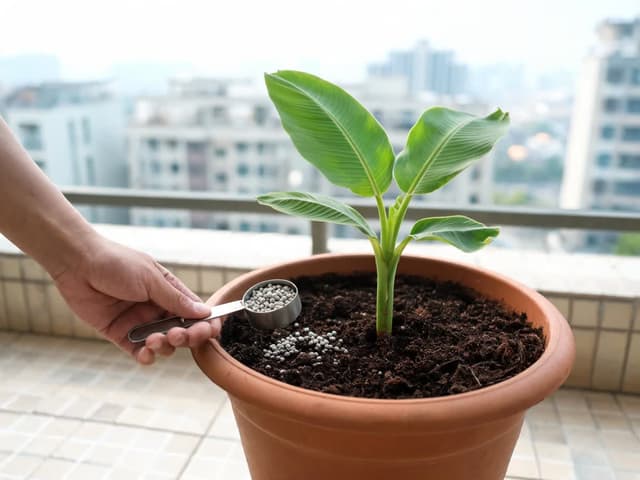
Banana plant fertilizer: fertilizing potted and backyard plants
Banana plant fertilizer needs more potassium than nitrogen, in a 3-1-6 ratio. For a potted plant on a balcony, use the label dose in spring and summer. In the backyard, fertilize every 2 months, adjusting the amount by mat age. Learn the formula, timing in Brazil, and signs of deficiency or excess.