Pothos Fertilizer: What to Use, How Much to Dilute, and When to Stop
Use balanced houseplant fertilizer at the label dose every 2 months from September to May, and stop from June to August (winter in Brazil). Learn dilution rates, why fertilizer cannot fix a pothos in the dark, and what DIY recipes actually deliver.
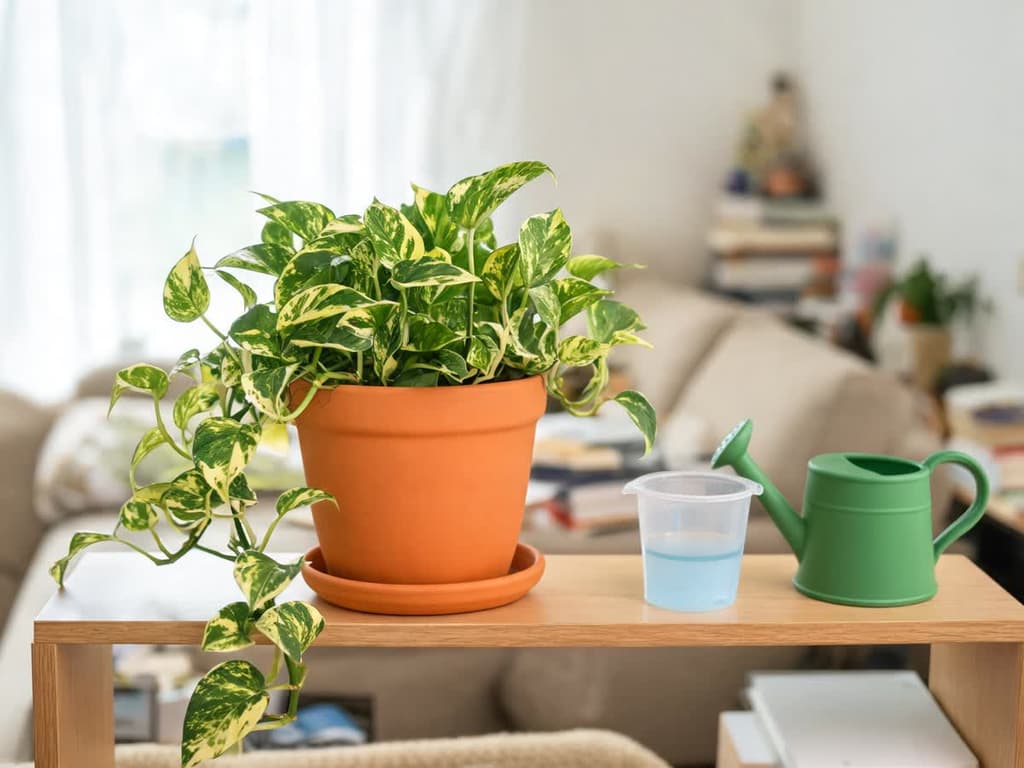
The best fertilizer for pothos (Epipremnum aureum) is a balanced houseplant fertilizer, such as a 10-10-10 or 20-20-20 NPK, at the label dose. Apply every 2 months while the plant is growing, from September to May in Brazil. Stop fertilizing in winter, from June to August. NC State and the University of Wisconsin recommend fertilizing every 2 months, except in winter.
Fertilizer only works if your pothos receives enough light. A pothos sitting stalled in a dark corner stays stalled with fertilizer, and the leftover salt in the soil burns the tips of its leaves.
Quick summary:
Liquid fertilizer for indoor plants: label dose, every 2 months, from September to May (spring, summer, and fall in Brazil).
General-purpose fertilizer formulated for gardens: use half or a quarter of the label dose.
Do not fertilize from June to August (winter in Brazil), or during the first 4 weeks after buying the plant.
Yellowing old leaves are a sign of improper watering. A smaller new leaf, or an entirely pale plant, can indicate a lack of fertilizer, but check light levels first.
Coffee grounds, eggshells, and rice water do not replace fertilizer.
A white crust on the soil or along the rim of the pot can indicate accumulated fertilizer salts: flush the soil with a large volume of plain water.
A pothos is the heart-shaped vine you likely have trailing in your home:
What is the best fertilizer for pothos
Pothos grows well with a balanced fertilizer that provides nitrogen, phosphorus, and potassium in similar ratios. These three nutrients make up the NPK on the label. The three numbers on the packaging tell you how much of each nutrient the product contains, as a percentage by weight. The order is always the same: nitrogen (N), phosphorus (P), and potassium (K). A 10-10-10 fertilizer has 10% of each.
University extensions recommend a complete fertilizer, which provides nitrogen, phosphorus, and potassium. The University of Illinois Extension recommends 10-10-10 or a 1:2:1 ratio, such as 5-10-5 and 10-20-10. The same extension tells you never to use a mix stronger than the label indicates. Clemson recommends 20-20-20 for foliage plants.
Commercial growers of pothos use more nitrogen than phosphorus. UF/IFAS, from the University of Florida, recommends 3:1:2 or 3:1:3 ratios to growers. The 3:1:2 ratio is for nursery production. For a pothos in the home, the extension services above recommend 10-10-10, 1:2:1, or 20-20-20. The ratio changes from plant to plant: a palm planted in the garden requires a formula rich in potassium and magnesium, quite different from a potted pothos.
The physical form of the fertilizer changes the risk of misjudging the dose:
Liquid or soluble powder: you dilute it in your watering can. Clemson prefers this format for houseplants because the diluted solution lowers the risk of burning roots.
Slow-release granules: these pellets release fertilizer gradually. According to Illinois, most last 3 to 4 months in a pot.
Standard garden granules: these were formulated for garden beds, where plants grow faster. In a pot, the label dose is too strong for pothos.
Can you use NPK on pothos?
Yes. NPK refers to any fertilizer containing nitrogen, phosphorus, and potassium, and this is precisely the type extension services recommend for pothos. The key lies in the dosage, which depends on the type of product. If the NPK product is made for houseplants, use the label dose. If it is a general-purpose fertilizer, such as a granular 10-10-10 garden fertilizer, use half or a quarter of that dose, as Iowa State notes.
How much fertilizer to use on pothos: dosage matters just as much as frequency
Fertilizing every 2 weeks with a diluted dose can deliver less fertilizer than feeding every 2 months with a full dose. That is why extension service recommendations appear more divergent than they actually are:
Source | How often | At what dosage |
|---|---|---|
NC State (pothos) | Every 2 months, except in winter | Not specified |
University of Wisconsin (pothos) | Every 2 months, except in winter | Not specified |
Clemson (pothos) | Every 2 months, in spring and summer | Not specified |
Penn State (pothos) | Every 2 weeks; once a month in winter | Not specified |
Clemson (indoor plants) | Every 2 to 3 months | Label dose |
Clemson (indoor plants) | At every watering during the growing season | One-tenth of the label dose |
Illinois (tropical plants) | 2 to 3 times during the growing season | Half of the label dose |
Iowa State (houseplants) | Only during the growing season | Label dose for houseplant fertilizer; half or a quarter for general-purpose fertilizer |
Iowa State explains the dosage difference between the two types of products. The label on general-purpose fertilizer was written for garden plants, which grow faster than houseplants.
This guide follows NC State and Wisconsin: label dose of a houseplant fertilizer every 2 months. Clemson recommends the same interval for pothos. The reason for choosing the longer interval is excess salt. According to Wisconsin, surplus fertilizer leaves salts in the soil, and these salts blacken leaf edges and tips. Penn State fertilizes more frequently but does not state the dosage, so the two regimens cannot be compared directly.
Pick one of the two methods and stick to it. If you prefer to fertilize with every watering, use one-tenth of the label dose, as Clemson outlines. In that case, skip the bimonthly feeding. Combining both methods supplies too much fertilizer.
When to fertilize pothos in Brazil
Fertilize your pothos from September to May, the phase when it grows in Brazil. Stop from June to August, which is winter in the Southern Hemisphere. The sources for this guide are from the United States, where winter runs from December to February. That is why the calendar here is inverted compared to theirs. The sources also diverge on the end of the season. Clemson cites only spring and summer for pothos. Illinois cites March to September, which becomes September to March in Brazil. NC State and Wisconsin only exclude winter, and this guide follows both.
This pause serves two purposes. During the short days of winter, houseplants enter a rest period and use almost no fertilizer, according to Illinois and Clemson. In Florida nurseries, UF/IFAS reports that pothos slows its growth whenever night temperatures drop below 18 °C.
Penn State is the exception: it maintains feeding once a month in winter. This guide follows the seasonal pause, which is the recommendation from NC State, Wisconsin, Clemson, and Illinois. Fertilizer that the plant cannot use turns into salts in the soil.
Has your pothos stopped growing: fertilizer or light?
For a stalled pothos, check the light before fertilizing. Light is measured in foot-candles, a unit used in the United States, or in lux. According to Clemson, a foliage plant only shows the effects of fertilizer with at least 200 foot-candles (about 2,150 lux) for 12 hours a day. At around 100 foot-candles (1,080 lux), the plant merely maintains itself without growing.
UF/IFAS provides the specific numbers for pothos. It survives on as little as 50 foot-candles (about 540 lux), but new leaves emerge small, and pothos varieties with yellow or white variegation lose their variegation. Starting at 150 foot-candles (about 1,600 lux), the plant maintains leaf color and size. These two numbers do not conflict: 150 maintains color, while 200 is what Clemson specifies for fertilizer to take effect.
The interior of a well-lit home typically measures under 100 foot-candles, according to Clemson. That is why a pothos scheduled for feeding must sit near a bright window, shielded from direct sun hitting its leaves. Illinois warns that excess fertilizer does the most damage specifically to plants that grow slowly due to insufficient light. Pothos prefers indirect light and cannot tolerate much direct sun, and the complete guide on how to care for pothos explains where to position your pot.
Slow growth also stems from issues other than light and nutrition, such as root-bound pots, pests, and root rot. The page on slow-growing pothos in Bloom's catalog lists 14 causes, each with its own treatment.
Sick or newly purchased pothos: wait before fertilizing
Do not fertilize a pothos that just arrived home. UF/IFAS recommends waiting around 4 weeks before fertilizing or repotting. The plant is already adjusting to a change in environment.
Fertilizer will not rescue a sick pothos either. Illinois recommends feeding only plants that are actively growing. The same extension service notes that applying fertilizer to a plant in dry soil burns roots. If leaves are turning yellow and dropping daily, the culprit is typically watering issues or root rot. Resolve the root cause first with the step-by-step instructions in our guide on pothos with yellow leaves.
None of the sources in this guide address pothos that has lost part of its root system. As a precaution, treat such a plant like a newly purchased one, following the rationale behind the UF/IFAS rule: do not stack one stress on top of another. Wait until new leaves resume sprouting before fertilizing.
How to tell if your pothos needs fertilizer
Examine which leaf changed color. Nutrient deficiency shows up on new leaves and across the entire plant, whereas improper watering appears on older leaves:
What you see | Likely cause | What to do |
|---|---|---|
Old leaves turning yellow, one at a time | Soil that is too dry or too wet (UF/IFAS) | Get the watering right before thinking about fertilizer |
New leaves that are smaller and have less yellow or white than the old ones | Low light, magnesium deficiency, or too little fertilizer (UF/IFAS) | First more light; then, fertilizer at the right time |
Entire plant pale, soil not waterlogged | Underfertilizing (Clemson) | Fertilize from September to May (in Brazil), at the label dose |
White crust on the soil or on the rim of the pot, brown tips | Fertilizer salt buildup (Clemson) | Stop fertilizing and flush the soil |
Burned patch only on the light part of the leaf | Strong light or heat (UF/IFAS) | Move out of direct sunlight |
The yellow streaks on common golden pothos and the uniformly chartreuse leaf of 'Neon' pothos are natural traits of the plant. They are not signs of nutrient deficiency or disease. If new leaves emerge smaller and display less yellow or white variegation than older ones, UF/IFAS points to three possible causes: low light, magnesium deficiency, or too little fertilizer.
When your symptom does not match any entry in the table, a photo helps isolate the cause. The Bloom app diagnoses plant health issues from a leaf photo on its Premium plan, available exclusively on iPhone.
How to make pothos look lush and bushy
Fertilizer cannot make a thin pothos bushy. The University of Wisconsin recommends potting several rooted cuttings (clipped stem sections that have already developed roots) together in the same container. Long, bare vines call for pruning. Penn State directs you to snip the vine with clean, sharp shears just above a node, the point on the stem where a leaf attaches. Find step-by-step rooting directions in our guide on how to propagate pothos.
How to fertilize pothos step by step
Use this routine with liquid or water-soluble fertilizer, from September to May (in Brazil):
Check the soil. If it feels dry, water thoroughly with plain water and fertilize during the next watering session. Illinois warns that applying fertilizer to dry potting mix burns the roots.
Measure the label dose using the packaging measuring cup or an oral syringe. General-purpose fertilizer takes half or a quarter of that dose.
Dilute the dose in the amount of water specified on the label. Using more water creates a weaker solution, never a stronger one.
Pour the solution over the soil, working around the base of the plant until runoff flows through the pot drainage hole.
Empty the drip tray once drainage stops, as Clemson recommends to prevent salt buildup.
Note the date. The next application comes 2 months later.
DIY fertilizer for pothos: what each recipe actually provides
No homemade recipe replaces a dedicated houseplant fertilizer. The recipes commonly seen in online videos for pothos include the following, along with the verified facts for each:
Recipe | What the evidence shows | Verdict |
|---|---|---|
Coffee grounds or coffee powder in the soil | A thick layer repels water and prevents it from penetrating the soil (Illinois). Fresh grounds are toxic to several plants (WSU). | Do not use it in the pot. Send it to the compost bin. |
Crushed eggshells | It takes 1 to 5 years to decompose, even crushed (Illinois). It delivers calcium, not NPK. | Does not fertilize in a useful timeframe. |
Cinnamon water with cloves | One teaspoon of cinnamon has 11 mg of potassium (USDA). No one has measured its effect on pothos. | Not a fertilizer. |
Peanut shells with charcoal | No one has tested the recipe on pothos. Charcoal is almost pure carbon, and none of the sources in this guide provide the nitrogen, phosphorus, or potassium that it or peanut shells deliver. | No evidence. |
Rice water | No one measured this in potted pothos. | No evidence. |
Banana peel | It provides potassium, but no one has measured how much actually reaches the plant. | No evidence. Belongs in the compost bin. |
Worm castings | Already decomposed organic matter. I found no trial using worm castings as the sole fertilizer for potted pothos. | No evidence as fertilizer. It does not replace indoor plant fertilizer. |
Coffee grounds. University of Illinois Extension warns that a thick layer of grounds forms a film that repels water. The same extension says there is little research on grounds changing soil acidity. Washington State University (WSU) adds that fresh grounds are toxic to several plants and compact the soil. Grounds contain nitrogen, but it only becomes available after soil organisms break them down. For this reason, both extensions send coffee grounds to the compost bin, not the pot.
Cinnamon and cloves. One hundred grams of ground cinnamon contain 431 mg of potassium, according to the USDA FoodData Central table. A teaspoon weighs 2.6 g, so it provides about 11 mg of potassium. Eleven milligrams of potassium is a very small amount, and its effect on pothos has not been measured. I found no measurements for the mixture of clove and cinnamon on houseplants.
Eggshells. The shell is almost entirely calcium. Illinois notes that it takes 1 to 5 years to decompose, even when crushed.
Most of these recipes lack empirical testing on pothos in the sources used for this guide. A recipe-by-recipe evaluation complete with source citations for another potted plant can be found in our guide on homemade fertilizer for peace lilies. The general guide to plant fertilizing compares organic and mineral options for any potted houseplant.
Can you put coffee grounds on a pothos plant?
Do not add them. According to Illinois, a thick layer of grounds creates a water-repellent barrier. WSU notes that fresh coffee grounds are toxic to several plants. Pothos struggles when potting soil dries too slowly and roots lack aeration. Save your coffee grounds for the compost pile.
Fertilizing pothos in water
No university extension publishes a fertilizer dose for pothos grown in water. What the extensions do publish is maintenance: Illinois instructs changing the water when it starts to get cloudy.
None of the sources in this guide measured pothos growth in water, but plain water does not supply the minerals that fertilized soil provides. Two common home suggestions surface for water cultivation: adding one teaspoon of worm castings with each water change, or adding two drops of bleach. Neither method has documented research on pothos.
The safest approach is changing the water as soon as it clouds over. To foster more vigorous growth, move your pothos into potting soil. Illinois cautions that water-formed roots struggle during the transition to a pot. If you still want to fertilize in water, use one-tenth of the label dose in the fresh water with each change. That represents the weakest solution Clemson publishes for houseplants, though it was designed for soil watering. No verified study has measured this dosage in water.
Overfertilizing pothos: warning signs and how to flush the soil
Too much fertilizer leaves salt in the soil, and the salt damages the roots. Clemson describes the signs:
a white residue on the soil surface or a white crust on the container rim and drainage hole;
slowed growth;
brown leaf tips;
shedding lower leaves;
wilting foliage.
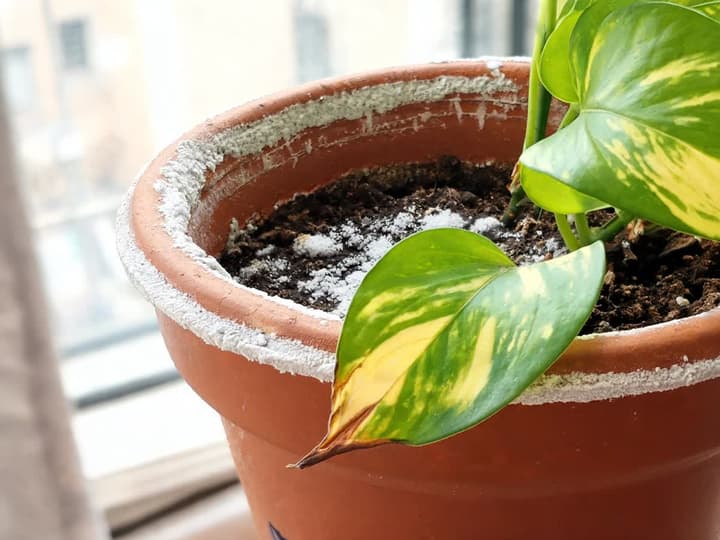
The University of Wisconsin adds blackened margins and tips on pothos foliage. Since these markings also stem from overwatering or underwatering, the white crust is what pinpoints fertilizer salts.
To leach out the excess salts, take the pot to the sink and slowly pour a large volume of plain water through it, allowing it to drain freely for several minutes. Let it drain thoroughly and empty the saucer. Resume fertilizing only after the pothos puts out new leaves, as Illinois advises feeding exclusively actively growing plants. Repeat this flush every 4 to 6 months to keep salts from accumulating again, also per Illinois.
The Bloom catalog includes a detailed page on salt buildup in pothos, complete with warning signs and step-by-step remediation:
Frequently asked questions
Does fertilizer make pothos grow faster?
Only when the pothos receives sufficient light. According to Clemson, foliage plants only show a response to fertilizer with at least 200 foot-candles of light (about 2,150 lux) for 12 hours a day. Under low light, the fertilizer your pothos cannot consume turns into soil salts and burns leaf tips.
Does foliar feeding work on pothos?
This is not the right way to fertilize a pothos at home. WSU, in a paper on trees and shrubs, concludes that leaves do not absorb enough nitrogen, phosphorus, and potassium to supply the entire plant. UF/IFAS only recommends spraying foliage in commercial production to correct magnesium deficiency. Fertilize through the soil.
Can I fertilize my pothos in winter?
Do not fertilize pothos from June through August, the winter in Brazil. During the short days of winter, houseplants barely grow and do not use fertilizer, according to Illinois and Clemson. Penn State is the exception and fertilizes once a month during this period. This guide follows the pause to prevent salt from building up in the soil.
What is the best natural fertilizer for pothos?
Worm castings and well-aged compost are already decomposed organic matter, unlike raw coffee grounds or crushed eggshells. Neither has been empirically tested as the sole fertilizer for containerized pothos, and their nutrient profiles fluctuate. Raw kitchen scraps, such as coffee grounds and eggshells, do not nourish pothos in a practical timeframe. For regular upkeep, a liquid houseplant fertilizer is much easier to measure accurately.
Does a newly purchased pothos need fertilizer?
No. UF/IFAS recommends waiting about 4 weeks after the plant arrives home before fertilizing or repotting. The reason, according to the same source, is to avoid adding another stress to the change of environment. After that period, follow the September-to-May schedule in Brazil.
Summary: fertilize lightly, at the right time, and with adequate light
Pothos needs a balanced houseplant fertilizer, at the label dose, every 2 months from September to May in Brazil. Without light, fertilizer will not make the plant grow, and the excess turns into salt in the soil. Before fertilizing a yellowed or stalled pothos, check watering and light.
When a leaf discolors and you are unsure whether the culprit is nutrient deficiency, watering problems, or disease, Bloom identifies the root cause from a photo:
Related articles
How to Care for a Maidenhair Fern: Light, Water, and Revival Tips
Learn how to care for a maidenhair fern indoors: bright indirect light, consistently moist soil, high humidity, and how to revive it if it dries out completely.
How to Propagate Spider Plants: Root the Pup Before Cutting
The safest spider plant cutting comes from a pup still attached to the mother plant: rest the plantlet on soil in a small pot, wait for roots to establish, and only then cut the stolon. Learn when the pup is ready, whether rooting in water is worth it, how to divide the clump, and why plants fail to produce babies.
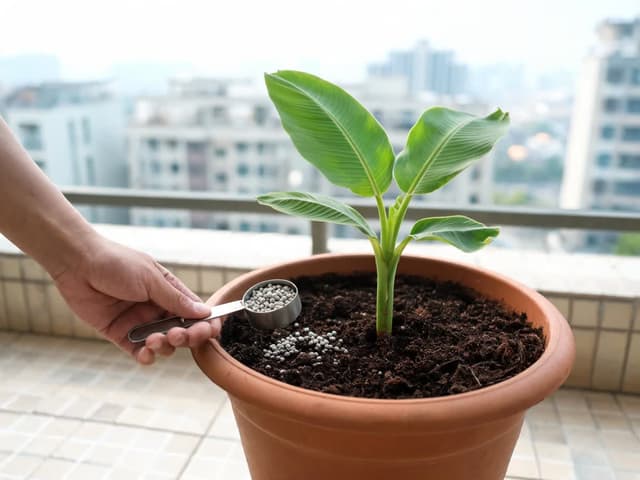
Banana plant fertilizer: fertilizing potted and backyard plants
Banana plant fertilizer needs more potassium than nitrogen, in a 3-1-6 ratio. For a potted plant on a balcony, use the label dose in spring and summer. In the backyard, fertilize every 2 months, adjusting the amount by mat age. Learn the formula, timing in Brazil, and signs of deficiency or excess.