Monstera plant care: from leaf holes to moss poles and aerial roots
How to care for Monstera deliciosa in a pot: placement, watering schedules, fixing solid leaves, setting up a moss pole, and handling aerial roots and leaning stems.
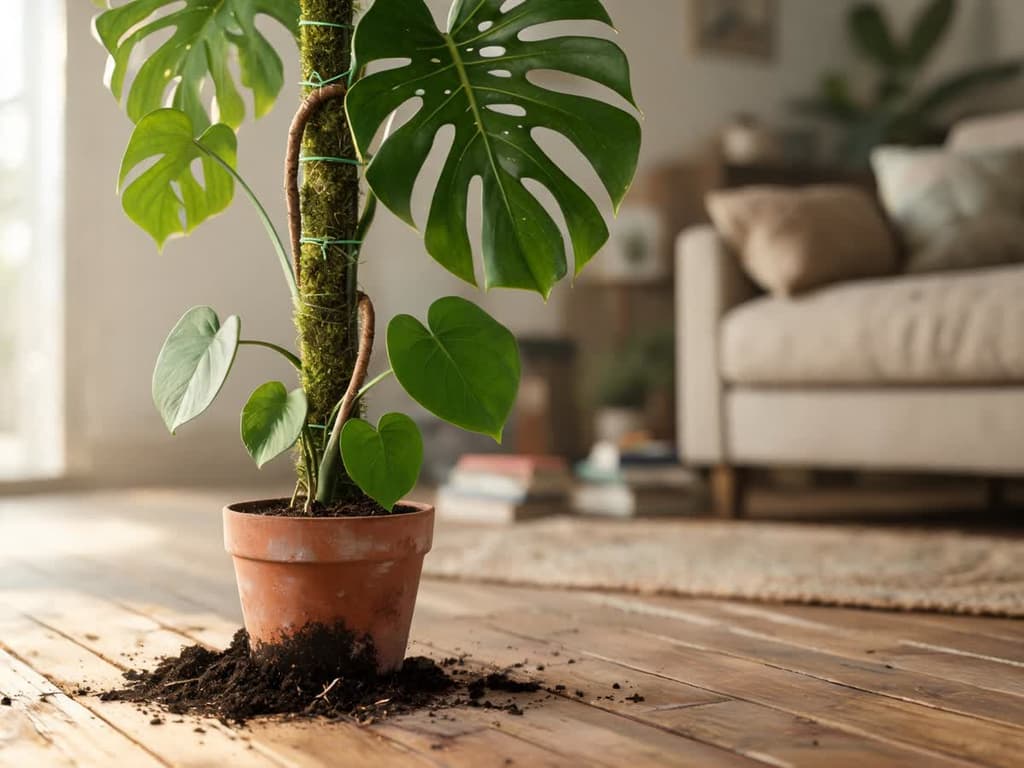
To care for a Swiss cheese plant (Monstera deliciosa), provide bright light near a window without harsh direct sunlight hitting the foliage. Water only when the top layer of potting mix dries out. Use a container with drainage holes at the bottom. Give the plant a sturdy support to climb, as it is a natural vine that scales trees in the wild.
A monstera that fails to split, turns leggy, or falls over is usually dealing with low light, lack of support, or young age. Immature plants produce solid foliage, developing fenestrations only as they mature. The plant is also toxic to cats and dogs.
Care factor | Requirement |
|---|---|
Light | Bright, near a window; only gentle direct morning sun |
Watering | When the top quarter of the potting mix dries out |
Temperature | Between 60 °F and 85 °F (16 °C and 29 °C); growth stops below 50 °F (10 °C) |
Air humidity | Above 50% |
Potted size | 6 to 8 feet (1.8 to 2.4 m) tall, with support |
Cats and dogs | Toxic: keep out of reach |
Is your plant really a Monstera deliciosa?
Three similar plants are sold or called Swiss cheese plants, and each has its own care requirements. NC State Extension records that Monstera deliciosa is often confused with the first two on the list.
Monstera adansonii: much smaller leaves with oval holes, according to the Penn State Extension.
Mini monstera (*Rhaphidophora tetrasperma*): small, split leaves. NC State notes that it is not a true monstera and that its splits develop at an earlier stage.
Tree philodendron (*Thaumatophyllum bipinnatifidum*): large, deeply lobed leaves without holes, with a short, thick stem. It is a Brazilian plant: Flora e Funga do Brasil records the tree philodendron as native to 13 states. The philodendron guide covers the tree philodendron.
The Swiss cheese plant, by contrast, is not native to Brazil. It comes from the forests of southern Mexico to Panama. The Flora e Funga do Brasil records the species as cultivated in the country.
If your plant arrived without an identification tag, verify the species before adjusting your care routine. The Bloom app identifies plants from a single leaf photo.
Why your monstera leaves are not splitting
Solid leaves stem from three possible reasons: the plant is still juvenile, it lacks sufficient light, or it needs a climbing support. The splits and holes in the leaves are technically called fenestrations. They appear exclusively on mature foliage.
Juvenile plant. According to NC State, only mature leaves have holes. A small, newly purchased plant has solid, heart-shaped leaves. This is normal and requires no changes to your care routine. The guide on how to identify an indoor plant explains why a juvenile Swiss cheese plant looks like a different plant.
Lack of light. The University of Wisconsin Extension notes that Swiss cheese plants do not form holes when light is insufficient. If your plant is already large and new leaves keep emerging solid, move the pot closer to the window.
Lack of support. In the wild, the Swiss cheese plant climbs tree trunks, and the leaf changes shape during the ascent. UConn notes that after the plant attaches to a moss pole, leaf size typically increases significantly. Penn State describes the same effect in a related species, Monstera siltepecana: trained upward on a support, it produces larger leaves with splits.
Fenestrations form while the leaf develops, according to NC State. Because of this, an existing solid leaf will never develop holes, and improvements will only show up on new growth.
Leggy or leaning monstera
A Swiss cheese plant becomes leggy when it lacks light. Penn State notes that it grows tall and spindly in low light. The stem stretches, the space between leaves widens, and new leaves emerge small. The stem also bends toward the window.
A monstera topples over when it lacks support. The stem is thick and heavy, and the plant cannot stand upright on its own past a certain height. NC State states that sturdy support is necessary to keep the stems from breaking. Without it, the plant grows sideways and ends up resting over the edge of the pot.
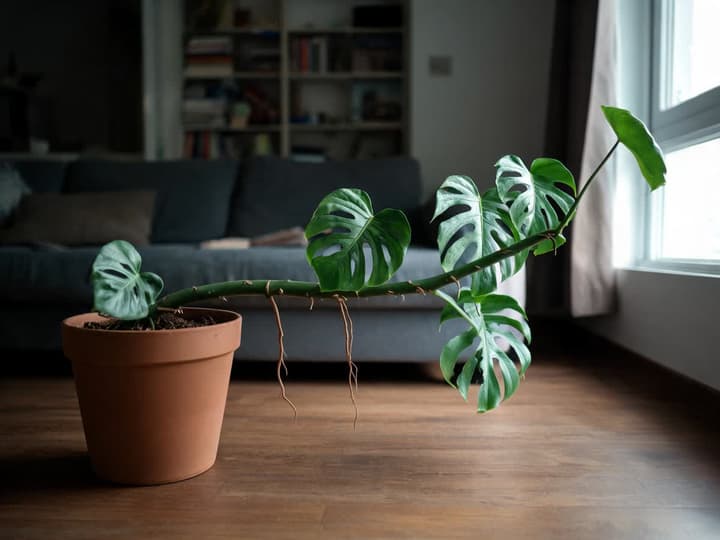
Resolve both issues simultaneously: move the container closer to bright light and provide a pole for the plant to climb. If the leaning stem has grown too long to attach neatly to the pole, you can prune the tip and propagate it (see the pruning section below).
Moss poles: how to build and attach a monstera
A moss pole is a moss-covered stake placed in the container next to the stem. Penn State lists the options that work: a moss pole, a trellis, bamboo, and a plank covered with sphagnum moss (a moss that retains a lot of water). The moss mimics a tree trunk, and the aerial root (the root that grows from the stem, above the soil) clings to it.
To set up and attach the plant, according to the University of Wisconsin Extension and UF/IFAS:
Wrap sphagnum moss around a wooden plank or stake and secure it firmly with nylon thread.
Insert the stake deep into the pot alongside the stem until it stands completely stable. Add the support during repotting to avoid severing established roots.
Rest the stem against the stake and secure it with cotton twine or another natural soft fiber. UF/IFAS advises against using metal wire or thin nylon string directly on stems, as they will cut into plant tissue over time.
Direct aerial roots toward the moist moss.
When watering the plant, moisten the moss on the pole as well. Wisconsin recommends keeping the moss damp so aerial roots can absorb moisture and dissolved nutrients.
A tall plant climbing a moss pole becomes top-heavy. Choose a wide, heavy container, such as terracotta or ceramic, to keep the entire setup from tipping over.
Monstera aerial roots: train, bury, or trim?
Guide the aerial root toward the pole or tuck its tip into the potting soil. The extension services that discuss monstera aerial roots (Penn State, Wisconsin, and UConn) instruct you to secure the root to the support. UF/IFAS notes that the aerial root takes root when it touches the ground. None of the consulted extension services instruct you to cut them.
None of these institutions have measured the precise physiological impact of pruning aerial roots, so the exact setback to the plant remains unquantified. When in doubt, the safest horticultural choice is simply guiding them. If a rogue aerial root blocks a walkway and cannot reach the pole or the pot, you can selectively snip just that one root close to the main stem using clean pruners.
Aerial roots serve as the monstera's natural mechanism for climbing and gathering ambient moisture, not a sign of sickness or stress.
Pruning to control monstera size
The Swiss cheese plant grows between 1.8 and 2.4 m tall indoors, according to NC State. In the wild, its stem reaches 21 m. The guide to large indoor plants compares this size with other living room plants.
NC State recommends pruning in the spring, and UF/IFAS recommends the warm season of the year, so the plant has time to sprout again. In Brazil, spring and summer run from September to March. To reduce height, cut the stem just below an aerial root. The University of Wisconsin-Madison Division of Extension describes this same cut for propagation: the cut tip goes into a pot and roots.
Wear protective gardening gloves when pruning. Penn State cautions that monstera sap can cause skin irritation. To remove an individual old or unsightly leaf, simply snip its petiole flush against the main stem.
Where to place your monstera: light requirements
Place your Swiss cheese plant near a bright window, where it receives bright light and only direct morning sun. Penn State recommends bright light, but not direct sun. UConn accepts 3 to 6 hours of direct sun per day, provided the plant gradually acclimates. According to UConn, the large leaves burn easily. This guide follows the safer option and recommends only direct morning sun.
In Brazil, an east-facing window receives sun only in the morning and is the safest choice. A north-facing window receives sun almost all day in the winter. Near this window, keep the pot out of the strip of sunlight coming through the glass, or place it behind a sheer curtain.
Monsteras can survive in moderate light placed further inside a room, which is why they appear on lists of plants for low light. In dimmer settings, the plant will persist, but it will produce noticeably smaller, solid leaves without splits. NC State adds that variegated monstera varieties (those displaying white or cream patches) require higher light levels than all-green types.
Growing monstera outdoors on a patio or porch
Swiss cheese plants can stay outdoors where there is no frost. UF/IFAS, which studies the plant in Florida landscapes, notes that it grows best in light shade, such as that provided by a large tree. In full sun, the plant produces more fruit, but the leaves turn light green and can scorch.
If you move the pot from indoors to a porch or backyard, make the transition gradually. The University of Wisconsin Extension warns that the plant will scorch if moved all at once to a much brighter spot. Start in the shade and gradually increase its exposure to direct sun.
Ambient cold sets the hard boundary for outdoor placement. The Royal Horticultural Society (RHS) recommends keeping plants outdoors only above 64 °F (18 °C). This guide relies on university extension research as the authoritative benchmark: bring your container indoors before temperatures dip to 50 °F (10 °C). According to Wisconsin, monstera growth halts below 50 °F (10 °C), and frost will kill the vine entirely. UF/IFAS reports that foliage dies at temperatures between 30 °F and 32 °F (−1 °C and 0 °C). Where frost occurs, such as parts of Southern Brazil, shelter the plant or keep it indoors from June through August.
How to water a monstera
Water your Swiss cheese plant when the top quarter of the soil is dry. NC State recommends watering thoroughly and waiting for one-quarter to one-third of the soil in the pot to dry out. In a small pot, this range equals 1 to 2 inches (2.5 to 5 cm) of dry soil, the measurement indicated by Penn State. Stick your finger or a wooden skewer into the soil to check.
Watering intervals shift depending on pot material, ambient light, and the season, meaning there is no reliable set-day routine. During winter, from June to August, soil dries much more slowly, requiring longer stretches between water applications.
Water droplets beading along leaf tips and margins in the morning point to overly saturated soil. Wisconsin describes this condition as the monstera "sweating" (guttation). Space out your watering sessions until the top quarter dries down to protect against root rot.
Soil mix, pots, and repotting monstera
Use fast-draining soil and a pot with drainage holes at the bottom. Penn State recommends a potting mix rich in organic matter (decomposed plant debris). To improve drainage, add pine bark, perlite (lightweight white granules), or charcoal. The recommended pH ranges from 6.0 to 8.0, around neutral (7.0).
The Swiss cheese plant grows quickly, and Wisconsin notes that it needs frequent repotting so the roots fit in the pot. NC State recommends repotting in the spring, from September to November in Brazil. Use repotting as an opportunity to add the support.
Monstera fertilizer: how much and how often
Fertilize your Swiss cheese plant once a month while it produces new leaves, from spring to fall (from September to May in Brazil). In winter, stop. Sources differ on the frequency: Penn State recommends fertilizing every 2 weeks during the growing season and once a month in winter. The RHS, the British horticultural society, recommends a balanced liquid fertilizer once a month, only during the growing season.
This guide follows the RHS and Wisconsin, which also recommend fertilizing only from spring to fall. UConn explains the reasoning: excess fertilizer salts in the soil easily burn the plant.
Temperature and humidity requirements
The Swiss cheese plant prefers temperatures between 16 °C and 29 °C (60 °F to 85 °F), according to Penn State and NC State. Penn State also notes that it dislikes cold drafts. Do not leave the pot in front of an air conditioning vent or near a door that opens to the cold.
Ideal humidity stays above 50%. In very dry environments, Penn State suggests placing a humidifier near the plant. NC State suggests setting the pot on a tray filled with pebbles and water, keeping the bottom of the pot from touching the water. When the air is too dry, according to Wisconsin, leaf margins turn brown.
Yellow leaves and brown leaf tips on monstera
To diagnose yellow foliage on your monstera, first look at where the discoloration occurs. An older bottom leaf yellowing and dropping occasionally is simply natural leaf turnover. Multiple yellowing leaves paired with constantly moist soil point directly to overwatering. The guide to yellow leaves explains how to distinguish underlying causes across any houseplant.
Brown tips and edges on a Swiss cheese plant have two causes recorded by extension services: dry air (Wisconsin) and excess fertilizer salts (UConn). First check the air humidity and fertilization frequency. For any other symptom, the guide what is wrong with my plant starts with the three diagnostic questions.
Monstera pests: thrips, spider mites, and scale insects
Penn State lists Swiss cheese plant pests: scale, aphids, mealybugs, spider mites, thrips, and fungus gnats. Check the underside of the leaves in good light, as each pest leaves a different sign.
Thrips. Silvery patches on the leaf with black dots in the middle are a sign of thrips. The University of Maryland Extension describes the damage like this: the leaf turns pale and silvery where the insect fed. The excrement appears as dark specks stuck to the leaf. Thrips are insects up to 2 mm long, shaped like a grain of rice. To remove them without chemicals, the same extension recommends a strong spray of water from the sink or shower and cutting off deformed leaves.
Spider mites. The leaf becomes speckled with light yellow, and with high mite numbers, fine webbing appears. The guide to spider mites shows how to confirm and treat them.
Mealybugs. White, cottony tufts in the leaf axils (the point where the leaf meets the stem). The guide to mealybugs shows how to remove the tufts from a broadleaf plant.
If you share your home with cats or dogs, consult a veterinarian before applying any pest treatments, including products marketed as natural. Maryland recommends discarding heavily infested plants when dealing with thrips, as replacement is simpler and less costly than extensive chemical control. For a large monstera showing isolated damage on a few leaves, start with a water spray and prune off deformed leaves, avoiding treatments altogether. Discard the specimen only if the infestation is overwhelming. The guide to indoor plant pests covers remaining houseplant pests.
How to propagate a monstera
A Swiss cheese plant cutting comes from a stem piece with an aerial root. The University of Wisconsin Extension recommends cutting off a stem tip just below an aerial root and potting the piece in a container. The same extension notes that this can be done at any time of the year.
Are monsteras toxic to cats and dogs?
Yes. The ASPCA, an animal poison control center in the United States, lists the Swiss cheese plant as toxic to dogs and cats. The toxic principle is insoluble calcium oxalate, a needle-shaped crystal.
The ASPCA describes symptoms including oral irritation and burning of the mouth, tongue, and lips, excessive drooling, vomiting, and difficulty swallowing. If your pet chews on a leaf, call your veterinarian immediately. You do not necessarily have to get rid of the plant: place the container well out of reach and promptly collect any dropped leaves. The guide to pet-toxic plants outlines other household species containing the same oxalate crystals.
Penn State notes that all parts of the plant are toxic to humans and animals, except for the fully ripe fruit. Wisconsin warns that unripe fruit contains enough crystals to cause immediate throat pain.
Frequently asked questions
What should you avoid doing with a monstera?
Do not water on a rigid calendar schedule: water only when the top quarter of the soil mix dries out. Do not use containers lacking drainage holes. Do not transfer the plant abruptly from a dim room into full direct sun, or the foliage will scorch. Avoid securing stems with tight metal wire. Never position the plant where cats or dogs can chew it, as it remains toxic to both.
Do monsteras purify indoor air?
Not in any practical amount that impacts a typical household. This common claim stems from research conducted inside sealed experimental chambers. A comprehensive review by Drexel University researchers modeled these dynamics for residential spaces. A typical building exchanges indoor air about once per hour. Matching that fresh air turnover rate would require between 10 and 1,000 indoor plants per square meter of floor space. The guide to air-purifying plants explains the detailed math.
Why do monstera leaves develop holes?
No one knows for sure. The most frequently cited explanations are letting wind pass through without tearing the leaf and letting light reach lower leaves. A 2013 study in The American Naturalist proposed another explanation. The holes make plant growth more regular, since light reaches the forest floor in scattered patches. All three remain hypotheses.
Do potted monsteras produce fruit indoors?
Rarely. NC State explains that monstera almost never flowers or fruits as an indoor houseplant. Grown outdoors in the garden, UF/IFAS notes that developing fruit requires 12 to 14 months between initial flowering and full maturity. NC State states that the fruit is ripe once the exterior rind scales detach on their own. Before that stage, the immature fruit severely irritates the mouth and throat.
Conclusion
Examine your monstera and answer three basic questions. Does it receive bright light right near a window? Does it have a sturdy climbing support to scale? Is it mature enough to produce adult split foliage? The missing factor explains solid leaves, stretching stems, or a drooping habit.
Before every watering, insert your finger into the soil. If the top quarter feels dry, water thoroughly until moisture flows out through the drainage holes. If it feels damp, wait.
To verify whether your houseplant is a true Monstera deliciosa, Bloom identifies your species from a single leaf photo and schedules your custom watering reminders. The app is available for iOS.
Related articles
How to Care for a Maidenhair Fern: Light, Water, and Revival Tips
Learn how to care for a maidenhair fern indoors: bright indirect light, consistently moist soil, high humidity, and how to revive it if it dries out completely.
How to Propagate Spider Plants: Root the Pup Before Cutting
The safest spider plant cutting comes from a pup still attached to the mother plant: rest the plantlet on soil in a small pot, wait for roots to establish, and only then cut the stolon. Learn when the pup is ready, whether rooting in water is worth it, how to divide the clump, and why plants fail to produce babies.
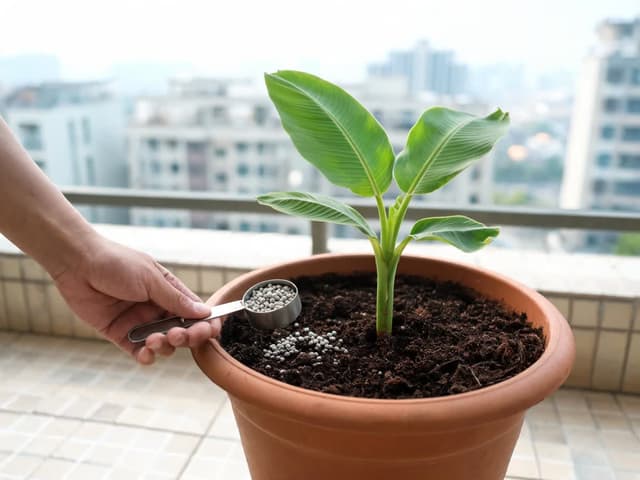
Banana plant fertilizer: fertilizing potted and backyard plants
Banana plant fertilizer needs more potassium than nitrogen, in a 3-1-6 ratio. For a potted plant on a balcony, use the label dose in spring and summer. In the backyard, fertilize every 2 months, adjusting the amount by mat age. Learn the formula, timing in Brazil, and signs of deficiency or excess.