How to Make an Anthurium Bloom: The Missing Light and What Doesn't Work
An anthurium that only produces leaves is almost always getting too little light. Each new leaf brings a spathe, and the plant blooms with around 1,000 lux. Here is how to find that spot in an apartment and why phosphorus fertilizer will not fix it.
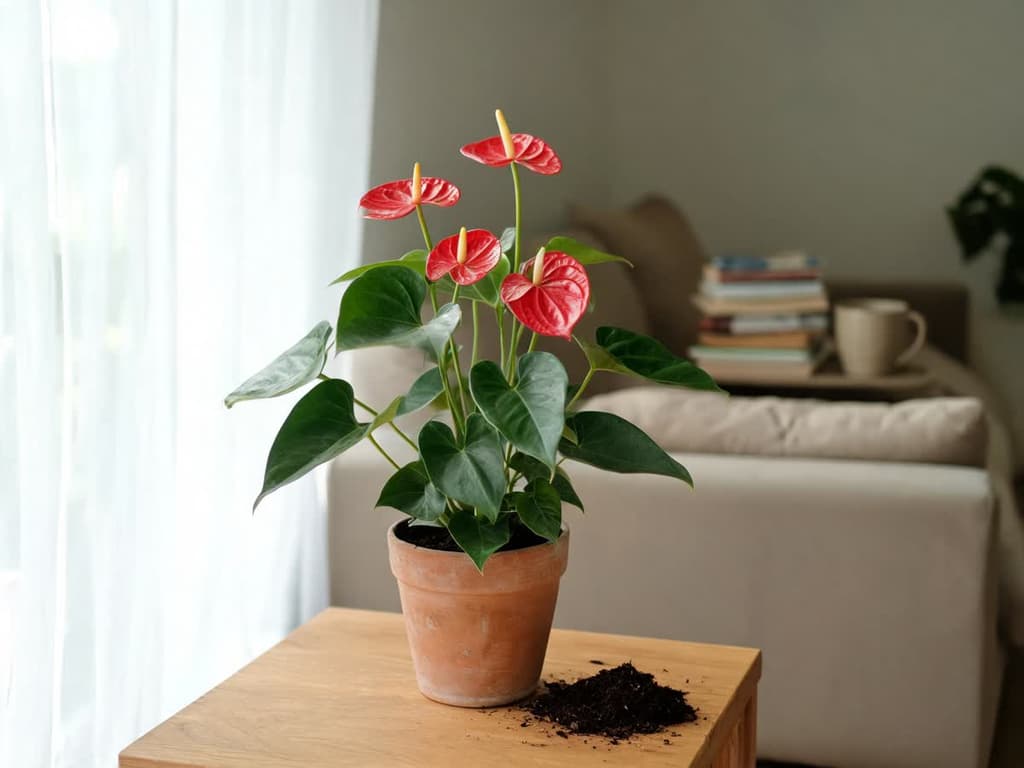
Caring for an anthurium to make it bloom starts with light. A healthy anthurium that only puts out green leaves is almost always too far from the window. The University of Florida lists this combination, plenty of leaves and few or no flowers, with a single cause: light that is too low (UF/IFAS EP159).
The solution is to move the plant to a spot with at least 1,000 lux at midday, with no direct afternoon sun. After that, the flower comes along with the next new leaf. High-phosphorus fertilizer and hormones will not bring the spathe back.
Quick summary:
Every new leaf on an anthurium brings a spathe, the red heart-shaped piece. A plant that does not make leaves does not make flowers either.
Several anthurium varieties bloomed continuously for more than a year and a half under 100 foot-candles, about 1,000 lux (UF/IFAS EP159).
In a study conducted in São Paulo, each plant produced 6.48 spathes per year. One came out every 50 days in warm weather and every 68 days in cold weather (Lima et al., Ciência Rural, 2014).
Fertilizer rich in phosphorus does not make an anthurium bloom indoors. The recommended indoor dose is a balanced, weak fertilizer, once a month.
Each spathe lasts up to 4 weeks. When it fades or dries out, cut the stem flush with the base.
Why an anthurium does not bloom
Anthuriums do not bloom when they stop producing new leaves. In anthuriums (Anthurium andraeanum), each spathe emerges from the leaf axil, the point where the leaf stem meets the main stem. The University of Hawaii at Hilo describes a constant sequence of leaf and flower throughout the life of the plant (UH Hilo, 2017).
Because of this, instead of asking "how do I make my anthurium bloom," ask "why isn't it growing new leaves." A stalled plant that has not produced a new leaf in months lacks the light to grow. A plant that puts out plenty of leaves and few or no spathes is also getting too little light, according to the same table from the University of Florida.
The colorful piece everyone calls a flower is the spathe, a modified leaf. The true flowers are the tiny dots on the center spike, the spadix. The anthurium care guide explains this structure and the rest of basic care: potting mix, watering, and toxicity to cats and dogs.
In a commercial crop in Pariquera-Açu, in the Ribeira Valley (SP), under 70% shade netting, each plant produced an average of 6.48 spathes per year. Leaves that emerged from September to April produced a spathe every 50 days. Those from May to September, every 68 days (Lima et al., Ciência Rural, 2014).
Is it an anthurium or a bromeliad?
If you received the plant without a label and it had a "stiff red flower," check which of the two it is before waiting for a new bloom. An anthurium has heart-shaped leaves, each on a long stalk. The red spathe is also heart-shaped, with a spike in the center. A bromeliad forms a rosette of strap-like leaves, shaped like a cup, and the colorful part emerges from the center of that rosette.
Most bromeliads produce pups after flowering, and the mother plant slowly dies after the bloom (Wisconsin Horticulture, UW–Madison). In these bromeliads, the next flower comes from the pup. The anthurium flowers throughout its entire life on the same plant.
How much light does an anthurium need to bloom?
The anthurium needs at least 1,000 lux at midday to bloom indoors. This number comes from a test by the University of Florida. Several varieties of potted anthurium bloomed continuously under 100 foot-candles, about 1,000 lux, for more than a year and a half (UF/IFAS EP159). Foot-candle is an American unit of light, and 1 foot-candle equals about 10 lux.
Too much light also causes problems. In production, light stays between 1,000 and 2,500 foot-candles, about 10,000 to 25,000 lux, and should not exceed 2,500. Light above that makes the leaf turn pale, and growers often confuse this paleness with a nutrient deficiency (UF/IFAS EP159).
In practice, a potted anthurium indoors blooms between 1,000 lux and the bright light near a window. The condition is that direct afternoon sun must not hit the foliage. Direct afternoon sun burns the leaves, leaving dry, bleached patches that will not recover.
How to find this spot in an apartment
The eye does not work for measuring light. It adapts so well that, after a few minutes, two spots look equally bright. The actual difference between them can be ten times more light, according to the University of Florida (UF/IFAS Gardening Solutions). The same page notes that phone apps that measure light work well for comparing spots, even without the precision of a dedicated meter.
Take the measurement like this:
Download a light meter app (measuring light in lux) on your phone.
At midday, on a bright day, rest the phone where the anthurium sits, with the screen facing the window.
Note the number, then repeat at 50 cm and 1 m from the window.
Keep the anthurium at the farthest spot from the window that still reads 1,000 lux or more, without direct afternoon sun hitting the leaf.
Light drops quickly as you move away from the glass. Mississippi State University Extension records a drop from 1,000 to 100 foot-candles in less than 2 meters (Mississippi State Extension). The same source states that it is difficult to grow plants more than 8 to 10 feet from a window, which is 2.5 to 3 meters.
The direction of the window also matters, and here the source needs to be converted for Brazil. American extensions say that a south-facing window receives the most sun. In the Southern Hemisphere, the opposite happens: in Brazil, the window with strong sun is the north-facing one. An east- or west-facing window does not change by hemisphere. It usually provides 100 to 500 foot-candles, about 1,000 to 5,000 lux (University of Maryland Extension).
Where the anthurium is | What usually happens | What to do |
|---|---|---|
More than 2.5 m from the window, bookshelf, hallway | Under 1,000 lux; leaves only, or no new leaves | Move closer to the window |
Near an east window | Gentle morning sun; good light the rest of the day | Classic spot: can sit right up against the glass |
Near a west window | Harsh afternoon sun on the leaves | Move 1 m back from the glass or use a sheer curtain |
Near a north window (Brazil) | Direct sun for a large part of the day | Sheer curtain or 1 m back from the glass |
Near a south window (Brazil) | Indirect light, weaker | Place right against the glass and measure |
Bathroom or windowless room | Artificial bulb light, well below 1,000 lux | Not a place for an anthurium to bloom |
Why an anthurium bought in bloom stops blooming at home
The flower shop anthurium came from a greenhouse with 10 to 25 times more light than the 1,000 lux it still blooms under at home. Production greenhouses work with 1,000 to 2,500 foot-candles (UF/IFAS EP159). In a corner 3 meters from the window, the spathes that were already formed open and last. The next leaf takes a long time, and the next spathe does not appear.
Hormones do not explain the pause. The University of Florida reports that the anthurium blooms repeatedly under natural conditions, without hormones. Gibberellic acid, the regulator used to induce flowering in other plants of the same family, serves to branch the plant in anthuriums (UF/IFAS EP447). A study conducted in São Paulo applied this regulator in five doses and found no increase in the number of spathes (Lima et al., Ciência Rural, 2014).
Water is not the issue either. Changing your watering schedule, up or down, will not yield spathes, and overwatering rots the roots. Water when the top 2 to 3 cm of the potting soil feel dry.
The anthurium does not depend on night length, either. The University of Florida explains that, in most tropical foliage plants, changing day and night length does not induce flowering (UF/IFAS EP447). Because of this, the anthurium does not require the dark treatment that makes poinsettias rebloom or the long nights that make Christmas cactus bloom.
Fertilizer to make an anthurium bloom: phosphorus will not guarantee flowers
High-phosphorus fertilizer does not make an anthurium bloom indoors. This is the most repeated tip on the subject, in three versions: "bloom" fertilizer, bone meal, and banana peels buried in the pot. The University of Florida publication on potted anthuriums recommends something else for the houseplant (UF/IFAS EP159).
The recommendation for more phosphorus does exist, but it is for greenhouses. Commercial growers start with fertilizer at a 3-1-2 ratio and later switch to 1-2-2 to promote flowering. They test the salt levels in the potting soil every 2 to 3 weeks. For a plant already settled indoors, the same publication recommends a balanced 20-20-20 fertilizer, diluted to 50 ppm of nitrogen, once a month. Ppm stands for parts per million, the concentration of the fertilizer in the water.
Too much fertilizer hinders blooming. The leftover salt builds up in the potting soil and burns the tips and margins of the leaves (UF/IFAS EP159). Brown tips and yellow lower leaves indicate excess fertilizer. In that case, stop fertilizing and flush the potting soil until water drains out through the bottom hole.
For those looking for homemade fertilizer to make an anthurium bloom, the defensible option is aged worm castings mixed into the potting soil when repotting. Aged means decomposed before going into the pot. Repot every 2 to 3 years, or when the roots take over the pot (NC State Extension).
How long an anthurium flower lasts and when to cut it
Each anthurium spathe lasts up to 4 weeks open, and the plant blooms several times a year under the right conditions (NC State Extension). A spathe that wilts after a few weeks is at the end of its normal life. This wilting is not a sign of disease.
Cut the spent spathe when it fades or dries out. The University of Florida recommends removing spent flowers as needed (UF/IFAS EP159). Use clean shears and cut the spathe's stalk flush with the base, without cutting the adjacent leaf stem.
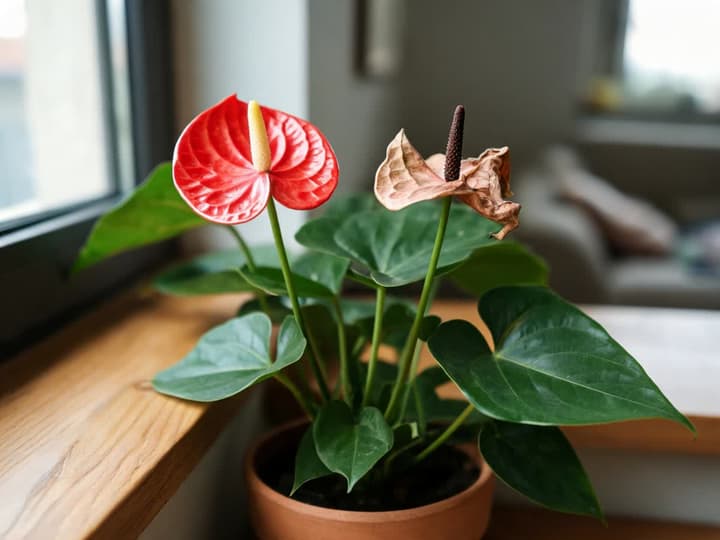
A spathe that wilts just a few days after opening, with soft leaves and soil that is still moist, points to root rot from overwatering. A spathe that emerges already deformed, spotted, or scraped may be thrips. Thrips are insects about 1 mm long that enter the closed bud and damage the flower before it opens (UH Hilo, 2017).
Ideal temperature and humidity for blooming
Anthuriums bloom best between 18 °C and 27 °C, with relative humidity between 60% and 80% (NC State Extension). Below 13 °C, the plant suffers damage, whether visible or not, and growth slows down even after the temperature returns to normal (UF/IFAS EP159).
In Brazil, the longest interval between spathes falls from May to September. The Pariquera-Açu study measured 68 days between spathes during these months, compared to 50 days from September to April (Lima et al., Ciência Rural, 2014). If your anthurium blooms less between May and September, this longer interval is expected and does not call for fertilizer.
For humidity, the University of Florida recommends misting the leaves: the water removes dust and raises humidity for a short time (UF/IFAS EP159). Keep the anthurium away from air conditioning and appliances that give off heat, such as televisions and refrigerators.
What your anthurium is showing you
What you see | Likely cause | What to do |
|---|---|---|
Healthy green leaves, no spathes for months | Light too low | Measure the light and move to a spot with 1,000 lux or more |
No new leaves for months | Light too low or temperatures below 13 °C | Address light first; move away from cold windows and air conditioners |
Pale leaves, almost uniformly yellow, with direct sun hitting the leaf | Light too intense | Sheer curtain or 1 m back from the glass |
Brown tips and yellow lower leaves | Excess fertilizer | Stop fertilizing and flush the potting mix |
Spathe wilting in days, limp leaves, wet soil | Root rot | Inspect the roots and replace the potting mix |
Spathe opening deformed or scarred | Thrips in the flower bud | Inspect the closed bud with a magnifying glass and isolate the plant |
Brown tips and yellow leaves have more than one cause. The complete anthurium guide breaks down each spotting pattern and shows how to treat root rot.
When a spathe opens spotted and you are unsure if it is thrips, fungus, or bacteria, a close-up photo clears up the question. Bloom diagnoses plant diseases from photos in its Premium plan on iPhone.
What triggers peace lilies, holiday cacti, and poinsettias to bloom
The peace lily belongs to the same family as the anthurium and also features a spathe instead of petals. It can bloom in low light as well, though not in complete darkness, and the guide on how to make peace lilies bloom outlines the numbers. Holiday cacti and poinsettias set flowers when nights grow long, with holiday cacti also needing cool nights. Anthuriums do not rely on either factor.
Frequently asked questions
What should I give my anthurium to make it bloom?
Light, not fertilizer. Move the anthurium to a spot with at least 1,000 lux at midday, with no direct afternoon sun. Under this light, several varieties bloomed continuously for more than a year and a half (UF/IFAS EP159). A balanced, weak fertilizer, once a month, is enough. High phosphorus does not trigger blooming.
What time of year do anthuriums bloom?
An anthurium blooms year-round because every new leaf brings a spathe. In a study conducted in São Paulo, a spathe emerged every 50 days from September to April. From May to September, one emerged every 68 days (Lima et al., Ciência Rural, 2014).
Where is the best place to put an anthurium?
Near an east-facing window, or 1 m back from a north or west window with a sheer curtain. The spot must read at least 1,000 lux at midday on a light meter app. More than 2.5 m away from a window, light is usually too dim for blooming.
How many times a year does an anthurium bloom?
Under cultivation in Brazil, each plant produced an average of 6.48 spathes per year, according to a study conducted in Pariquera-Açu, São Paulo (Lima et al., Ciência Rural, 2014). The study evaluated commercial cultivation under shade cloth. No one has measured this number indoors.
Where to start
Today at midday, measure the light where your anthurium sits. If it registers under 1,000 lux, move the pot near a window before buying any fertilizer. Then wait for the next new leaf, since the spathe arrives with it. In the study conducted in São Paulo, the interval from one spathe to the next was 50 to 68 days.
Related articles
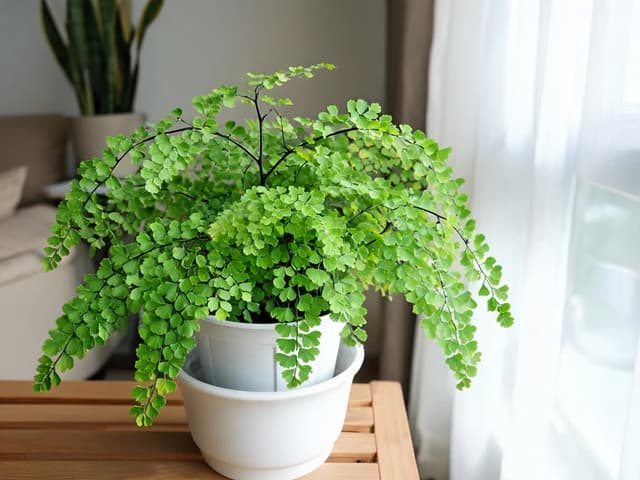
How to Care for a Maidenhair Fern: Light, Water, and Revival Tips
Learn how to care for a maidenhair fern indoors: bright indirect light, consistently moist soil, high humidity, and how to revive it if it dries out completely.
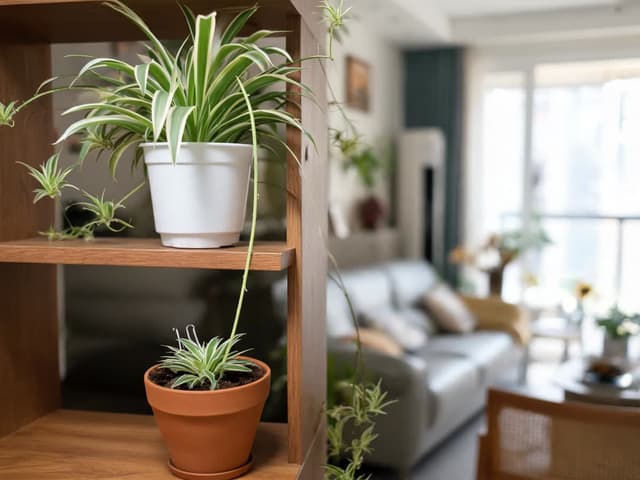
How to Propagate Spider Plants: Root the Pup Before Cutting
The safest spider plant cutting comes from a pup still attached to the mother plant: rest the plantlet on soil in a small pot, wait for roots to establish, and only then cut the stolon. Learn when the pup is ready, whether rooting in water is worth it, how to divide the clump, and why plants fail to produce babies.
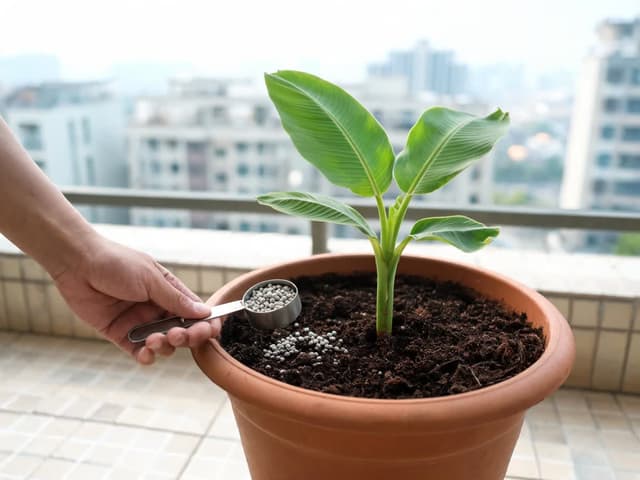
Banana plant fertilizer: fertilizing potted and backyard plants
Banana plant fertilizer needs more potassium than nitrogen, in a 3-1-6 ratio. For a potted plant on a balcony, use the label dose in spring and summer. In the backyard, fertilize every 2 months, adjusting the amount by mat age. Learn the formula, timing in Brazil, and signs of deficiency or excess.