How to Care for Rose Bushes: A Guide by Type, in Pots and in Beds
To care for rose bushes, start by identifying your type: miniature, floribunda, hybrid tea, or climber all require different pruning and space. Here are three rules that apply to all of them and the best month to prune.
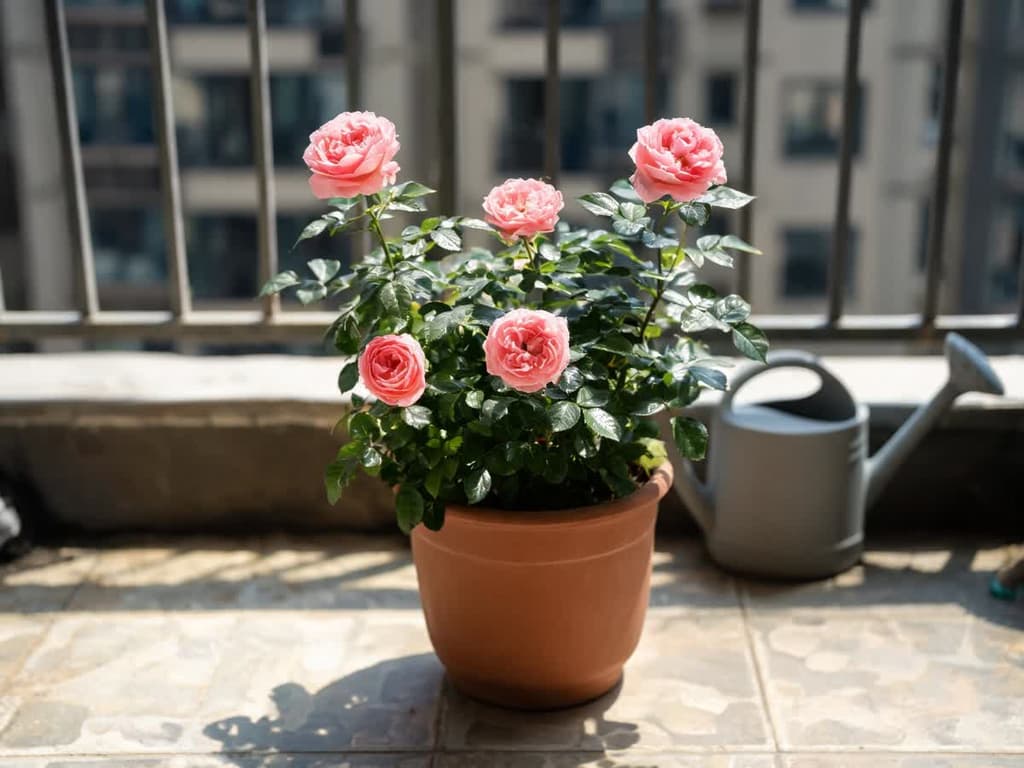
Three rules apply to all roses. They need six hours of direct sunlight every day. Water goes at the base of the soil, never over the foliage. And air must circulate freely between plants. Everything else varies depending on your rose group. A potted miniature rose and a thirteen-foot climber are not pruned the same way, nor do they fit in the same space.
Roses are outdoor plants. They thrive in garden beds or large containers on a balcony with direct sunlight, and they cannot adapt to a living room table.
Quick summary:
Clemson University Cooperative Extension recommends 6 to 8 hours of direct sun daily, preferably in the morning. Morning sun dries dew-soaked foliage quickly.
In Southeast and South Brazil, annual pruning takes place in July and August. US extension services and the Royal Horticultural Society say "late winter," which in the Northern Hemisphere falls in February and March.
A potted rose may need water every day in hot weather. The same rose growing in a garden bed can go an entire week on a single deep watering.
Which Rose Do You Have?
The rose is the flower and the rose bush is the plant that produces it, so caring for roses in the garden means caring for the rose bush. Rose bush is the name of a large group of plants, and the group determines the size, location, and pruning. Clemson University Extension divides cultivated roses into six groups and gives the size for each one.
Rose group | How to recognize | Mature size | Where it grows | Pruning level |
|---|---|---|---|---|
Hybrid tea | One large bloom per long stem, pointed bud | 6 to 8 ft (1.8 to 2.4 m) | Garden bed, or very large container | Hard pruning, once a year |
Floribunda | Smaller flowers in clusters, many at once | Shorter and bushier than hybrid tea | Garden bed and large container | Moderate pruning |
Grandiflora | Pointed bud with large blooms, in clusters | Between hybrid tea and floribunda | Garden bed | Moderate pruning |
Climber | Long canes tied to fences, trellises, or arbors | 8 to 15 ft (2.4 to 4.5 m) | Wall, fence, arbor | Specialized pruning that renews older canes |
Miniature | Small plant and flowers; often sold as potted plants | 8 to 24 in (20 to 60 cm) | Pots and garden bed borders | Light pruning |
Landscape / shrub rose | Full shrub, dense foliage, flowers readily | Variable size | Garden bed and hedges | Least pruning of all |
Hybrid teas were bred as cut flowers, with one bloom per stem, and they require the most pruning. Landscape shrub roses were bred for the overall effect of the entire bush and need the least. If you do not know which one you have, Bloom can identify the plant from a photo.
The care guide in Bloom covers the entire Rosa genus, not just a single group:
The numbers on this profile combine the 8-inch miniature with the 13-foot climber. Treat the height and spread as a range for the entire genus, not the exact measurement of your specific plant.
Potted Miniature Roses Are Not Indoor Houseplants
The miniature rose sold in pots at supermarkets is an outdoor plant. That is why it sheds its leaves just a few weeks after arriving home. Inside an apartment, even near a window, it receives only a fraction of the light it needs. Bloom's care card classifies Rosa as an outdoor plant and notes that it is not suitable for indoor spaces.
The classic symptom is yellow leaves dropping in succession, from the bottom up, weeks after purchase, while the soil remains constantly damp. Watering more only worsens the situation: a plant getting low light uses very little water, and soggy soil rots the roots. Yellow leaves have other causes besides low light, and the yellow leaves guide breaks down each one by the pattern of yellowing on the leaf.
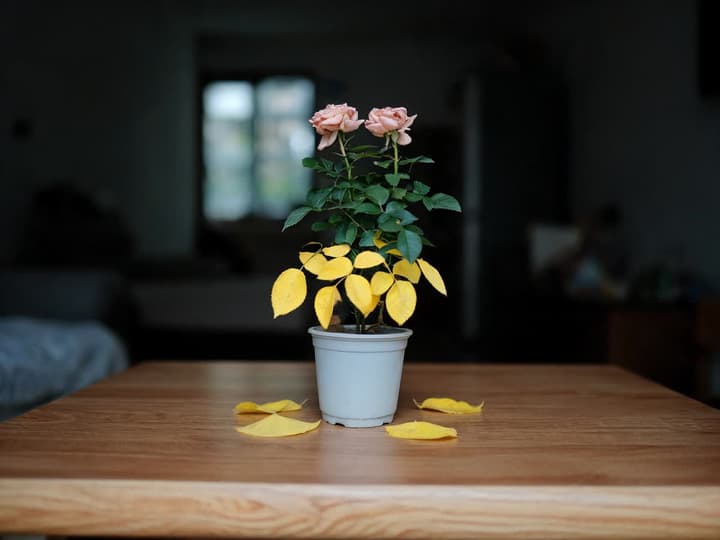
Fixing this takes three steps. Move the pot to a balcony, patio, or the sunniest windowsill available, where it receives six hours of direct sunlight. Check that the pot has drainage holes at the bottom and empty the drip tray after every watering. Wait for new foliage to emerge. Yellow leaves that have already fallen will not return, so new growth is the true sign your plant is recovering.
Six Hours of Direct Sun, Preferably in the Morning
Roses need direct sunlight for most of the day, and morning sun is worth more than afternoon sun. Clemson calls for "at least six to eight hours of direct sun each day." Morning sun matters because it dries the foliage, and dry leaves get sick less often. The University of Florida (UF/IFAS) gives the same six-hour minimum.
The Royal Horticultural Society in the United Kingdom accepts a four-hour minimum for British gardens. This guide sticks with six hours for two reasons: it is the number agreed upon by university extension services, and every lost hour of sun means one more hour of damp foliage.
Shade will not kill a rose directly, but the plant will flower poorly, stretch its canes toward the light, and catch fungal diseases much more easily. Six hours of direct sunlight is the baseline for an entire category of garden plants. Lavender and sunflowers require the same 6 to 8 hour range. Both react to shade just like roses, developing weak stems and lackluster blooms.
How to Water Roses
Water deeply and infrequently, directing moisture to the soil around the base of the stem, never over the foliage. Clemson explains why: deep watering fosters deep roots. Light, frequent watering draws roots toward the surface, where they struggle during the first hot spell.
In garden beds, the University of Illinois Extension recommends 2.5 cm of water per week during the growing season. The Royal Horticultural Society translates that same volume into 5 to 10 liters per plant, once a week, during dry summer periods.
In containers, watering works differently. The Royal Horticultural Society notes that potted roses require significantly more water than those planted in the ground. During hot spells, watering may need to happen daily because a small volume of soil dries out quickly. Bloom's care card notes "water every 7 days." This interval serves as a baseline for garden beds; a container sitting in summer sun will need water much sooner.
Timing matters too. Clemson recommends watering before noon. That way, any accidental splashes on foliage dry in the daytime sun instead of staying wet overnight.
Allow Air to Circulate Between Plants
Spacing between roses is a health safeguard. Clemson recommends two precautions: leave enough space between roses to match the mature spread of their specific group so air flows freely, and prune to keep the center of the shrub open. The Royal Horticultural Society describes the desired result as well-spaced stems that let air circulate freely.
The reasoning lies in the triggers for the two most common rose diseases. Powdery mildew appears as a white powder on the upper surface of the leaf. It develops when temperatures stay between 70 °F and 80 °F (21 °C and 27 °C), with high humidity at night and dry conditions during the day. Black spot follows prolonged warm, wet periods, which characterizes much of the Brazilian summer.
The rose cultivation guide from the Federal Institute of Bahia lists six diseases as the most common in Brazil: powdery mildew, rust, downy mildew, gray mold, black spot, and canker. According to the guide, high humidity favors all of them. Two routine tasks lower this pressure. Pick up fallen leaves from the ground, along with the mulch where they landed. Lay down a fresh layer of mulch before new shoots emerge.
Pruning: where to cut, and in which month in Brazil
Every pruning cut follows three general rules. The Royal Horticultural Society instructs cutting no more than 1/4 inch (5 mm) above a bud eye, the small swelling on a cane where new shoots emerge. Angle the blade downward away from the bud so rainwater runs off instead of pooling. Pick an outward-facing bud; canes grow in the direction the bud points, and outward buds keep the shrub's center open. Before anything else, remove all dead, diseased, spindly, or crossing wood.
How much to cut back depends on the group, and UF/IFAS gives the general guideline: shorten mature canes by one-third to one-half their length.
The pruning month depends on your hemisphere. American extensions and the Royal Horticultural Society advise pruning in late winter, which corresponds to February or March in the Northern Hemisphere. In Southeast and South Brazil, late winter falls in July and August, which is when annual pruning takes place. Pruning occurs right before spring growth begins so new canes emerge as warm weather arrives.
In North and Northeast Brazil, plants experience no true winter dormancy, and the schedule shifts accordingly. UF/IFAS describes a similar pattern in South Florida, where roses never truly stop growing. Pruning there might be needed twice a year, and fertilizing continues year-round. Wherever your rose keeps its leaves through winter, replace a heavy annual cut with routine deadheading and cleanup after each flush of blooms.
An overgrown, woody rose inherited with a garden can be cut back hard. The RHS recommends renovating it between late fall and late winter while the bush is dormant and leafless. Without foliage, you can clearly see what you are cutting. If you do not know the variety, prune it as you would a hybrid tea. When you cannot predict how vigorously the shrub will respond, spread rejuvenation pruning over two seasons: remove half the old canes the first year and the rest the next. After pruning, feed the plant and topdress the soil with 2 inches (5 cm) of compost or well-rotted manure.
Fertilizing: In-Ground and Potted Plants Need Different Routines
In the garden bed, the Royal Horticultural Society fertilizes twice a year. The first application is in early spring, before flowering; the second comes after the first flush of flowers. In Brazil, these two moments fall around September and December.
Pots require a different schedule because the soil volume is limited and regular watering leaches nutrients through the drainage holes. The RHS suggests applying liquid fertilizer every two weeks for potted roses, from mid-spring through late summer. Switch products midway through: use a balanced, general-purpose feed while the plant builds foliage, and switch to a high-potassium fertilizer once flower buds form. Bloom's care card notes "fertilize every 30 days," which works well for garden soil but falls short for a potted rose in peak bloom.
In areas with winter frost, stop fertilizing before cold weather arrives. Feeding late in the fall encourages soft new shoots right when freezing temperatures will burn them.
Spider Mites and Aphids: What to Do When Oil Fails
Tiny yellow or pale stippling on the upper leaf surface paired with fine webbing underneath indicates spider mites. Clemson outlines these two signs and notes what triggers them: high heat, dry conditions, and thirsty plants. A rose left for weeks without deep watering is the first to attract spider mites.
Do not confuse this with powdery mildew. Powdery mildew shows up as white powder across the leaf surface and leaves no webbing. Fine webs belong to spider mites, and that is how to tell them apart with the naked eye. The same spider mites attack indoor plants, where they are also the only common houseplant pests that produce webs.
Treatment begins with plain water. Clemson states that a strong stream of water knocks away eggs, larvae, nymphs, and adults. Direct the spray at the undersides of the foliage, repeating the wash as often as necessary. Insecticidal soaps and horticultural oils work well, but thorough coverage is decisive. Spraying only the top of the leaf misses the pests entirely, since they hide underneath. A single treatment will not solve the issue, which is why many assume horticultural oil sprays are ineffective.
Two caveats from Clemson change what you buy and when you spray:
Dish soap is not insecticidal soap. Clemson states that dish and laundry detergents are too strong for plants because of their additives. Insecticidal soap is a potassium salt of fatty acids and is used at 1% or 2%.
Do not spray in direct sun or when temperatures exceed 90 °F (32 °C), as the product will burn the foliage.
Avoid broad-spectrum insecticides on roses infested with mites. According to Clemson, these sprays kill the natural predators that keep mite numbers in check, causing the infestation to return with greater force.
Aphids are tackled using a similar approach, with one additional detail. A strong jet of water works well on both the tops and bottoms of leaves, though it needs repeating. Focus the stream on fresh new shoots, which is where colonies congregate. The right soap dilution and the reason aphids often return within a week are covered in the aphid guide. If your plant's symptoms do not match any of these descriptions, our plant diagnosis guide helps distinguish pests from diseases and care issues.
Roses and Pets: Prickles Are the Hazard, Not Poison
The ASPCA lists Rosa spp. as non-toxic to dogs, cats, and horses.
The risk from roses is physical and comes from contact with the stem. The North Carolina State University Extension (NC State) explains that the sharp points on the stem are prickles, not true thorns. Their size and quantity vary from species to species. Wear gardening gloves when pruning and tying. If you have children or dogs at home, keep the pot out of hallways where everyone walks.
Do Coffee Grounds, Dish Soap, and Epsom Salt Work?
Three home remedies get mentioned constantly for roses, and all three have been studied.
Coffee grounds. Washington State University Extension measured the pH of coffee grounds and the effect of uncomposted grounds on plants. Coffee grounds are not reliably acidic: the measured pH ranges from mildly acidic to mildly alkaline. In addition, uncomposted grounds are phytotoxic, meaning toxic to plants, so dumping them at the base of a rosebush can hurt rather than help. They contain more than 10% nitrogen-rich protein by weight and work as compost material, limited to 20% of the pile's volume. Once composted, they go down in a thin layer of up to 1.3 cm (0.5 in), under a thicker layer of mulch.
Dish soap. Do not use it. Clemson classifies dish and laundry detergents as too harsh for plants because of their additive content. The proper horticultural equivalent is insecticidal soap, applied at a 1% or 2% concentration.
Epsom salt (magnesium sulfate). Clemson only recommends it when a soil test indicates a magnesium deficiency. Excess magnesium hinders calcium uptake by the plant. The salt builds up in the root zone, where it can even block water intake.
Frequently Asked Questions
Do I need to prune my rose bush every year?
Annual pruning is standard for most groups. Hybrid teas, floribundas, and grandifloras require a hard cutback once a year in late winter. Landscape shrub roses are the exception: they need far less pruning, and simply removing dead or diseased wood is generally enough.
How do you care for a potted rose?
Use a deep container with drainage holes, set it where it gets six hours of direct sunlight, and empty the drainage saucer after watering. In hot weather, you may need to water daily because small pots dry out rapidly. Apply a liquid fertilizer every two weeks from mid-spring through late summer.
Do roses prefer sun or shade?
Direct sun, six to eight hours each day, ideally starting in the morning. A rose can survive in partial shade, but it will yield fewer blooms and stretch its canes looking for light. It is also more prone to powdery mildew and black spot because the leaves take much longer to dry.
How can I get my rose bush to bloom more?
Provide six hours of direct sun, fertilize in spring and again after the first round of flowers, and deadhead spent blooms before they develop hips. Late-winter pruning helps too, stimulating the fresh canes that produce the next flush of flowers.
Where to Begin
If you have a rose bush right now, start with its location. Six hours of direct sunlight will solve more rose problems than any bottled product. It is the one foundational requirement that no amount of subsequent care can replace. After that comes watering at the soil base, giving plants room to breathe, and pruning in late winter.
Leaf spots and yellow foliage can stem from fungus, pests, or improper watering, and they can be tricky to tell apart with the naked eye. When in doubt, snap a picture: Bloom matches the photo against known symptoms for each issue. The app is available on iPhone.
Roses belong to the category of full-sun outdoor plants that thrive on this same level of intense light:
Related articles
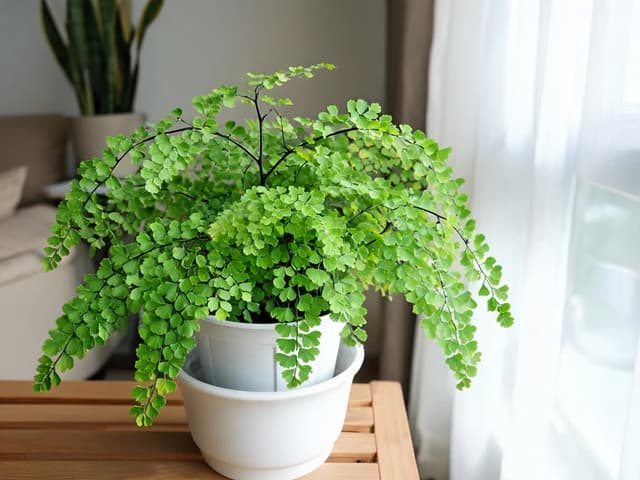
How to Care for a Maidenhair Fern: Light, Water, and Revival Tips
Learn how to care for a maidenhair fern indoors: bright indirect light, consistently moist soil, high humidity, and how to revive it if it dries out completely.
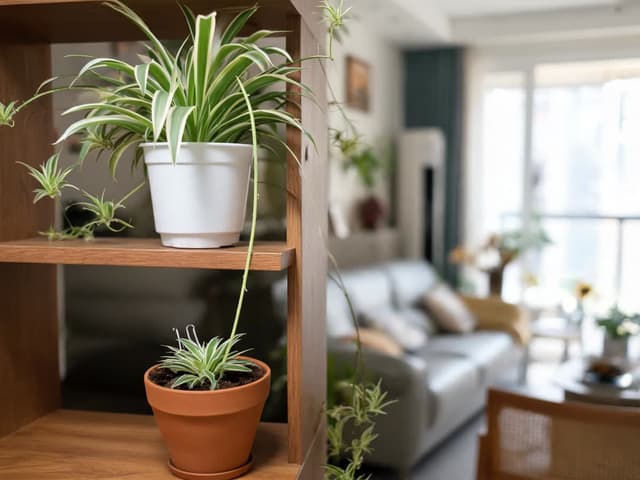
How to Propagate Spider Plants: Root the Pup Before Cutting
The safest spider plant cutting comes from a pup still attached to the mother plant: rest the plantlet on soil in a small pot, wait for roots to establish, and only then cut the stolon. Learn when the pup is ready, whether rooting in water is worth it, how to divide the clump, and why plants fail to produce babies.
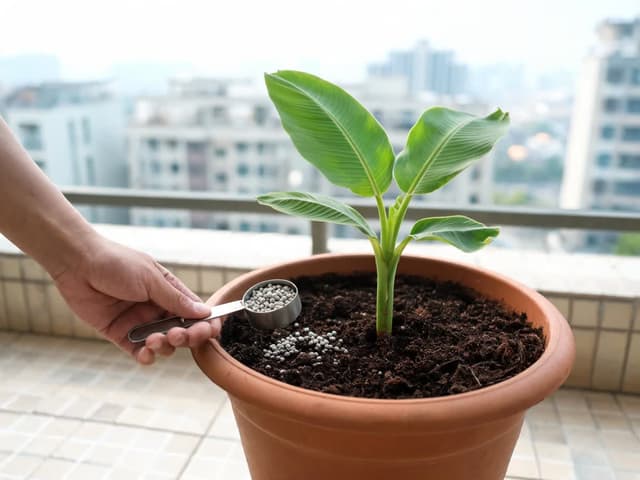
Banana plant fertilizer: fertilizing potted and backyard plants
Banana plant fertilizer needs more potassium than nitrogen, in a 3-1-6 ratio. For a potted plant on a balcony, use the label dose in spring and summer. In the backyard, fertilize every 2 months, adjusting the amount by mat age. Learn the formula, timing in Brazil, and signs of deficiency or excess.