How Often to Water a Venus Flytrap: The Tray Method
Venus flytraps need constantly moist soil, with water in a tray under the pot. Learn when to refill the tray in hot and cold weather, how much water to leave, how to water during dormancy, and which water won't kill your plant.
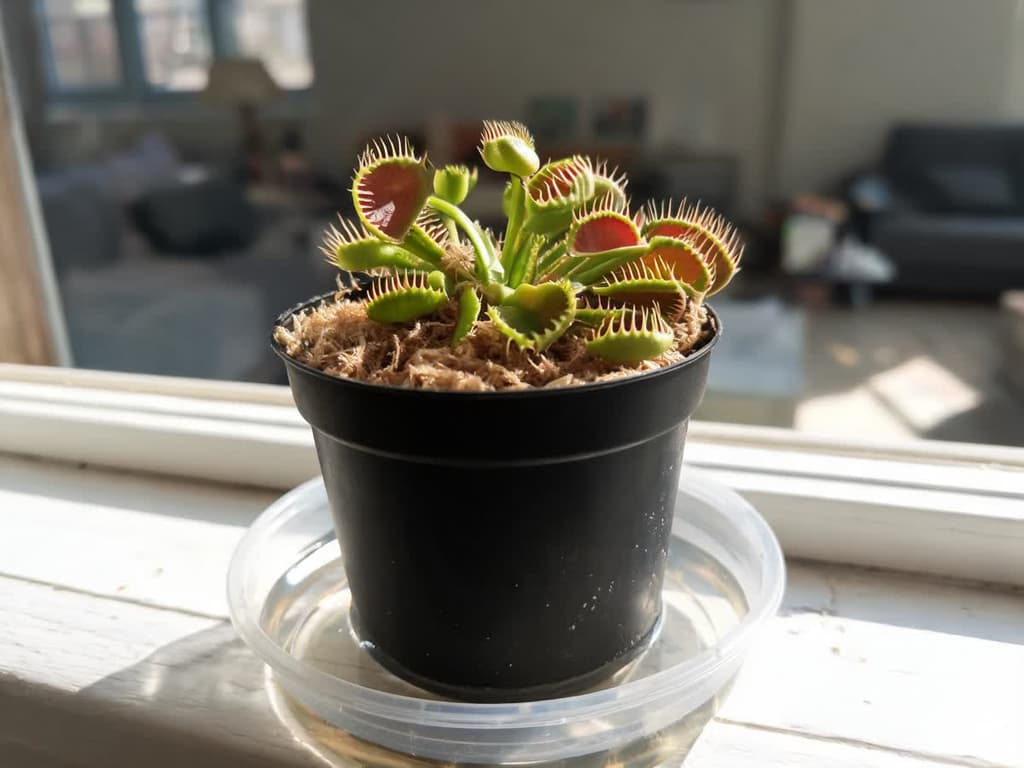
How often to water a Venus flytrap: the soil in the pot must never dry out. Keep the pot in a saucer with 1 to 2.5 cm (0.5 to 1 inch) of pure water and refill the saucer whenever it empties. In hot weather, this can happen every 2 to 3 days. During winter dormancy, when the plant rests and barely grows, keep the soil only slightly damp. Waterings spread out to every 3 to 4 weeks.
The Venus flytrap (Dionaea muscipula) is the carnivorous plant with snap traps. The type of water matters just as much as watering frequency: tap water with too many mineral salts kills the plant even when watered on schedule.
Quick summary:
Constantly moist soil, never dry. The Venus flytrap is a bog plant. The "let the soil dry out between waterings" rule does not apply here.
Bottom watering using a tray. A pot with drainage holes, a tray with 1 to 2.5 cm of water, and water kept more than 5 cm below the soil surface.
Refill the tray whenever it empties. In sunny and warm weather, check the saucer every day.
Keep soil only slightly damp during dormancy. Fill the saucer, wait 1 or 2 days, and discard whatever remains.
Use pure water only: distilled, reverse osmosis, or clean rainwater. Household filters do not remove salts from water.
Why the Venus flytrap doesn't follow the dry-out rule
The Venus flytrap is a bog plant and needs moist soil all the time. It grows naturally in wet, acidic areas of the coast of North Carolina and South Carolina, in the United States. The NC State Extension plant profile is direct: do not let the soil dry out.
The Venus flytrap turns the standard houseplant watering rule upside down. When watering a palm, you wait for the top 2 to 3 cm of soil to dry before watering again. When watering a bromeliad, you empty the saucer under the pot after every watering. With a Venus flytrap, both practices kill the plant: the soil must not dry out, and the saucer stays filled with water.
The New York Botanical Garden (NYBG) Venus flytrap guide lists the plant's most common problems. The roots drying out completely, "even briefly," is one of them. For this reason, watering a Venus flytrap does not follow a fixed number of days. It follows the water level in the saucer.
The tray method, step by step
The tray method (also called bottom watering) keeps the Venus flytrap with water in the saucer. The soil stays damp through capillary action, as water rises on its own from the saucer into the soil without soaking the base of the plant. It is the method recommended by the NYBG, the International Carnivorous Plant Society (ICPS), and Barry Rice's carnivorous plant FAQ.
Use a pot with bottom drainage holes. The NYBG recommends a pot around 10 cm (4 inches) tall.
Place the pot in a tray with 1 to 2.5 cm of pure water. These are the measurements from the NYBG (half an inch to one inch).
Always keep the water more than 5 cm below the soil surface. The ICPS Venus flytrap guide and the NYBG give this distance. If the saucer is deep and the pot is short, the soil gets too wet.
Refill the tray whenever it empties. Pour water into the saucer, not over the plant itself. Water travels up through the soil on its own.
Top-water once a month if you wish. Carnivorous Plants Hub (CP Hub) top-waters until water begins collecting in the saucer, then dumps that water out. This rinse flushes out part of the salts that accumulate in the soil.
The ICPS explains the relationship between pot height and water depth: the wetter the soil, the taller the pot must be. In a shallow pot, the soil mix needs more sand. That same guide warns against using pure sphagnum moss or pure peat (bog material made of moss and decomposed plants) in such shallow pots, as both stay too soggy.
Keep water in the tray at all times or empty it?
Sources are divided. The NYBG, ICPS, Barry Rice's FAQ, and California Carnivores instruct growers to keep Venus flytraps standing in water at all times. The NYBG writes: "never allow the saucer of water to dry out." Two nurseries, CP Hub and FlytrapCare, prefer watering and letting the soil drop to "just damp" before watering again.
CP Hub explains why: standing water left for too many days can trigger crown rot. The crown is the base of the plant where leaves emerge. For that reason, the nursery dumps the saucer whenever water lingers past 3 days.
This guide follows the botanical garden and the carnivorous plant society, which carry more authority than commercial nurseries: keep water in the tray at all times. The ICPS rule resolves rot concerns directly. Keeping water more than 5 cm below the soil surface leaves the plant base damp without soaking it. CP Hub's precaution makes sense when water takes a long time to disappear from the tray. That delay happens during winter dormancy, in cold temperatures, and after several days of rain on an outdoor pot.
How often to water a Venus flytrap in warm and cold weather
Watering frequency for a Venus flytrap is simply how often the tray goes dry, which changes with temperature and sunlight. Where the table does not provide a measured number, the guideline is to check the saucer.
Condition | What happens to the water | What to do |
|---|---|---|
Heat above 24 °C (75 °F), in direct sun | The saucer empties in 2 to 3 days (CP Hub) | Refill whenever it empties and check the saucer daily |
Small pot, hot and dry air | The soil can dry out in 1 day (FlytrapCare) | Check the saucer daily and never leave the pot without water |
Indoors, away from intense sun | Water lasts longer than outdoors (CP Hub) | Refill only once the saucer runs dry |
Winter dormancy | One watering lasts 3 to 4 weeks (CP Hub); up to 1 month (FlytrapCare) | Fill the tray, wait 1 or 2 days, and dump any leftover water |
Heavy rain for several days, outdoor pot | Soil becomes waterlogged (CP Hub) | Remove the pot from the saucer and let water drain out through the holes |
In summer, on sunny days above 24 °C (75 °F), the saucer tends to empty in 2 to 3 days. A small pot on a hot windowsill can dry out overnight. CP Hub also suggests learning the weight of the pot: a light pot, lifted by hand, needs water.
Watering a Venus flytrap during winter dormancy
During dormancy, the Venus flytrap needs soil that is merely damp, never bone dry. Dormancy is the plant's winter rest period. It stops producing new traps, slows growth to a crawl, and sheds leaves that turn black. Signs begin in autumn as days shorten. Dormancy spans the winter months: in the Southern Hemisphere, roughly June through August; in the Northern Hemisphere, December through February.
During this rest stage, the plant consumes very little water, and a continuously flooded saucer can rot the base. Barry Rice recommends keeping the mix "just damp," whether watering from overhead or via the tray. The NYBG agrees. CP Hub fills the tray, lets the plant soak up water for 1 or 2 days, and then pours out any excess.
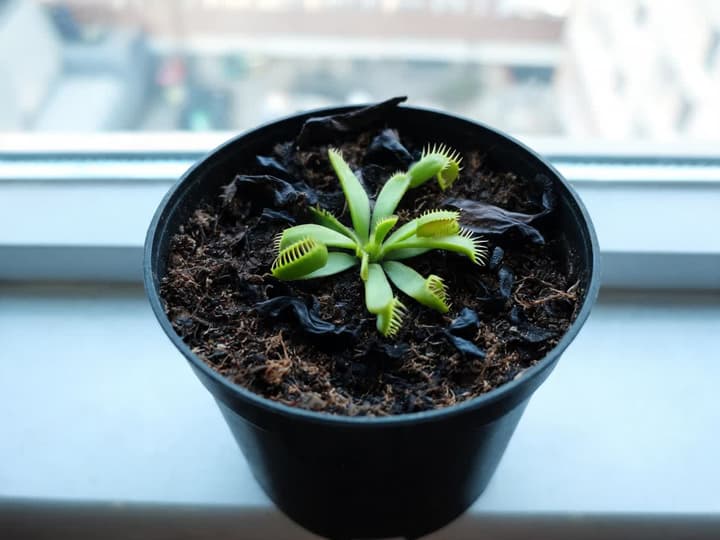
Sources disagree on whether indoor Venus flytraps require dormancy:
The ICPS states that a Venus flytrap does not need dormancy indoors under strong artificial light when fed well. In their view, putting the plant in a refrigerator is a "waste of time."
Barry Rice recommends dormancy for beginners. For tropical climates, he considers the refrigerator method (never the freezer) "probably the best method."
The NYBG notes the disagreement and treats dormancy as optional.
California Carnivores states that plants weaken and die if deprived of dormancy for several consecutive years.
None of these sources cites a study comparing both methods directly. The watering guidelines apply whether the plant is resting in dormancy or continuing to grow under strong lights. Choosing between the two paths depends on your indoor lighting and your home's winter temperatures. If your plant stopped producing traps and slowed its growth, switch to lightly damp soil. Inside a refrigerator, Rice also advises keeping the soil damp.
Barry Rice defines a "chilly" winter as daytime highs rarely exceeding 24 °C (75 °F) and night temperatures rarely dropping below 0 °C (32 °F). With a winter like that, he instructs growers to leave the Venus flytrap outside in full sun with moist soil. Across much of Brazil, winter stays warmer than that threshold.
Which water to use: tap water kills even on a perfect schedule
A Venus flytrap can only tolerate water with very low dissolved mineral salts: distilled, reverse osmosis, or clean rainwater. NC State warns that municipal tap water (treated with chlorine) or hard water (rich in calcium and magnesium) can kill the plant. Dissolved salts accumulate in the soil with every watering.
The deciding metric is TDS (total dissolved solids, the concentration of minerals in water), measured in ppm (parts per million). The ICPS states that tap water with a TDS under 90 ppm can be used. Above that mark, switch to distilled, reverse osmosis, or clean rainwater. Barry Rice sets a stricter standard for home reverse osmosis systems: around 50 ppm or less. A pen-style TDS meter measures this value directly.
What works and what doesn't, according to expert sources:
Distilled or reverse osmosis water: works. Rice notes that the label must specifically say "distilled" or "reverse osmosis." A label reading only "drinking water" guarantees nothing.
Rainwater: works as long as it is clean, according to the ICPS.
Household filters (clay pots, pitcher filters, or standard tap purifiers): do not work. The ICPS explains that filtering does not remove dissolved mineral salts.
Boiled water: does not work. Rice explains that boiling evaporates pure water and concentrates remaining minerals in the leftover volume.
Water left out overnight: does not work. Dissolved mineral salts remain untouched in the water.
Mineral water: generally no. The NYBG warns that bottled water and filtered water "likely" have too much salt for the Venus flytrap. In many countries, the mineral water label lists the "residue on evaporation at 180 °C" (or "dry residue"), in mg/L. This number is the amount of dissolved solids, and 1 mg/L equals 1 ppm. Above 90, the water fails the ICPS criterion.
Black or yellow traps: water issues, dormancy, or natural life cycle?
An occasional black trap is completely normal. The NYBG explains that each Venus flytrap leaf lives for a few months, turns black, and gives way to new growth. Traps that have digested several meals also die off as part of the natural cycle.
When many traps turn black at the same time, investigate watering and light:
In autumn, slow growth and leaves turning black over several weeks: this signals the start of dormancy. Barry Rice notes that a dormant plant always keeps at least some green leaves.
A soft plant that collapses like thawed lettuce: this indicates rot. Rice describes dead plants this way, with the bulb (the fleshy leaf base) turned mushy and foul-smelling.
New traps failing to form: the ICPS links this to salt buildup in the soil. The NYBG recommends repotting in fresh substrate in that situation.
A trap turning black after closing on prey: Rice points to low light levels or prey that was too large. Prey should measure at most one-third the size of the trap.
If the Venus flytrap shows green foliage and has a firm bulb, it is alive. Rice advises waiting patiently without unpotting to check: disturbing the roots of a dormant plant invites fungal infections.
How to save a Venus flytrap after wrong water or dry soil
The remedy depends on how long the plant received mineral-heavy water. Barry Rice outlines three scenarios:
A few weeks of tap water: take the pot to the sink and pour pure water through the top until it drains out the bottom holes. Repeat several times to flush the entire soil volume.
Months of tap water, with the plant deteriorating: replace the soil completely. Rice recommends a half-and-half mix of peat moss and sand, free of any fertilizer.
Months of tap water, but the plant remains healthy: your local tap water is likely naturally low in minerals. A TDS meter will confirm.
If the soil dried out completely, set the pot back into a saucer of pure water and let the soil soak up moisture from below. FlytrapCare describes soaking the pot for 30 to 45 minutes in a water tray so the mix absorbs all the moisture it can hold. Afterward, maintain the saucer level as outlined in the tray method.
What about other potted carnivorous plants?
The tray method works for almost all commercially sold carnivorous plants, with a few exceptions. Barry Rice lists Nepenthes (pitcher plants), many Pinguicula, and certain rare species as exceptions. According to Rice, pitcher plant pots should not sit continuously in standing water.
The pure water rule applies across all of them. Rice notes that carnivorous plants require substantially more water than typical houseplants. In his view, a water saucer is a sound approach for almost all carnivorous plants, apart from those exceptions.
Frequently asked questions
Can I mist my Venus flytrap?
Misting is not necessary. The NYBG states that in most homes, a Venus flytrap needs no misting provided watering is done properly. Damp soil and a filled saucer already raise humidity around the plant. If home air dries out the saucer too fast, the NYBG suggests using a terrarium with adjustable airflow.
How many days can a Venus flytrap go without water?
None of the sources records an exact number of days. The NYBG lists roots drying out completely, "even for a short time," among the plant's most common fatal issues. FlytrapCare notes that in hot, dry conditions, a small pot can dry out within 1 day. Treat completely dry soil as an emergency.
Can I water a Venus flytrap from above?
Yes, using pure water. Barry Rice considers top-watering or saucer watering equally acceptable. CP Hub waters from the top once a month to flush accumulated minerals from the soil. The tray method remains simpler for keeping the mix consistently moist every day. Overhead watering cannot replace the saucer during hot weather.
Can I use bottled mineral water for a Venus flytrap?
Generally, no. The NYBG warns that bottled water likely contains too many dissolved minerals for the plant. The only way to know is checking the exact analysis: the "dry residue" or mineral content on the label, in mg/L, must stay under 90 ppm to pass the ICPS standard. Distilled water is the safest option.
What to do with your Venus flytrap today
Confirm that the pot has drainage holes and sits in a tray with 1 to 2.5 cm (0.5 to 1 inch) of pure water.
Measure the distance between the tray water level and the soil surface: it must exceed 5 cm (2 inches).
Switch tap water out for distilled water, reverse osmosis water, or clean rainwater.
In warm weather, check the saucer daily. During dormancy, fill it, wait 1 or 2 days, and dump any leftover water.
If the plant received tap water for weeks, flush the soil thoroughly with pure water at the sink.
Bloom's free plan includes a watering schedule. For your Venus flytrap, use the schedule as a daily reminder to inspect the saucer water level, and refill whenever it runs dry.
Bloom is currently available on iPhone only.
Sources
International Carnivorous Plant Society (ICPS), John Brittnacher, Growing Dionaea muscipula (updated in 2019): pot always standing in pure water, TDS below 90 ppm, filters do not remove salt, water more than 5 cm below the soil surface, taller pot for wetter soil, dormancy optional indoors under strong light, refrigerator a "waste", do not fertilize.
Barry Rice, The Carnivorous Plant FAQ (2018 revision): on water (wet soil, water tray for almost all carnivores, except Nepenthes and many Pinguicula); purified water (distilled or reverse osmosis on the label, boiling does not purify, TDS of around 50 ppm or less); dormancy and dormancy methods (lightly damp soil, cool winter, refrigerator in the tropics); wrong water or soil; dormant or dead; black traps.
New York Botanical Garden (NYBG), Venus Flytrap Houseplants (Dionaea muscipula) (2026): saucer with half to one inch of water, 2-inch margin to the soil, never let the saucer dry out, 4-inch pot, bottled and filtered water contains too much salt, dry roots even for a short time, optional dormancy, misting unnecessary.
NC State Extension, North Carolina Extension Gardener Plant Toolbox, Dionaea muscipula: do not let the soil dry out, do not fertilize, use rainwater or distilled water, treated or hard water can kill the plant.
Carnivorous Plants Hub (store, US), How Much Water Do Venus Flytraps Need? (2024): saucer empties in 2 to 3 days above 75 °F, empty the saucer when water sits for more than 3 days, monthly top watering, pot weight, dormancy with watering every 3 to 4 weeks.
FlytrapCare (store, US), How often should I water my Venus flytrap?: small pot can dry out in 1 day in dry heat; up to 1 month between waterings in winter; homepage: pot for 30 to 45 minutes in the tray with water.
California Carnivores (store, US), Venus Flytrap Care: saucer always with distilled or purified water, dormancy necessary long term.
Related articles
How to Care for a Maidenhair Fern: Light, Water, and Revival Tips
Learn how to care for a maidenhair fern indoors: bright indirect light, consistently moist soil, high humidity, and how to revive it if it dries out completely.
How to Propagate Spider Plants: Root the Pup Before Cutting
The safest spider plant cutting comes from a pup still attached to the mother plant: rest the plantlet on soil in a small pot, wait for roots to establish, and only then cut the stolon. Learn when the pup is ready, whether rooting in water is worth it, how to divide the clump, and why plants fail to produce babies.
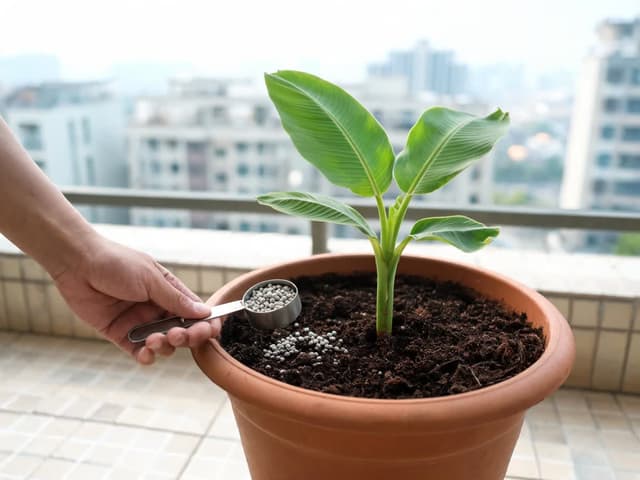
Banana plant fertilizer: fertilizing potted and backyard plants
Banana plant fertilizer needs more potassium than nitrogen, in a 3-1-6 ratio. For a potted plant on a balcony, use the label dose in spring and summer. In the backyard, fertilize every 2 months, adjusting the amount by mat age. Learn the formula, timing in Brazil, and signs of deficiency or excess.