How Often to Water a Palm: The Soil Test by Species
Water your potted palm when the top 1 to 1.5 inches of soil feel dry, until water drains from the hole. Learn the differences between areca and parlor palms, garden care for new plantings, and why brown tips are not fixed by extra water.
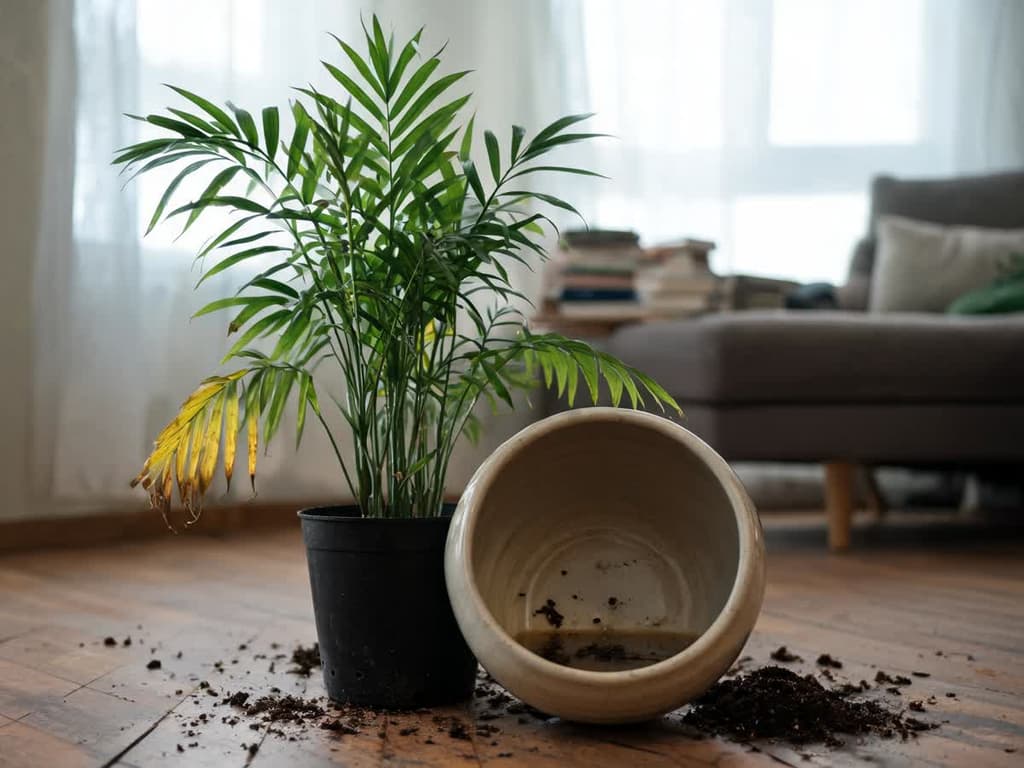
How often to water a palm: in a pot, when the top 1 to 1.5 inches of soil feel dry to the touch. Water until liquid flows out of the drainage hole, and empty whatever collects in the saucer. Indoors, during warm weather, this usually takes 5 to 10 days. A newly planted garden palm coming from a container requires watering every other day for the first few months.
"Palm" is the name of a whole family of species, and they do not drink the same way. The majesty palm and the areca palm prefer evenly moist soil, whereas the parlor palm can handle drying out slightly between waterings. The guide on how to care for palms explains how to identify each one and how much light it needs.
Quick summary:
The soil test determines watering day. Push your finger 1 to 1.5 inches into the soil. Dry: water. Moist: wait and check again in 2 days.
Every watering must soak all the soil. Pour water slowly until it drains through the bottom hole, and empty the saucer right away.
The species determines how dry the soil can get. Potted majesty, areca, bamboo, and pygmy date palms prefer moist soil. Parlor and lady palms tolerate slight drying.
Newly planted garden palms from containers: water or rainfall every other day for 6 to 8 months, according to the University of Florida.
Brown tips do not call for more water. They stem from fertilizer salts in the soil, underwatering, or boron excess. Confirm the underlying cause before changing your routine.
How often to water palms
The day to water a palm comes from the soil test. The University of Maryland Extension advises against watering potted plants on a fixed schedule. Under a fixed rule, the plant receives too much water during a cool week and too little during a hot week. The number of days between waterings follows from the soil test and changes with the palm's conditions:
Palm situation | When to water | Source |
|---|---|---|
Indoor potted palm | When the top 1 to 1.5 inches of soil dry out | Soil test (UMD, NC State) |
Outdoor potted palm | Same test; the potting mix dries faster than garden ground | Atlanta Palms (nursery) |
In the garden, newly planted from a container | Watering or rainfall every other day for 6 to 8 months | UF/IFAS |
In the garden, newly planted field-grown palm | Soil around the root ball kept moist, never soggy, for 4 to 6 months | UF/IFAS |
In the garden, well-established | Reduced watering, or none if rainfall is sufficient | UF/IFAS |
The plant profiles in Bloom provide a baseline starting interval for potted palms. Areca palm and bamboo palm start every 5 days. Parlor palm, lady palm, kentia palm, and majesty palm start every 7 days, and pygmy date palm starts every 9 days. The British retailer Plants for All Seasons recommends 7 to 10 days for indoor palms during the growing season. Use these numbers as a reminder to check the soil. If the soil is still moist on that day, watering waits.
The deciding test: 1 to 1.5 inches of dry soil
Push your index finger into the soil near the rim of the pot down to the first knuckle. That equals about 1 to 1.5 inches. Dry fingertip with no sticking soil: water. Moist fingertip or clinging soil: wait 2 days and test again.
The weight of the pot confirms the finger test. The University of Maryland recommends lifting the whole pot, because dry soil weighs far less than wet soil. Lift your palm right after a thorough watering to memorize how heavy it feels. Moving forward, a light pot means dry soil.
Soil that has dried out too much begins to repel water. Virginia Tech Extension explains that peat- or bark-based soil acts this way when it dries out completely. Water runs quickly down the sides of the pot and exits through the drainage hole, but the center of the root ball (the mass of soil attached to the roots that comes out in one piece when you remove the plant from the pot) remains dry. If the pot stays light right after watering, the soil did not absorb the water.
Species by species: how much palm soil can dry out
Potted palms follow the same testing method, but each species tolerates a different level of dryness. North Carolina State University (NC State) Extension outlines the watering needs of each one:
Majesty palm (Ravenea rivularis): moist soil at all times. NC State warns that it can be difficult to maintain indoors and that overwatering causes root rot.
Areca palm (Dypsis lutescens): moist soil, but never waterlogged, throughout the active growing season.
Bamboo palm (Chamaedorea seifrizii): lightly moist soil. NC State points out root and stem rot caused by overwatering.
Pygmy date palm (Phoenix roebelenii): lightly moist soil during the growing season, avoiding excess water.
Parlor palm (Chamaedorea elegans): tolerates dry soil from time to time. NC State points out overwatering as its main issue.
Lady palm (Rhapis excelsa): regular watering, reduced throughout the winter months.
Kentia palm (Howea forsteriana): generous watering in summer and, in winter, only when the soil feels dry, according to Clemson.
Clemson University Extension is stricter than NC State and states that no palm should dry out. This guide follows a safe middle ground between both sources. Water when the top 1 to 1.5 inches dry out, without letting the soil dry out completely to the bottom. NC State classifies the parlor palm and the lady palm as drought-tolerant. Both can tolerate soil drier than that from time to time.
UF/IFAS categorizes palms in the genus Phoenix as drought-tolerant once established in garden soil. For potted specimens, NC State and Clemson advise keeping the soil moist for the pygmy date palm. For the round-leaf fan palm (Livistona rotundifolia), none of the consulted extension services list specific watering schedules. The profile for this fan palm recommends moist soil and a starting baseline of watering every 6 days.
Each of these palms has a dedicated care profile covering water, light, and temperature:
If you do not know which palm you have at home, Bloom identifies the species from a photo of the plant.
How to water a potted palm
Check the soil. If the top 1 to 1.5 inches feel dry, it is time to water.
Pour water slowly over the entire surface of the soil, not just in one spot, until it flows from the drainage hole.
Wait until the water stops dripping, then empty the saucer. Virginia Tech recommends leaving pots in standing saucer water for no more than 60 minutes.
If your palm sits inside a decorative cachepot without drainage holes, remove the plastic nursery pot before watering. Place it back inside only after all excess water drains away.
Cachepots hide pooled water. Many palms come in standard plastic nursery pots with holes, placed inside solid decorative pots. Drainage water collects out of sight at the bottom of the cachepot, keeping roots submerged for days.
Let a little water run out of the drainage hole with every watering. UF/IFAS recommends this for potted palms because the exiting water washes away fertilizer salts.
Palms in the garden: newly planted specimens need a different routine
A garden-planted palm drinks like a potted plant until its roots spread into the new soil. The University of Florida (UF/IFAS) explains that the soil in the container root ball drains well and dries out before the surrounding soil. Because of this, a container-grown palm needs regular watering for 6 to 8 months. The same publication notes that watering or rainfall every other day is usually enough during this period.
Field-grown palms dug up and moved follow a different rule. UF/IFAS advises keeping the soil surrounding the root ball evenly moist, but never soggy, for the initial 4 to 6 months. After that window, supplemental watering can taper off or stop entirely when normal rainfall meets the plant's needs.
To direct water to the root ball, build a low ring of soil around it. UF/IFAS recommends this ring at the edge of a newly planted palm's root ball. It holds water over the roots instead of letting it run off across the lawn. Wetting the canopy does not help. The same publication cites a study where watering the canopy offered no advantage over watering the soil.
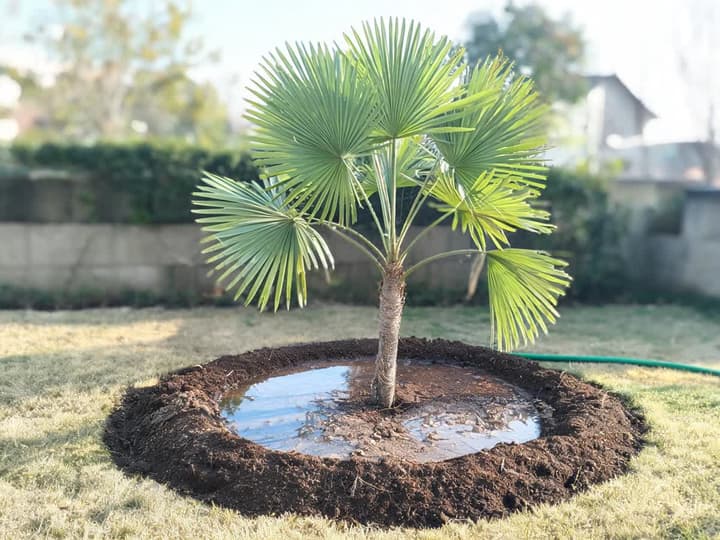
For established palms, watering numbers vary from one place to another. The nursery Atlanta Palms, in Georgia (USA), mentions 2 to 5 waterings per week in the summer. The company Palm Wrangler, in the California desert, mentions one watering every 7 to 14 days. The difference comes from the climate, soil, and rain of each region. None of the consulted extensions publishes an interval for established palms. UF/IFAS only says that watering can be reduced or eliminated when rainfall is sufficient.
To determine when an established garden palm needs water, inspect the soil deeper down than you would for a potted plant. Florida nursery Santana Plants checks soil moisture at a depth of 3 to 4 inches, right next to the root ball. Dry soil at that depth calls for a deep soaking that fills the basin. Moist soil means you can skip watering.
Overwatering versus underwatering in palms: how to tell them apart
A palm tree exhibits dehydration slowly, beginning at the tips and on its lowest fronds. Peace lilies, in contrast, collapse on the very day their potting mix dries out, as detailed in our guide on how to water peace lilies. Drooping fronds and yellow foliage occur both with too much water and with too little. Because of this, adding more water the moment you see drooping leaves can worsen your palm's health. The true differentiator is the soil, followed by the roots:
What you observe | Overwatering | Underwatering |
|---|---|---|
Potting soil | Soggy for several days, occasionally smelling sour | Dry all the way to the base; lightweight pot |
Fronds | Yellow and soft, beginning with the lowest foliage | Yellow and dry, crisp to the touch |
Leaflet tips | Can turn dark brown or blackish | Crisp, dry, and brown |
Roots, when unpotted | Brown, mushy, disintegrating under gentle pressure | Firm, pale, wrapped in dry soil |
A leaflet is each individual segment of a palm frond. To inspect the roots, tilt the pot sideways, hold the palm securely at the base of the stems, and slide the root ball out. Healthy roots are firm and light-colored. The causes behind each type of yellow foliage, organized by species, are outlined in our guide on yellow leaves on palms.
Dry or waterlogged palm: immediate recovery steps
First, gently squeeze the central spear where the new fronds emerge. UF/IFAS explains that each palm stem grows from a single point, and the death of this point kills the stem. A firm spear means you can still save the palm, even with many yellow fronds.
Soil dry to the bottom of the pot: place the pot inside a basin filled with 2 to 3 inches of water for 15 to 30 minutes. Virginia Tech recommends this bottom-watering technique for potting mix that has turned hydrophobic. Lift the pot out once moisture reaches the surface, and let it drain completely. Do not leave the container standing in water for more than 60 minutes.
Waterlogged soil: withhold all watering. Take the pot out of any decorative cachepot, empty the saucer, and allow the potting mix to dry out until the top 1 to 1.5 inches are dry. If the roots are brown and soft, the palm requires fresh soil and a container with functional drainage holes.
Fronds that have turned brown and dried out will not regain their green color. Trim away only totally dead leaves, and watch for the emergence of the next new frond to verify that your palm is recovering.
Brown tips on palms: salt buildup, underwatering, or excess boron
Brown tips on palm leaflets stem from three primary causes identified by UF/IFAS: accumulated fertilizer salts, insufficient water, and boron toxicity. All three create identical markings on the fronds. Only underwatering resolves with increased moisture. In the other two scenarios, watering more frequently fails to fix the issue. The soil requires thorough leaching, and you must correct the fertilizer application or the water source supplying the excess.
A white, crusty deposit on the soil surface or around the drainage holes signals accumulated salts. The University of Maryland attributes these salts to fertilizer and tap water, noting symptoms such as brown tips, shedding of lower foliage, and stunted growth. To leach the potting mix, slowly pour a volume of water equal to twice the size of the container through the soil and allow it to drain out completely. Clemson suggests repeating this leaching process for lady palms twice each year.
When domestic tap water contains high levels of dissolved salts, UF/IFAS offers an additional rule: never allow the soil to dry out completely. Fluoride toxicity does not feature in UF/IFAS documentation on palms. The university does document fluoride damage on dracaenas, which belong to an entirely different plant group.
Cold temperatures slow soil drying in palms
The palm drinks less in cold weather because the roots work less. UF/IFAS records that the roots of many tropical palms greatly reduce their activity when the soil drops below 18 °C (65 °F). For this reason, the university advises reducing watering and fertilizer during this period.
The finger test remains unchanged during the winter months, and the gap between waterings naturally stretches out. Lady palm and kentia palm are two specific species for which extension agencies explicitly recommend cutting back on moisture in winter.
Is your houseplant truly a palm?
Several popular houseplants sold with the word "palm" in their common names are not true palms and demand distinct watering care. The ponytail palm (Beaucarnea recurvata) stores water in its swollen base, and NC State rates it as highly drought-tolerant. The proper way to care for it is detailed in our guide on how to water a ponytail palm.
The "spiky tree" in a pot, with a tuft of narrow leaves atop thin stems, is usually a dracaena. Brown tips on a dracaena count fluoride among their causes, according to UF/IFAS, and watering it follows different guidance. The cycad (Cycas revoluta), also called sago, is another plant that is not a palm.
Peperomias store moisture within their fleshy, succulent-like leaves and last considerably longer without water than any palm tree. Step-by-step guidance on checking their moisture can be found in our article on how to water peperomias.
Frequently asked questions
How long can a palm tree go without water?
None of the reviewed university extension services have established an exact timeframe that a potted palm can endure without water. Parlor palms and lady palms withstand neglect better than others, according to NC State. Majesty palms and areca palms suffer first. If you plan to travel, water your palm until moisture drains out the day before departing, and move it away from direct sunlight. For trips extending beyond your palm's standard watering cycle, have someone perform the soil test.
How much water should I give my palm?
For potted palms, the right amount completely saturates the potting mix: pour until water streams out of the bottom drainage holes. In outdoor landscapes, fill the soil basin built around the root ball. For newly planted outdoor palms, Atlanta Palms nursery suggests approximately 2 gallons (7.5 liters) per session for small specimens and up to 15 gallons (57 liters) for large ones.
Does misting the leaves replace regular watering?
No. Roots take up water through the soil, and spraying the foliage does not moisten the potting mix. NC State highlights that areca and majesty palms favor humid air, and that dry air contributes to spider mite infestations on majesty palms. Running a humidifier nearby helps create these conditions, but regular watering remains essential.
Can I water my palm with tap water?
Yes. The primary concern is salt buildup: ensure water drains through the base at every session. If a white crust forms on the soil surface, leach the pot using a volume of water equal to twice the container's capacity.
What to do with your palm today
Identify your palm: majesty, areca, bamboo, and pygmy date palms need moist soil; parlor and lady palms can handle slight drying.
Push your finger 1 to 1.5 inches into the soil. Dry: water until liquid drains through the hole. Moist: wait 2 days and test again.
Empty both the saucer and any decorative cachepot after every watering session.
Lift the pot right after watering to get used to the weight of fully moist soil.
Newly planted garden palms from containers: provide water or rely on rainfall every other day for the first few months, using a soil ring around the root ball.
The free tier of Bloom includes an integrated watering planner. For palms, treat the schedule as a prompt to carry out the soil test, letting the soil dictate whether it is time to water.
Bloom is currently available exclusively for iPhone.
Sources
UF/IFAS Extension, Broschat, Transplanting Palms in the Landscape (EP001): container-grown palm with regular watering for 6 to 8 months, irrigation or rainfall every other day, field-grown palm with the soil kept moist and never waterlogged for 4 to 6 months, soil berm at the edge of the root ball, overhead irrigation of the canopy showing no advantage over soil watering.
UF/IFAS Extension, Broschat, Physiological Disorders of Landscape Palms (EP263): tip necrosis from salt, lack of water, and boron; part of the water draining through the hole with each watering; with saline water, do not let the soil dry out.
UF/IFAS Extension, Container Production of Palms (CN010): tropical palm roots are less active when soil temperatures drop below 18 °C (65 °F); reduce watering and fertilizer in cold weather.
UF/IFAS Extension, Broschat, Palm Morphology and Anatomy (EP473): a single growing point at the top of each stem.
UF/IFAS Extension, Dracaena Production Guide (EP149): damage from fluoride, boron, and salt in dracaena.
UF/IFAS Extension Citrus County, Foolproof palm care: Phoenix spp. (2023): drought-tolerant palms of the genus Phoenix, planted in the ground.
NC State Extension, Gardener Plant Toolbox: Ravenea rivularis, Dypsis lutescens, Chamaedorea seifrizii, Phoenix roebelenii, Chamaedorea elegans, Rhapis excelsa, and Beaucarnea recurvata.
Clemson Cooperative Extension, Home & Garden Information Center, Indoor Palms (revised in 2015): palms should not dry out or sit in standing water; kentia palm with generous watering in summer and only when the soil feels dry in winter; potted pygmy date palm moist; leach the soil of lady palms twice a year.
University of Maryland Extension, Watering Indoor Plants: do not water on a schedule, pot weight, signs of salt, leaching the soil with twice the pot's volume of water.
Virginia Tech, Virginia Cooperative Extension, Properly Watering Container Houseplants (SPES-804): dry soil that repels water, bottom-watering with 2 to 3 inches of water for 15 to 30 minutes, a maximum of 60 minutes with water in the saucer.
Santana Plants (nursery, Florida), Watering Schedule for Newly Planted Palms in Florida: check the soil at 8 to 10 cm (3 to 4 inches).
Plants for All Seasons (retailer, United Kingdom), How to Water a Palm Plant: indoor palm every 7 to 10 days during the growing season.
Atlanta Palms (nursery, USA), Palm Tree and Plant Care: a potted palm requires more watering than one in the ground; 2 to 5 waterings per week in summer; 7.5 to 57 liters per watering for a newly planted palm.
The Palm Wrangler (maintenance company, USA), How Often to Water Palm Trees in Coachella Valley: established palm every 7 to 14 days in summer.
Related articles
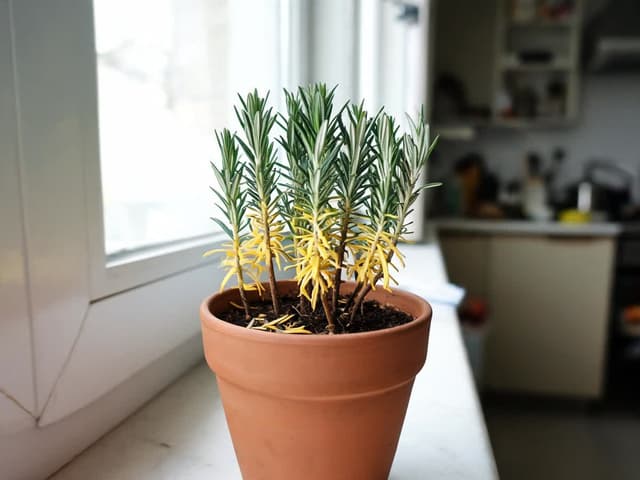
Rosemary Leaves Turning Yellow: Causes and Solutions
Rosemary with yellow leaves usually has overly wet roots. Check where the yellowing appears to see if it stems from wet roots, low light, spider mites, powdery mildew, or normal leaf shed, and learn how to save the plant.
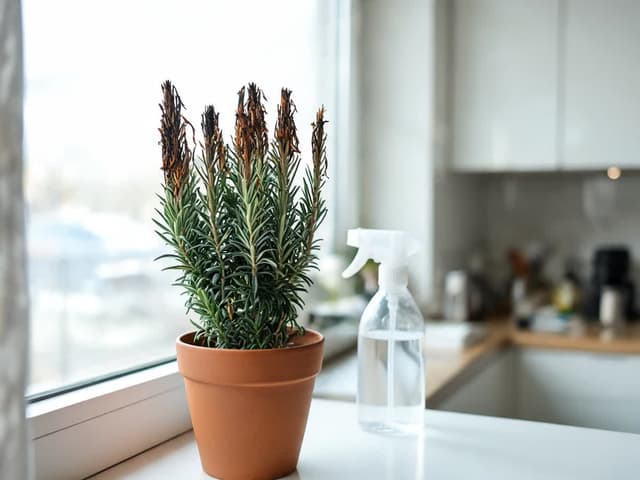
Is Your Rosemary Dying? How to Save Soap-Burned Rosemary
Rosemary with soap-burned leaves can usually be saved: the damage stays on the affected needles. Rinse the leaves, wait a week, scrape the stems, and prune only what is brown inside.
How to Fertilize Rosemary: When, How Much, and Which Fertilizer
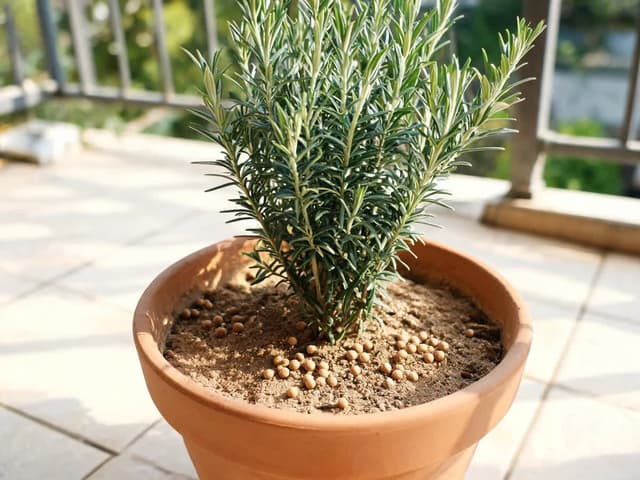
How to fertilize rosemary in pots and in the ground: rosemary needs very little fertilizer. Learn the right timing in Brazil, doses, coffee grounds, lime, and signs of overfertilizing.