How Often to Water a Monstera: The Soil Test That Decides the Day
Water your monstera when the top quarter to third of the soil is dry. Learn what that depth means for your pot size, how winter, light, and containers change the timing, and how to find your plant's schedule.
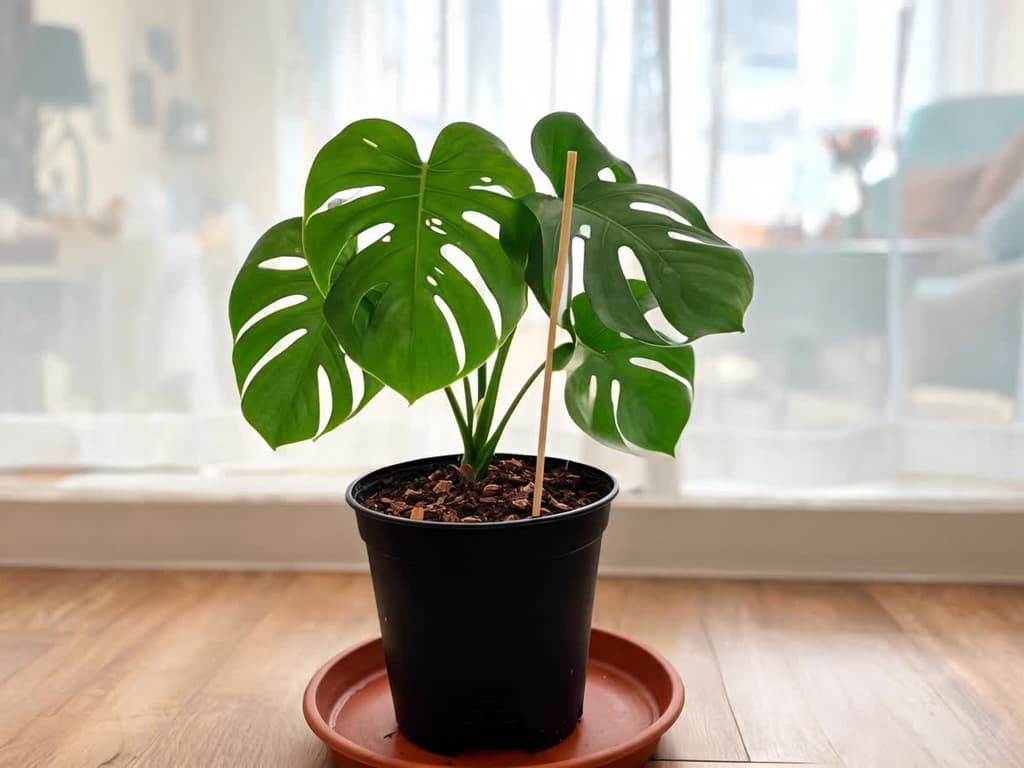
How often to water monstera (Monstera deliciosa, the monstera): when the top layer of soil in the pot, from one-quarter to one-third of the depth, is dry. This is the rule from the North Carolina State University (NC State) Extension. Extension is the service through which the university guides the public about plants. In a pot with 20 cm of soil, this means waiting for the top 5 to 7 cm to dry. There is no fixed day of the week to water.
The interval between waterings is the result of this test, and it changes with the season, light, and pot. For the exact same plant, store guides and magazines recommend everything from watering every other day to once every three weeks. These guides never specify which home, pot, or season each number applies to. Below you will find the depth test in inches for your pot size and the factors that lengthen or shorten the interval.
Quick summary:
The soil decides the day. Water when the top layer of soil, from one-quarter to one-third of the depth, is dry, and not before.
In inches, it depends on the pot. With 6 inches of soil, wait for 1.5 to 2 inches to dry out. With 12 inches of soil, wait for 3 to 4 inches to dry.
In winter, the soil takes longer to dry. In Brazil, winter runs from June to August. With less light, the plant uses less water.
Terracotta dries faster than plastic pots. Large pots dry more slowly than small pots.
Drooping leaves with moist soil do not mean thirst. Before watering again, check whether the soil is already dry.
How often to water a monstera
Water your monstera when the top quarter to third of the soil feels dry to the touch. Water thoroughly until water drains from the drainage hole. Then, wait for that same level of dryness before watering again. The number of days between waterings is the result of this test, not the other way around.
A fixed calendar fails because the same plant loses water at different rates throughout the year. In summer, with more light and heat, the soil dries out in fewer days. In winter, with less light, the same amount of soil takes much longer to dry. The University of Kentucky Extension summarizes the rule for houseplants: less light means less water.
The NC State rule is similar to that of other American universities. The Penn State Extension directs to water thoroughly and let the top 2.5 to 5 cm dry out between waterings. The same page warns that overwatering can cause root rot (the roots rot and the plant wilts). North Dakota State University (NDSU) states that the monstera prefers moist soil. Even so, it calls for the top layer to dry out between waterings.
How much soil needs to dry before the next watering
The practical rule is a layer measuring one-quarter to one-third of the total soil depth. A fractional guideline has an advantage over a fixed depth in inches: it scales with your pot size. A small pot holds little soil and dries quickly. A large pot retains moisture at the bottom for much longer.
This fraction explains much of the discrepancy among published measurements. With 4 inches of soil, one-quarter is 1 inch; with 16 inches of soil, it equals 4 inches. A single retail guide might tell you on the same page to let 1 inch dry, then 2 inches, and then 2 to 4 inches. The Penn State guideline of 1 to 2 inches matches the NC State fraction for a small pot. The table below converts the fraction across standard soil depths:
Soil depth in the pot | How much to let dry before watering |
|---|---|
5 inches (12 cm) | 1.2 to 1.5 inches (3 to 4 cm) |
6 inches (15 cm) | 1.5 to 2 inches (4 to 5 cm) |
8 inches (20 cm) | 2 to 2.8 inches (5 to 7 cm) |
12 inches (30 cm) | 3 to 4 inches (7.5 to 10 cm) |
16 inches (40 cm) | 4 to 5 inches (10 to 13 cm) |
Measure the depth of the soil, not the height of the container itself. A 10-inch pot with a 1-inch empty rim contains 9 inches of soil.
Three ways to check the soil
Your finger. Insert your index finger into the soil near the edge of the pot. A finger reaches about 2.5 to 3 inches deep, which is plenty for pots with up to 8 inches of soil depth. Dry soil falls away without clinging. Moist soil sticks to your skin and feels cool.
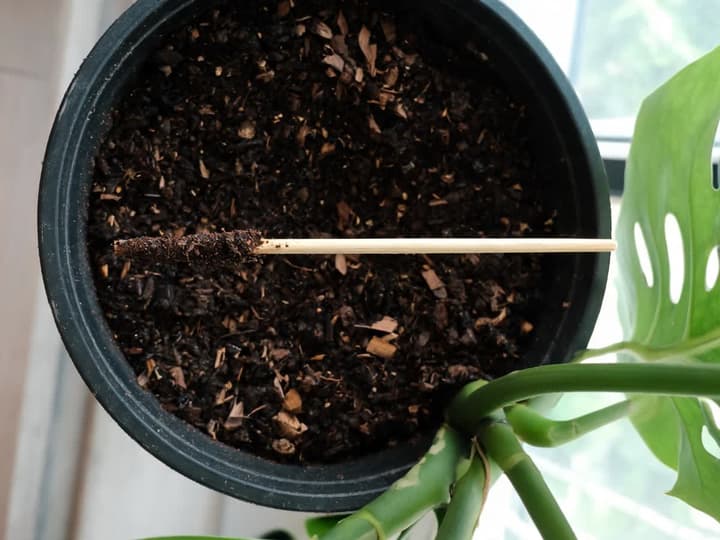
A wooden skewer. For deeper pots, insert a wooden barbecue skewer all the way to the bottom, wait one minute, and pull it out. On the buried section, the dark part with clinging soil was moist, and the clean, light-colored part was dry. Compare only the dry buried section with the table above.
Pot weight. Lift the pot immediately after a thorough watering, and then again when your moisture test shows it is time to water. Wet soil weighs significantly more than dry soil. After two or three waterings, you will recognize the weight of a dry pot. When it feels distinctly lighter than right after watering, verify the soil with your finger or a skewer.
Why published day counts vary so wildly
Published numbers for monstera range from watering every other day to watering once every three weeks. Revista Haus mentions watering every other day. The ABC Garden store guide mentions watering twice a week. Leroy Merlin also recommends watering twice a week, but only in the first few weeks after planting.
Store guides in English give longer intervals. The Spider Farmer store mentions watering once every 1 to 2 weeks in spring and summer. In fall and winter, the same store shifts to watering once every 2 to 3 weeks. The LivelyRoot store also gives watering once every 1 to 2 weeks, and warns that checking the soil works better than following the calendar.
No university extension publishes a fixed number of days for watering a monstera. University extensions publish the soil test instead. This guide follows university extension guidance because the soil test works reliably in any home. Fixed day counts from retailers and magazines leave out the pot size, lighting, and season they were meant for.
What shortens and lengthens the watering interval
Five factors influence how fast your monstera's soil dries:
Condition | Soil dries faster (shorter intervals) | Soil dries slower (longer intervals) |
|---|---|---|
Season | Spring and summer | Fall and winter |
Light | Near a bright window | Far from windows, dark corner |
Pot material | Unglazed terracotta | Plastic, glazed ceramic |
Pot size | Large plant in a small pot | Small plant in a large pot |
Location | Balcony, with wind and heat | Enclosed room |
The season in Brazil
In Brazil, winter runs from June to August and summer from December to February. Fall (March to May) and spring (September to November) fall in between. University of Kentucky Extension explains that, in winter, houseplants receive less light and use less water. The same page notes that during this time, you may only need to water once every two to three weeks. That figure applies to houseplants in general, not specifically to the Swiss cheese plant.
Keeping the summer interval in winter leaves the soil moist longer than the plant can handle. University of Nebraska Extension notes that more indoor plants die from overwatering than any other cause. When the season changes, measure the interval again.
Light
Monstera prefers light without direct sun on the leaves: NC State recommends moderate light and Penn State recommends bright light. The more light the plant receives, the more water it uses and the faster the soil dries out. In Brazil, the window that receives the most sun throughout the day faces north. A monstera 3 feet (1 meter) from that window may need water well before another one in the back of the same room.
Pots and soil
An unglazed clay pot allows water to escape through its walls, so the soil inside dries out faster. The Colorado State University Extension states that clay requires more frequent watering and that larger pots may require less frequent watering. The University of Nebraska Extension adds that a small plant in an oversized pot leaves the soil waterlogged for too long. Conversely, a large plant in a small pot dries out too quickly, which is a sign that it needs a larger pot.
Potting mix also matters. Penn State recommends a well-draining potting mix containing organic matter, suggesting additions like pine bark, perlite, or charcoal. Heavy, compacted soil holds onto water for days and starves roots of oxygen.
Compared to other potted houseplants, a monstera requires more soil to dry out than a palm, but less than a cactus. A cactus only receives water once the soil dries completely to the bottom, as explained in our guide on how often to water a cactus. For a potted palm, you water when the top 1 inch (2 to 3 cm) dries, as shown in the guide on how often to water a palm.
Balcony
Outdoor potted plants use much more water than indoor ones. The cause is the combination of light, heat, and wind, according to the University of Nebraska Extension. A monstera on a porch in the summer can reach the watering point in a few days. The porch in the summer is a possible explanation for Brazilian guides that mention watering twice a week.
How to find your monstera's watering interval
Measure your plant's watering schedule across four steps, using three consecutive waterings:
Give the plant a thorough watering until water drains from the bottom hole, and write down the date.
Starting on day three, check the soil every two days using your finger or a skewer.
When the top layer, from one-quarter to one-third of the soil depth, is dry, water thoroughly again and record how many days passed.
Repeat this process once to confirm. That number of days is your monstera's natural watering interval for that season, location, and container.
Retest whenever something changes: the season turns, the plant moves to a new spot, or it gets a new pot. Until then, use the measured interval as the day to check the soil. The author of the blog A Beautiful Mess does something similar: she checks all her plants on the same day of the week and skips watering when the soil is still damp.
How to water when the day arrives
According to the University of Nebraska–Lincoln Extension, a thorough watering moistens the entire soil volume in the container. It also leaches out excess fertilizer salts. Pour water slowly around the base of the stem until water drains freely from the bottom hole. Then, empty the saucer: leaving a pot standing in water keeps the soil saturated and deprives root pockets of oxygen.
Monstera plants receive water directly through the soil, not over their foliage. Plants with circular leaf rosettes, such as bromeliads, work differently: water fills the central cup formed by the inner leaves, as outlined in our guide on how to water a bromeliad.
Signs your watering schedule is off
Overwatering and underwatering produce remarkably similar symptoms on a monstera: droopy foliage, yellow leaves, and brown leaf tips. What tells them apart is the condition of the soil at the moment symptoms appear.
What you see | Soil is dry to the bottom | Soil has been moist for days |
|---|---|---|
Limp, drooping leaves | Underwatering: water until it drains | Possible root rot: do not water; inspect the roots |
Yellow lower leaves | Watering interval is too long | Watering interval is too short or pot lacks drainage holes |
Dark, mushy stem base | Not a sign of thirst | Indication of root and stem rot |
Alternating between underwatering and overwatering without checking the soil makes it impossible to pinpoint the real issue. Stop guessing and stick to the test of letting one-quarter to one-third of the soil dry. Keep in mind that yellowing lower leaves can also stem from factors other than watering.
Returning from vacation to a drooping monstera
If the soil is bone-dry all the way down, thirst is the most likely cause. Give the plant a thorough soak and observe how the foliage responds over the next few days. If the soil is still moist and the leaves remain wilted, hold off on watering.
To inspect the roots, you do not need to repot. Lay the pot on its side, tap the rim, and slide out the root ball (the soil and roots in a single block). The University of Maryland Extension describes root rot: the plant wilts even with moist soil, and the roots turn brown to black and soft. The outer layer of a rotted root strips off easily, leaving only a string-like core behind. Firm, light-colored roots are healthy roots: return the root ball to the pot and wait for the soil to dry out to the watering point.
Is your plant actually a monstera deliciosa?
Three lookalike plants are often sold under the same name:
Monstera adansonii: much smaller leaves with enclosed holes inside the blade and mostly intact outer margins.
Rhaphidophora tetrasperma, sold as "mini monstera": belongs to a different genus, featuring small split leaves.
Tree philodendron (Thaumatophyllum bipinnatifidum): deeply lobed finger-like foliage without interior holes, widely grown in outdoor landscapes.
The test in this guide was formulated for Monstera deliciosa, the variety with large, split, perforated leaves. Did you inherit a large houseplant with holes in its foliage and need to confirm what it is? The Bloom app identifies the exact species from a simple leaf photo.
Frequently asked questions
How long can a monstera go without water?
No university extension provides an exact day count for monsteras. Survival time depends on pot size, light levels, and the season, which are the same variables that dictate the watering interval. Before leaving on a trip, water the plant thoroughly and empty the drip tray. If you return to drooping leaves and bone-dry soil down to the bottom, give it a thorough soak. If the foliage is drooping while the soil is still wet, check the roots before adding any more water.
Does misting leaves replace watering?
No. Misting water onto foliage never reaches the root zone. NC State recommends raising ambient humidity with a room humidifier or setting the pot over a tray of wet pebbles, making sure the pot base sits above the water line. For hydration, continue using the soil test: water when the top quarter to third of the soil feels dry.
Does a monstera on a balcony need more water?
Yes. According to Nebraska Extension, outdoor potted plants use much more water than indoor ones. They receive more light, heat, and wind. On a balcony or porch in the summer, check the soil every 2 days. If the plant moves back indoors, measure the interval again.
Can I always water on the same day of the week?
You can pick a fixed day of the week to check your soil, but not to pour water automatically. On your designated day, perform the finger or skewer test. If the top quarter to third of the soil is dry, water thoroughly until it flows out the bottom. If it still feels moist, check back in two days.
What to do with your monstera today
Measure the depth of the soil in your pot and look up how many inches must dry in our reference table.
Check soil moisture using your finger or a wooden skewer.
Dry to the right depth: water thoroughly until runoff drains freely, then empty the saucer.
Still moist: wait two days and check again.
Log the dates of your next three waterings: the days between them reveal your plant's personalized interval for this season.
Bloom's free plan includes a built-in watering tracker. Use your observed interval as a reminder to check the soil, and let the soil itself decide whether it is time to water.
Bloom is currently available exclusively for iPhone.
Sources
NC State Extension, Gardener Plant Toolbox, Monstera deliciosa: water thoroughly and let the top layer of soil, one-quarter to one-third of the depth, dry out between waterings; high humidity with a humidifier or a wet pebble tray; moderate light without direct sun.
Penn State Extension, Monstera as a Houseplant: allow the top 2.5 to 5 cm (1 to 2 inches) to dry; overwatering causes root rot; well-draining mix containing bark, perlite, or charcoal; bright, indirect light.
NDSU Extension, Dakota Gardener: Monstera maintenance: moist soil, with the top drying out between waterings.
University of Kentucky, Keeping your houseplants happy during wintertime (2023): less light, less water; in winter, perhaps watering indoor plants once every two or three weeks.
Nebraska Extension in Lancaster County, Winter Care of Indoor Plants: overwatering as the leading cause of death for houseplants; thorough watering leaches fertilizer salts; outdoor plants use more water because of light, heat, and wind.
Nebraska Extension in Lancaster County, Choosing a Container for Houseplants: a container that is too large keeps the soil waterlogged; a large plant in a small container dries out quickly; empty the saucer.
Colorado State University Extension, PlantTalk, Houseplants: Containers: clay pots dry out faster and require more frequent watering; larger pots may require less frequent watering.
University of Maryland Extension, Root Rots of Indoor Plants: wilting with moist soil, roots that are brown to black and mushy, root cortex that pulls away and leaves a thread.
Spider Farmer (store, Europe), A Full Guide on How Often to Water Monstera: watering once every 1 to 2 weeks in spring and summer, every 2 to 3 weeks in fall and winter.
LivelyRoot (store, US), Learn When and How Often to Water Your Monstera: watering every 1 to 2 weeks; check the soil instead of following a calendar.
A Beautiful Mess (blog), How to Care for Monstera Plants: check the plants on a fixed day of the week and skip watering if the soil is moist.
Revista Haus, Costela-de-adão: como cuidar (2022): watering every other day.
ABC Garden (store), Monstera deliciosa how to care: two waterings per week.
Leroy Merlin (store), Monstera deliciosa: complete guide: two waterings per week during the first few weeks after planting.
Related articles
How to Care for a Maidenhair Fern: Light, Water, and Revival Tips
Learn how to care for a maidenhair fern indoors: bright indirect light, consistently moist soil, high humidity, and how to revive it if it dries out completely.
How to Propagate Spider Plants: Root the Pup Before Cutting
The safest spider plant cutting comes from a pup still attached to the mother plant: rest the plantlet on soil in a small pot, wait for roots to establish, and only then cut the stolon. Learn when the pup is ready, whether rooting in water is worth it, how to divide the clump, and why plants fail to produce babies.
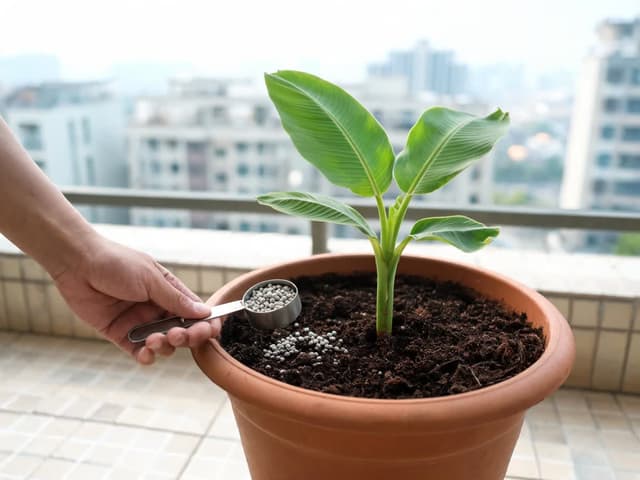
Banana plant fertilizer: fertilizing potted and backyard plants
Banana plant fertilizer needs more potassium than nitrogen, in a 3-1-6 ratio. For a potted plant on a balcony, use the label dose in spring and summer. In the backyard, fertilize every 2 months, adjusting the amount by mat age. Learn the formula, timing in Brazil, and signs of deficiency or excess.