Foliar Fertilizer for Orchids: When It Works and When It Wastes Time
Leaves absorb very little, which is why foliar sprays supplement root feeding instead of replacing it. Learn dilution rates, where to spray, and when to stop.
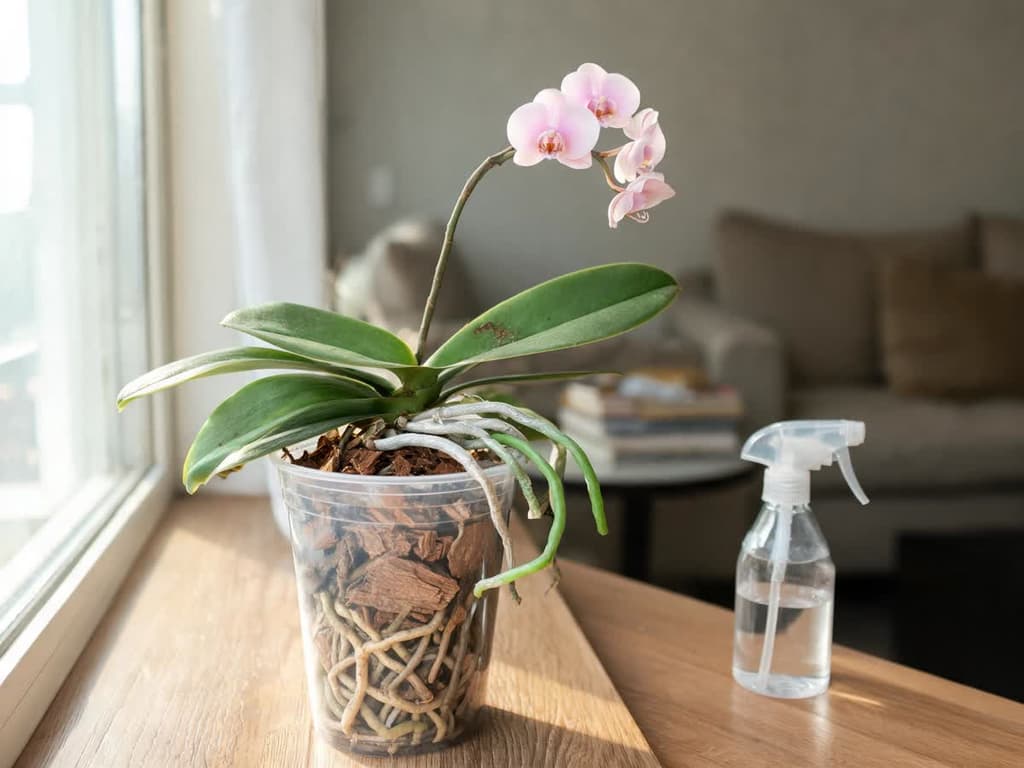
Using foliar fertilizer for orchids works as a supplement, not as a full meal. Orchid leaves absorb only small amounts of nutrients, so sprays are best suited for correcting micronutrient deficiencies rather than powering everyday growth. For an orchid, however, spraying helps through a different route. When you mist the whole plant, you wet the aerial roots, and those roots do the actual heavy lifting.
Quick summary:
University of Delaware Extension notes that growers apply more than 90% of fertilizer through the soil or potting medium. Leaves can only take in small amounts at a time.
Foliar feeding shines with micronutrients, the minerals plants consume in trace amounts: iron, manganese, and zinc.
Dosage: one-quarter label strength if feeding weekly, or half strength every two weeks.
Never let spray pool in the orchid crown. Trapped water rots the growing point, and a moth orchid cannot produce replacement leaves elsewhere.
Limp, wrinkled, or black-spotted plants should never receive foliar fertilizer.
What is foliar fertilizer
Foliar fertilizer is plant food diluted in water and sprayed directly onto the foliage, allowing nutrients to enter through the leaves rather than the roots. To get inside, the solution must cross the cuticle, the waxy protective layer that shields leaves from moisture loss. It serves as a targeted supplement when a plant requires a rapid nutritional boost.
The cuticle sets the ultimate limit on how much gets through. Chalker-Scott points out that cuticle thickness varies dramatically across plant species: the exact same spray penetrates easily on one plant and barely registers on another.
Leaves absorb very little, which shapes how you use it
Embrapa published an evaluation titled "Adubação foliar: fatos e mitos" (Foliar fertilization: facts and myths). The authors concluded that foliar sprays cannot replace root feeding. As they put it: "the quantities of nutrients normally involved in crop production are far greater than the quantities that could ever be absorbed through the leaves" (Nachtigall and Nava, Embrapa Uva e Vinho, 2010).
University of Delaware Extension highlights the practical scale of this limitation. Gordon Johnson writes that commercial growers apply over 90% of plant nutrition through the ground. Regarding foliar uptake, he is blunt: "only small amounts can be taken up through leaves at any one time" (UD Cooperative Extension).
The constraint is purely physical. Macronutrients like nitrogen, phosphorus, and potassium are required in bulk, and leaf tissue simply cannot take in that volume. Linda Chalker-Scott from Washington State University Extension puts it plainly: applying macronutrients to foliage "makes little sense, since leaves cannot absorb enough material to meet the demands of the entire plant" (WSU Extension).
A pale, stalled orchid shedding its lowest leaves needs fertilizer in its potting medium, whether that is bark chips or sphagnum moss where the roots live. Application rates, feeding schedules, and six scenarios where feeding should stop are covered in how to fertilize plants.
Where foliar feeding actually works: micronutrients
Micronutrients are elements consumed in tiny amounts: iron, manganese, zinc, copper, and boron. Because the required quantities are so low, they fit well within the limited absorption capacity of foliage. This is the one scenario where foliar feeding holds a distinct advantage. Chalker-Scott states directly: "micronutrients are the only minerals that are effectively applied through foliar application."
Delaware Extension explains the functional reason: iron, manganese, and zinc "are very effective for correcting local deficiencies." Localized means the mineral stays right where the droplet lands.
Indoor plants run into this problem frequently. Hard tap water and decomposing potting mixes push the pH higher over time. As pH climbs, iron becomes insoluble: it sits right there in the pot, but roots cannot pull it in. The telltale symptom is interveinal chlorosis, where new leaves turn yellow while the veins stay bright green. A full breakdown appears in yellow leaves.
An iron spray can green up affected leaves within days. The fix is temporary and confined strictly to the sprayed foliage, because iron does not travel easily from older leaves to newer ones. Greening up the treated foliage does not fix the root cause, which remains the elevated pH inside the pot.
Uptake speeds also vary by element. The technical portal Agrolink reports that potassium and micronutrients are taken up within a few hours to a day, whereas phosphorus moves much slower (Agrolink).
In orchids, aerial roots do the real absorption
Most orchids kept indoors are epiphytes: in the wild, they cling to tree bark rather than growing in dense dirt. The thick, silvery-gray tendrils spilling out over the pot rim are specialized aerial roots designed for quick intake. They are wrapped in velamen, a spongy layer of dead cells that instantly grabs any moisture contacting its surface.
Velamen is both rapid and efficient. A study published in Oecologia measured this dynamic across multiple orchid species, finding that velamen drinks in solutions "within seconds." Roots then pull nutrients across membranes through an active transport system that functions even at low concentrations (Zotz and Winkler, 2013).
This leads to two practical conclusions. Spraying an orchid delivers great results even though the leaves absorb little, and the solution must stay quite diluted because orchid roots evolved to catch weak rainwater trickling down forest tree trunks.
University of Maryland Extension describes watering a Phalaenopsis like this: place the pot in the sink and run tepid water "over the plant, bark, and aerial roots." Do three or four passes over about ten minutes. There is an easy visual indicator that requires no tools: aerial roots change "from silvery or white to light green when enough water has been applied" (Clement and Malinoski, UMD Extension, March 13, 2023).
The same guide is direct about misting: "misting orchids does not generally provide enough moisture under typical indoor conditions." Misting alone fails to hydrate the plant and does not raise room humidity in any meaningful way. Its genuine utility lies in delivering weak, dissolved nutrients directly to active roots.
Commercial orchid sprays sold in Brazil, such as Forth Orquídeas Floração, reflect this in their instructions: "spray the entire plant." The entire plant includes those exposed aerial roots. Broader species care is covered in how to care for orchids.
How to use foliar fertilizer on orchids without leaf burn
Burn has a known cause, and it is not the sun. All fertilizers are dissolved salts; when the water in the droplet evaporates, the salt stays behind concentrated on the tissue. Chalker-Scott describes the mechanism this way: foliar application of high concentrations "frequently results in leaf scorch as water evaporates and fertilizer salts remain."
The best defense against scorch is diluting well below package recommendations. The American Orchid Society recommends mixing fertilizers at one-quarter to one-half of the label rate. They also advise flushing the pot thoroughly with plain water once a month to wash out lingering salts (American Orchid Society).
Here is how the math works for a liquid fertilizer calling for 5 mL per liter:
Routine | Dilution rate vs. label | Frequency | Amount per 1 liter |
|---|---|---|---|
Fed with regular watering | One-quarter strength | Weekly | 1.25 mL per liter |
Applied between waterings | Half strength | Every 2 weeks | 2.5 mL per liter |
Monthly root flush | None | 1 watering per month | Plain water only |
The more frequently you apply fertilizer, the weaker the solution must be. Both schedules deliver roughly the same total nutrients over a month, so choose whichever fits your habits and avoid stacking them.
Four handling rules keep plants safe:
Moisten the root zone first. Dry media pulls salt right against sensitive root tissue. Water with plain water first, allow it to drain fully, and only then apply your diluted spray.
Spray the entire plant with a fine mist, including the aerial roots and the roots visible in the clear pot, but avoid the crown. Large droplets run off without being absorbed.
Apply in the morning. The plant needs to be dry overnight, because standing water during a cold night is what rots the crown.
Pause during winter. Maryland Extension recommends holding off on fertilizer through cold, low-light months. The universal rule is watching the plant: pause feeding whenever it stops putting out new leaves or root tips.
Never let spray settle in the orchid crown
The crown is the central core where fresh leaves emerge. On a monopodial orchid like a Phalaenopsis, the leaves form an upright cup that directs running moisture straight toward the center.
Sue Bottom, writing for the American Orchid Society, details the danger: "if water sits in the crown of your plant, naturally occurring bacteria will multiply, which can cause the growing tip to rot" (American Orchid Society). Once a moth orchid loses its central growing point to crown rot, it cannot generate replacement leaves from that stem.
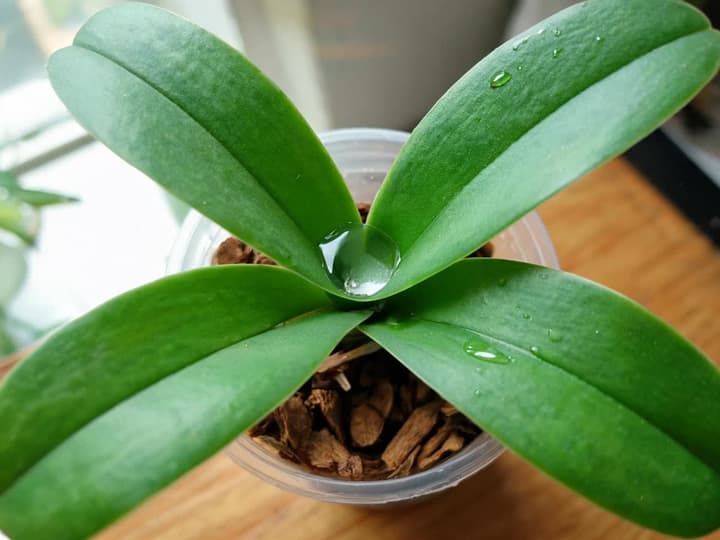
If moisture accidentally collects in the crown, tip the pot gently to let it run out, or touch the corner of a paper towel into the crevice to wick it dry. Do this early in the day so remaining moisture has hours of daylight to evaporate.
Bottom recommends watering early during colder seasons. Wetting foliage late in the day when temperatures drop invites edema, where leaf cells rupture under internal water pressure. Commercial field guides often advise spraying in late afternoon, which makes sense outdoors: longer drying times allow greater nutrient absorption. Indoors, conditions are reversed, and lingering moisture overnight is what triggers rot.
Five situations where you should never spray
1. Hairy or velvety leaves. African violets are the classic example. Iowa State University Extension warns that water lingering on fuzzy foliage "often causes discolored spots, especially if cold water is used," recommending bottom watering instead (Haynes and Steil, Iowa State Extension). Calathea foliage behaves similarly, as detailed in our guide on how to care for calathea.
2. Direct sunlight hitting wet foliage. The old myth that water droplets act like miniature magnifying lenses to burn smooth leaves has been tested and debunked. On smooth maple and ginkgo leaves, intense sunlight on water droplets caused zero burn damage. However, on leaves covered with fine hairs that hold droplets suspended above the surface, such as the floating fern Salvinia natans, scorch did occur (Egri et al., New Phytologist, 2010). The true hazard of spraying fertilizer in hot sun is rapid evaporation leaving concentrated fertilizer salts sitting on the leaf. Chalker-Scott advises spraying on calm, overcast days to prevent leaf scorch.
3. Cold nights. A wet plant that spends the night in low temperatures combines two problems: edema, the rupture of leaf cells from excess water, and standing water where bacteria settle. If you only have time at night, fertilize through the substrate on that day.
4. Diseased foliage or expanding spots. Water-soaked lesions that turn brown or black indicate bacterial soft rot. The American Orchid Society stresses that these pathogens spread through splashing water, advising growers to "avoid overhead watering and misting systems" (American Orchid Society). Agrolink concurs from an agronomic angle, recommending against foliar sprays whenever leaf spotting appears. Misting an infected orchid moves bacteria across the plant.
5. Wilted plants with limp leaves. Soft, leathery orchid leaves mean moisture is failing to reach the foliage. The underlying issue is almost always below the surface: severely desiccated roots, or rotted roots that can no longer take up water. Fertilizer will not fix either problem. Slide the orchid from its pot to inspect the root ball. Firm, greenish-white roots need a good soak; mushy, hollow, brown roots must be trimmed away before repotting into fresh bark.
What to look for on a fertilizer label
Forth Orquídeas Floração, sold in Brazil, lists 2% nitrogen, 14% P₂O₅, and 8% K₂O on its label, alongside boron, copper, iron, magnesium, manganese, and zinc. At 2% nitrogen, it is clearly not formulated to fuel structural growth. It is tailored to supply phosphorus and trace minerals in small doses, which matches what foliar pathways can manage.
The meaning of N-P-K ratios and the distinction between P₂O₅ and elemental phosphorus are explained in how to fertilize plants. When shopping for an orchid spray, focus on two factors:
Are micronutrients listed on the guaranteed analysis? If not, the product loses the only real advantage of foliar feeding.
Does the formula match the growth stage? Balanced formulas like 20-20-20 work well for active vegetative growth. Higher-phosphorus blends like 9-45-15 are marketed for flower spike initiation, though no fertilizer can force blooms if the orchid lacks sufficient indirect light.
Homemade foliar sprays for orchids
DIY concoctions provide no standardized, measured nutrient levels. In a foliar spray, this unpredictability poses an immediate risk: you cannot gauge the salt concentration, raising the chance of burning tender leaves.
There is an added risk when the recipe includes sugar, milk, beer, or rice. Organic matter lingering on wet leaves feeds fungi and bacteria, the very organisms that cause bacterial leaf spots that darken and turn black. What actually holds up and what is just a myth among homemade fertilizers is broken down in how to fertilize plants.
Frequently asked questions
What is the best foliar fertilizer for orchids?
Look for products that clearly list micronutrients on the guaranteed analysis, since trace minerals are what leaves absorb best. Use a balanced blend like 20-20-20 during active growth, or a bloom formula when flower spikes form. Always dilute to one-quarter or one-half of the label recommendation.
How much foliar fertilizer do you mix into 20 liters of water?
For a product calling for 5 mL per liter, 20 liters requires 100 mL at full strength, or 50 mL at half strength. However, 20 liters is a volume meant for commercial backpack sprayers. For houseplant collections, mix just 1 liter at a time, as mixed fertilizer water degrades and goes to waste if stored.
How fast does foliar fertilizer work?
Nutrient absorption happens quickly: potassium and micronutrients penetrate tissue within a few hours to a day, according to Agrolink. Visible recovery takes longer and shows up in new root and leaf tips. The exception is iron, which can green up treated foliage within a few days.
What is the best time of day to apply foliar fertilizer?
Early morning is ideal for indoor orchids. Leaves and the central crown must dry completely before dusk, because lingering moisture in cooler night air invites edema and rot. If direct sun is expected, choose an overcast morning so droplets do not dry too quickly and concentrate salts.
How do you use 20-20-20 fertilizer on orchids?
Dilute the powder or liquid to one-quarter or one-half strength and apply every 7 to 14 days, always making sure the potting medium is already damp. Spray the leaves and aerial roots while avoiding the center crown. Flush the pot with plain water once a month to wash away salt buildup.
Summary
Foliar fertilizer for orchids serves as a targeted corrective tool rather than an everyday diet. Leaves absorb limited amounts, making foliar applications best suited for delivering micronutrients like iron when potting mix pH locks them out. On orchids, misting works mainly because it coats exposed aerial roots, which absorb solutions within seconds and perform best with weak dilutions.
The safest approach is simple: cut the label dosage to one-quarter or one-half strength, spray in the morning, cover roots, and keep moisture out of the crown. If leaves feel soft or display dark spots, put the spray bottle down and check the roots first.
A quick photo can answer two common questions: which orchid variety you have, and whether a blemished leaf is fertilizer burn or an active infection. The Bloom app identifies species and analyzes plant symptoms (available for iPhone).
Related articles
How to Care for a Maidenhair Fern: Light, Water, and Revival Tips
Learn how to care for a maidenhair fern indoors: bright indirect light, consistently moist soil, high humidity, and how to revive it if it dries out completely.
How to Propagate Spider Plants: Root the Pup Before Cutting
The safest spider plant cutting comes from a pup still attached to the mother plant: rest the plantlet on soil in a small pot, wait for roots to establish, and only then cut the stolon. Learn when the pup is ready, whether rooting in water is worth it, how to divide the clump, and why plants fail to produce babies.
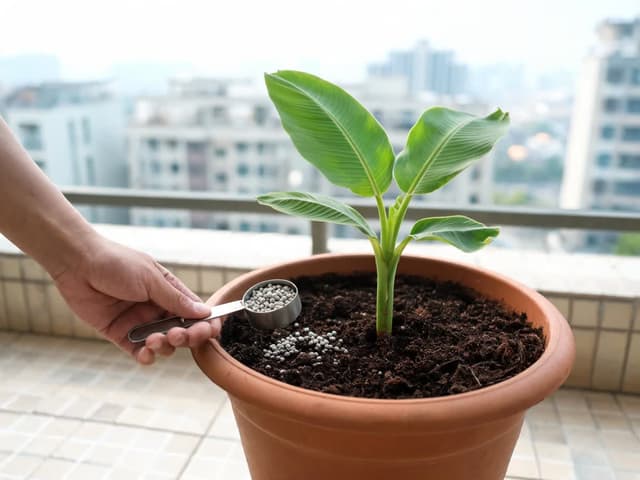
Banana plant fertilizer: fertilizing potted and backyard plants
Banana plant fertilizer needs more potassium than nitrogen, in a 3-1-6 ratio. For a potted plant on a balcony, use the label dose in spring and summer. In the backyard, fertilize every 2 months, adjusting the amount by mat age. Learn the formula, timing in Brazil, and signs of deficiency or excess.