Chinese Money Plant Flowers: What They Are, Whether to Cut Them, and How to Get Blooms
A Chinese money plant flower is a cluster of tiny, pinkish or whitish buds on a thin stalk growing from the center of the plant. It is normal and not a sign of disease. Learn how to recognize it, distinguish it from mealybugs, whether cutting the stalk helps, and what is known about getting a pilea to bloom.
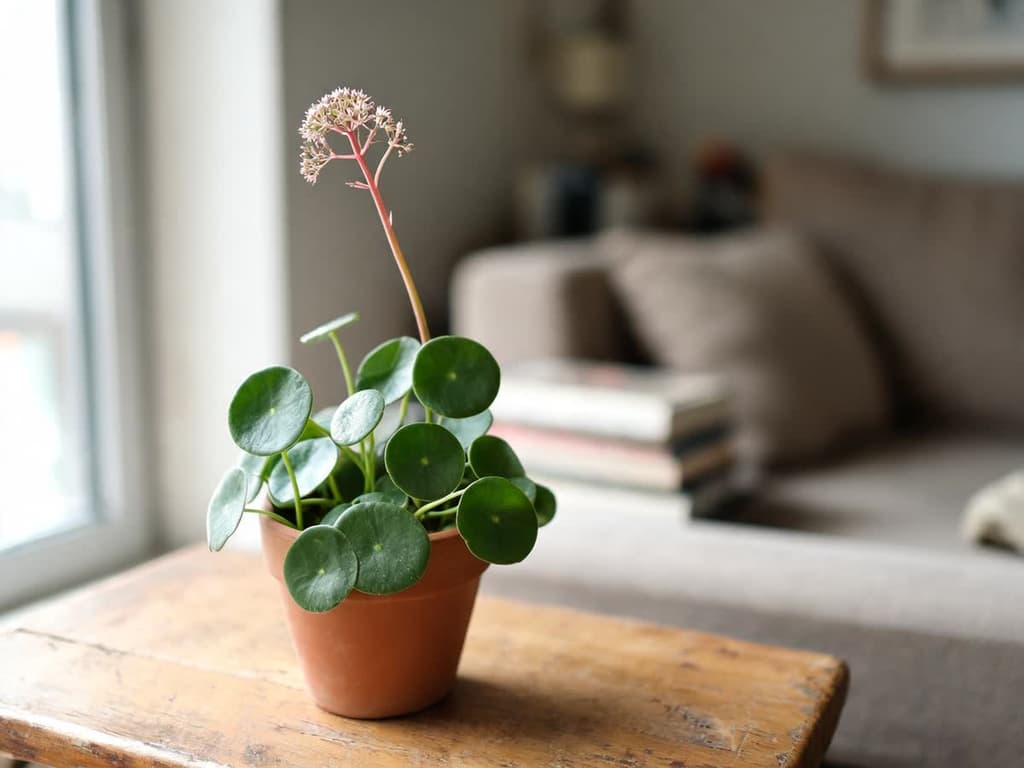
A Chinese money plant (pilea) flower is a cluster of tiny, pinkish or whitish buds. It sits at the tip of a slender stalk emerging from the center of the plant. The flower is normal and does not indicate disease or overwatering. You do not need to cut the stalk. Indoors, pilea blooms rarely and without a fixed schedule, and no one has measured what triggers flowering.
The plant in this guide is Pilea peperomioides, the Chinese money plant, known for round leaves with the petiole attached to the center of the blade. If your pilea sent up a strange stalk, this guide answers, in order: what it is, whether it is normal, and whether it is a pest. Then, whether to cut it and whether you can trigger blooming.
Quick summary:
It is a flower, not a sick shoot. The cluster looks like miniature broccoli, purplish when closed. The male flower bud measures about 2.5 mm (Flora of China).
Indoors, it is rare. NC State Extension sums it up: the species flowers, but houseplants rarely bloom.
Pilea does not die after blooming. It is a perennial plant: the stalk dries up and the plant keeps going.
Stickiness is not a flower. If the stalk or leaf is sticky, look for mealybugs, white insects that cling to the plant.
There is no tested recipe to make it bloom. The advice of a "cool winter and warm spring" circulates without measurements. You can try it without risk, staying within the plant's temperature limits.
What a pilea flower looks like
A pilea flower grows on a slender, long stalk emerging from the top of the stem, among the leaves. At the tip, the stalk branches out and forms a loose cluster of dozens of round buds. Closed, the buds look like miniature broccoli, purplish (Flora of China). Open, the color varies depending on the source: white to pinkish, according to the NC State Extension, or light green sometimes pinkish, according to the RHS.
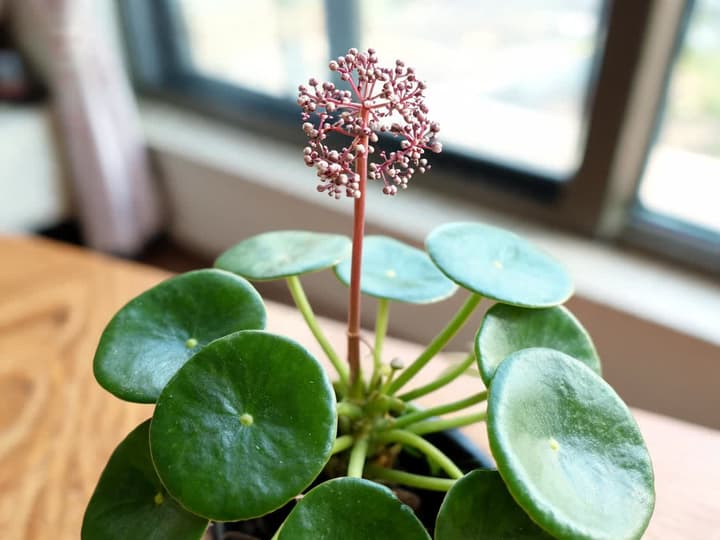
The measurements come from the botanical description of the species, in the Flora of China:
part | appearance |
|---|---|
stalk (peduncle) | 5 to 14 cm, thick, grows from one of the nodes near the top of the stem |
entire cluster | 18 to 28 cm long in male flowers; female clusters are shorter |
male flower bud | about 2.5 mm, purplish, with 4 stamens (the pollen-producing parts) |
open flower color | white to pinkish (NC State Extension); light green sometimes pinkish (RHS) |
The Flora of China measurements are from wild plants. No source has measured the stalk on potted indoor specimens.
The flower lacks showy petals. What you see is the pinkish stalk and the cluster of tiny dots. Plantsmith, a British plant-care retailer, states that it has no scent and lasts about a month.
Peperomia also sends up a slender stalk, but its flower is a smooth, cream-colored spike (NC State Extension). The pilea's flower is a branched cluster. If you are not sure which plant you have at home, check the leaf. On pilea, the petiole attaches to the center of the round leaf.
When pilea blooms
In the wild, pilea blooms from April to July and fruits from July to September, according to the Flora of China. These months correspond to spring and early summer in China, where the species is native. In Brazil, the same seasons run from roughly September to January.
The NC State Extension also lists spring as the species' bloom time. Indoors, however, the plant rarely flowers (NC State Extension).
Pilea grows naturally on damp, shaded rocks in forests, between 1,500 and 3,000 meters in elevation, in southwestern China (Flora of China). It is a cool-climate habitat. This explains why people associate flowering with a cold spell, but that connection has never been measured.
Is a blooming pilea a sign of stress?
No scientific source links pilea flowering to stress, and none links it to a "happy" plant. Both claims circulate without testing. The happy plant theory appears in writing from two sources: a Dutch flower-industry foundation and a commercial shop. Both state that the plant blooms when well cared for.
Botanical sources classify pilea as a perennial plant (Flora of China; NC State Extension). A perennial plant lives for several years and can bloom more than once. The flower is not the end of the pilea's life.
The flower requires no adjustments to your care routine. Keep watering when the top 3 cm of soil dries out. If the plant has firm, green leaves, it is doing well, with or without flowers.
Flower or mealybugs: how to tell them apart
A pilea flower always emerges at the tip of its own dedicated stalk, above the foliage. Mealybugs, insects coated in white wax, cling directly to plant tissue: in leaf axils, on petioles, and at the base of the stem. They also leave behind a sticky residue.
what you see | where it is found | to the touch | what it is |
|---|---|---|---|
cluster of round, pinkish or white buds | at the tip of a slender stalk, above the leaves | dry, firm | flower |
white, cotton-like masses | in leaf axils, on petioles, at the stem base | soft; the surrounding leaf feels sticky | mealybugs |
tiny white specks or a smooth crust | on the underside of the leaf | dry, smooth | mineral salt or sap deposits, harmless (RHS) |
Mealybugs suck sap and excrete a sugary liquid, honeydew, which leaves foliage sticky and darkens with fungus (UC IPM). Because of this, a sticky stalk or leaf indicates an insect, not a flower. NC State Extension lists mealybugs among pilea pests.
Did you spot cottony white tufts on the petiole? Isolate the plant from others and follow the steps in our mealybug guide. If the white residue does not match any of the three table rows, the guide on what is wrong with my plant will help you pinpoint other causes.
Should I cut the flower stalk on my pilea?
You do not need to cut the flower stalk off your pilea. Leaving the bloom does no harm to the plant. The flowers last several weeks, according to the Dutch foundation and Plantsmith, and then the stalk dries out. No source has measured whether trimming the bloom prompts more leaf growth, so removing it to "save energy" remains guesswork.
Cut it if the flower bothers you. Two common reasons: pollen, which Plantsmith describes being released from the flower in small clouds, and the look of the dried stalk.
To cut it:
Use clean shears.
Trim the stalk flush with the point where it emerges from the stem, avoiding damage to adjacent leaf petioles.
Remove only the stalk. No foliage needs to come off with it.
Can you make a pilea bloom?
There is no tested method to force a pilea to bloom. Only one recipe circulates: keep the plant in a cool room over winter and move it to a warmer spot in spring. It appears in Plantsmith and on the Dutch flower-industry foundation site, without sources. No university extension confirms it.
The recipe aligns with the plant's native habitat, a cool mountain range. Still, no one has published a trial comparing pilea plants kept cold versus warm to see how many flowered.
Other plants have a measured trigger. The holiday cactus sets buds with nights between 50 °F and 59 °F (10 °C to 15 °C) for 6 to 8 weeks. The peace lily blooms in the store because the grower applies a hormone. For pilea, no such number exists.
If you want to try, do so without putting your plant at risk:
Use a mature plant, with abundant foliage. No one has published a minimum age for pilea blooming.
In the winter, leave the pot in the coolest room of the house. In Brazil, winter runs from June to August. Always keep the plant above 10 °C (50 °F), the minimum from the RHS. Preferably, keep it above 13 °C (55 °F), the lowest temperature on Bloom's species profile.
Maintain bright, indirect light, near a window.
Water less in the cold. Only water when the top 3 cm of soil are dry, which takes longer during winter.
In spring, return to normal care. The species's flowering period corresponds, in Brazil, to the months of September through January.
The species profile outlines the temperature, lighting, and watering needs for the rest of the year:
If nothing happens, there is nothing wrong with your plant. Indoor pileas rarely bloom, whether given a cool winter or not.
Does a pilea flower produce seeds?
Rarely, at home. Pilea usually has single-sex flowers on each plant, and only sometimes has both sexes together (Flora of China). A plant that only forms male flowers does not produce seed.
When fruit forms, it is a purplish grain measuring about 0.8 mm, enclosed inside the dried flower (Flora of China). The RHS lists seeds as a propagation method for the species. In practice, however, the practical way to grow a new plant is through offsets: the baby pups that sprout in the soil alongside the main stem.
Frequently asked questions
Is it rare for a pilea to bloom?
Indoors, it is rare. NC State Extension describes the species' flowers and notes that indoor plants rarely bloom. No source gives a concrete numeric frequency.
Does pilea die after flowering?
No. Pilea is a perennial, according to Flora of China and NC State Extension. Perennial plants flower and live on. After blooming, the stalk dries out and you can trim it or let it fall off naturally. The leaves and stem continue growing as usual.
Why is my pilea blooming?
The exact trigger has never been measured. What is known is that the species blooms during spring and early summer in the wild (Flora of China). A mature pilea given bright light may bloom during this period. No sources link flowering to stress, excess moisture, or fertilizer.
Are pilea flowers sticky?
Pilea flowers are not described as sticky in any botanical literature. A sticky stalk or leaf is almost always honeydew, the sugary fluid excreted by feeding mealybugs (UC IPM). Look for white cottony masses in leaf axils and around the base of the stem before suspecting the bloom.
Conclusion
A pilea flower is a slender stalk tipped with a cluster of pinkish or whitish buds, and it is completely normal. It does not signal disease, will not kill your plant, and does not require removal. If anything feels sticky, look for mealybugs. If you want to try encouraging blooms, keep a mature plant in a cool room over winter, always staying above 10 °C. No measurements confirm whether this works.
Does your plant's stalk look different from the photo? It might not be a pilea. The Bloom app identifies plants from a photo and is available exclusively for iPhone.
Related articles
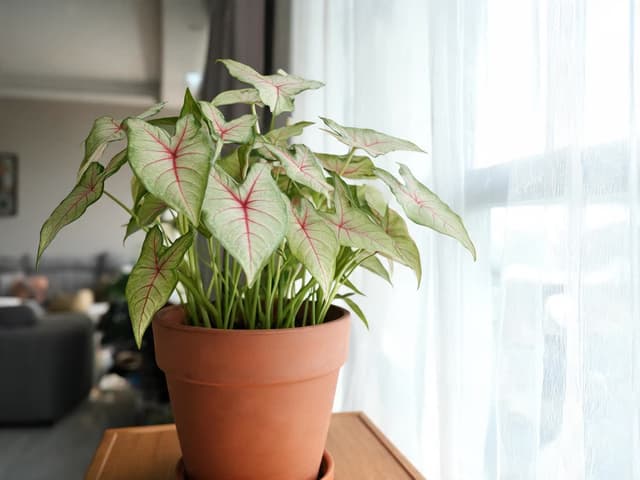
How to Care for Syngonium: Light, Watering, Cuttings, and Pests
How to care for syngonium indoors: bright indirect light, watering when the soil surface dries, 64 to 81°F (18 to 27°C), and 40 to 60% humidity. Also cover water cuttings, thrips, yellow leaves, and pet toxicity.
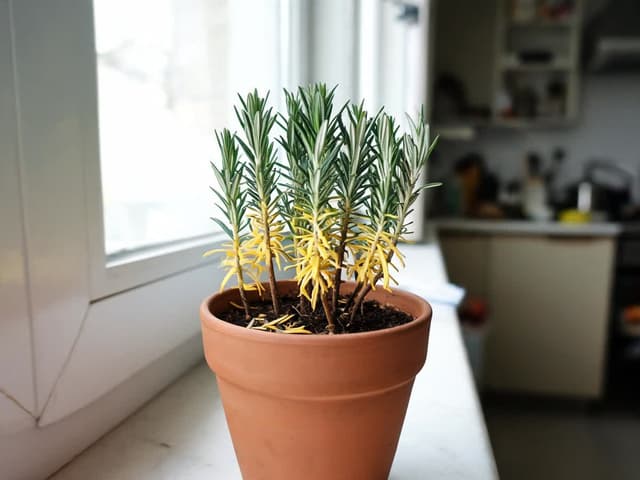
Rosemary Leaves Turning Yellow: Causes and Solutions
Rosemary with yellow leaves usually has overly wet roots. Check where the yellowing appears to see if it stems from wet roots, low light, spider mites, powdery mildew, or normal leaf shed, and learn how to save the plant.
Is Your Rosemary Dying? How to Save Soap-Burned Rosemary
Rosemary with soap-burned leaves can usually be saved: the damage stays on the affected needles. Rinse the leaves, wait a week, scrape the stems, and prune only what is brown inside.