Orchidaceae
Crimson Cattleya: Aromatic Plant
Cattleya labiata
Requires bright indirect light, watering every 3-4 days in summer and weekly in winter, humidity between 50-80%, and well-draining substrate like pine bark.
Every 4 days
Partial shade
18° - 35°C
50% - 80%
Categories
What is Crimson Cattleya?
Crimson Cattleya (Cattleya labiata) is a medium-care plant from the Orchidaceae family. Cattleya labiata is an epiphytic orchid native to northeastern Brazil, found in states such as Ceará, Pernambuco, Bahia, Sergipe, Alagoas, and Paraíba. Known as the "Queen of the Sertão" (Brazilian outback), it is one of Brazil's most emblematic orchids and was officially designated as the flower sy...
Crimson Cattleya grows up to 25cm, spread of 30cm, watering every 4 days, 18°C – 35°C, 50–80% humidity. It is suitable for indoor environments and safe for pets.
Unlike many popular species, Crimson Cattleya is safe to keep around pets. Without adequate drainage, root rot can develop within 8 days.
How to Care for Crimson Cattleya?
TLDR: Crimson Cattleya needs Partial shade, watering every 4 days, and temperatures between 18-35°C with 50-80% humidity.
How Often Should You Water Crimson Cattleya?
Water in the morning, twice weekly in summer and once in winter. Allow substrate to dry slightly between waterings. Shriveled pseudobulbs indicate underwatering; rotting roots indicate overwatering.
How Much Light Does Crimson Cattleya Need?
Prefers bright indirect light with about 60% shade. Avoid direct sunlight which can burn leaves. Dark green leaves indicate insufficient light.
What Is the Best Soil for Crimson Cattleya?
Use well-draining substrate such as pine bark or coconut fiber. The pot must have drainage holes to prevent water accumulation and root rot.
What Pot Should You Use for Crimson Cattleya?
Clay or plastic pot with many drainage holes, 15-20cm diameter. Can also be grown in wooden baskets or mounted on coconut fiber slabs.
Care Schedule
Fertilize
Every 30 days
Misting
Every 3 days
Rotate
Every 7 days
Repot
Every 730 days
What Is Crimson Cattleya and Where Does It Come From?
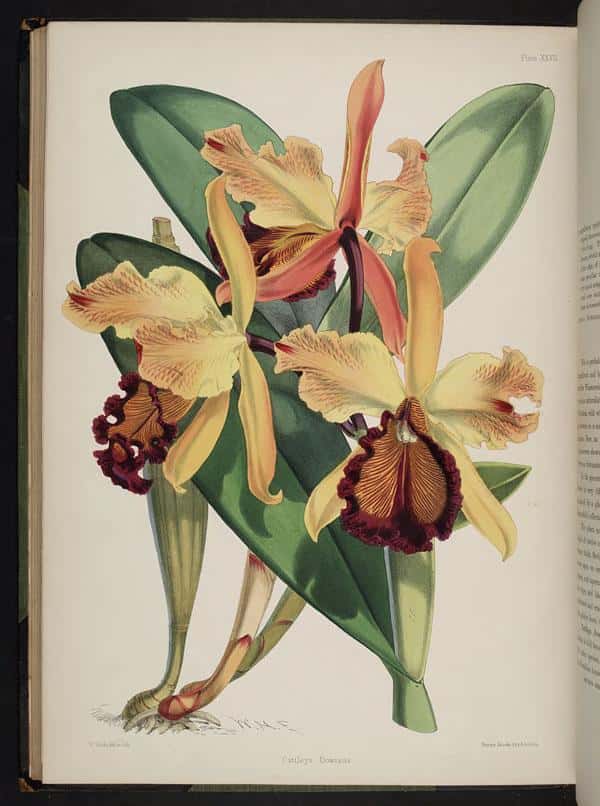
Cattleya labiata is an epiphytic orchid native to northeastern Brazil, found in states such as Ceará, Pernambuco, Bahia, Sergipe, Alagoas, and Paraíba. Known as the "Queen of the Sertão" (Brazilian outback), it is one of Brazil's most emblematic orchids and was officially designated as the flower symbol of Ceará state in 2025. Its club-shaped pseudobulbs can reach 25cm in height, with a single thick, leathery light-green leaf. It produces 2 to 5 flowers per bloom, each measuring 15-20cm, in shades of pink, lilac, purple, and white, with a vibrant lip and a distinctive fragrance that inspired the famous Chanel N°5 perfume.
How to Propagate Crimson Cattleya?
Clump division
- Divide in spring when new growths are emerging
- Use sterilized scissors to prevent disease
- 1 Choose mother plant
Select a healthy adult plant with at least 6 pseudobulbs.
- 2 Remove from pot
Carefully remove the orchid from its pot to preserve the roots.
- 3 Division
Divide the plant keeping at least 3 pseudobulbs with roots in each division.
- 4 Potting
Plant each division in a pot with pine bark substrate, with the oldest pseudobulb against the edge.
- 5 Post-division care
Keep in shaded location for 2 weeks, watering moderately.
Materials needed:
How Big Does Crimson Cattleya Grow?
TLDR: Crimson Cattleya can reach up to 25cm tall with Medium growth rate.
Max height
25cm
Spread
30cm
Growth rate
Medium
Foliage
Evergreen
Plant Uses
Ornamental
Great for decoration
Aromatic
Pleasant fragrance
Is your plant showing symptoms?
Click on the symptom to discover possible causes:
What Diseases Commonly Affect Crimson Cattleya?
TLDR: Crimson Cattleya is susceptible to 15 known diseases. Monitor regularly for early detection.
Anthracnose
Anthracnose is a fungal disease caused by fungi in the genus Colletotrichum that affects many plants, including vegetables, fruits, and trees. The disease thrives in cool, wet conditions, causing dark, sunken lesions on leaves, stems, flowers, and fruits.
Fusarium Wilt
Fusarium wilt is a serious fungal disease caused by the soil-borne fungus Fusarium oxysporum. The fungus invades roots and blocks the water-conducting vessels (xylem) of the plant, causing progressive wilting and eventual death. Host-specific forms of the pathogen exist that attack different plant species.
Pythium Root Rot
Pythium root rot is a serious fungal disease caused by various Pythium species including P. aphanidermatum, P. ultimum, and P. irregulare. These water molds are present in practically all cultivated soils and attack plant roots under wet conditions, causing rapid wet rot that can extend into the stem. The disease is favored by poor drainage, overwatering, and specific temperatures depending on the species.
Phytophthora Root Rot
Disease caused by fungus-like organisms (oomycetes) that live in soil and can survive for years. It affects roots, stem, and crown of plants, being especially severe in waterlogged or poorly drained soils. It is the second most common cause of root rot in trees and shrubs.
Meaning & Symbolism
Symbol of elegance, femininity, and love. Official flower symbol of Ceará state and northeastern Brazil, representing the richness and diversity of Brazilian flora. Associated with luxury and exclusivity since the Victorian Era.
Compare with similar plants
| Attribute | Difficulty | Light | Watering | Pet Safe |
|---|---|---|---|---|
| Dark Fieldcap | Medium | Low light | 2d | ⚠️ |
| Azalea | Medium | Partial shade | 3d | ⚠️ |
| Muriel's Bamboo | Medium | Partial shade | 3d | ✓ |
| Bougainvillea | Medium | Direct sun | 7d | ⚠️ |




