Rutaceae
Rue: Aromatic Plant
Ruta graveolens
Grow in a location with good light, well-drained soil, and moderate watering. It is sensitive to overwatering and can be toxic.
Every 12 days
Direct sun
-5° - 35°C
30% - 50%
Categories
What is Rue?
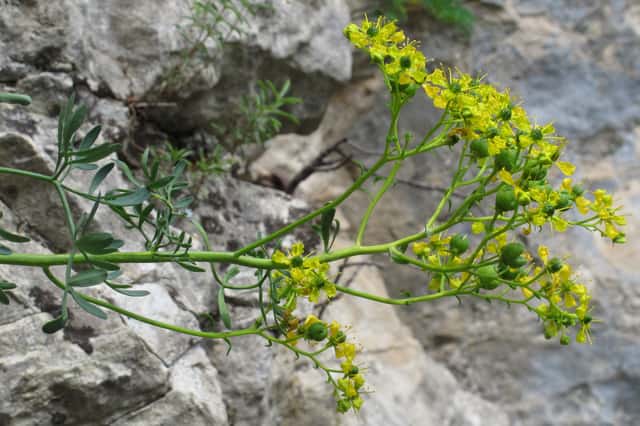
Rue (Ruta graveolens) is a easy-care plant from the Rutaceae family. Rue (Ruta graveolens) is a perennial shrub known for its strong aroma and medicinal properties. It has finely divided, grayish-green leaves and small, cream or yellowish flowers that appear in summer. It is a hardy plant, but requires attention due to its toxicity.
Rue grows up to 60cm, spread of 60cm, watering every 12 days, -5°C – 35°C, 30–50% humidity. It is not suitable for indoor environments and not safe for pets.
Unlike many tropical plants, Rue tolerates watering mistakes. Best for beginners. Without precautions, ingestion can cause irritation in pets. Keep out of reach of cats and dogs.
How to Care for Rue?
TLDR: Rue needs Direct sun, watering every 12 days, and temperatures between -5-35°C with 30-50% humidity.
How Often Should You Water Rue?
Water only when the soil is dry to the touch. Avoid waterlogging, as the plant is sensitive to root rot.
How Much Light Does Rue Need?
Prefers full or partial sunlight. Avoid strong midday sun in very hot climates.
What Is the Best Soil for Rue?
Use a well-drained substrate with good aeration. A mix of potting soil, coarse sand, and perlite works well.
What Pot Should You Use for Rue?
Terracotta or ceramic pots with good drainage are ideal to allow the soil to dry out slightly between waterings.
Care Schedule
Fertilize
Every 30 days
Repot
Every 730 days
What Is Rue and Where Does It Come From?
Rue (Ruta graveolens) is a perennial shrub known for its strong aroma and medicinal properties. It has finely divided, grayish-green leaves and small, cream or yellowish flowers that appear in summer. It is a hardy plant, but requires attention due to its toxicity.
How to Propagate Rue?
Stem Cuttings
- Use a rooting hormone to increase success rates.
- Keep the cutting in a high-humidity environment until rooting occurs.
- 1 Cutting Selection
Choose a semi-hardwood branch 10-15 cm (4-6 inches) long, cutting just below a node.
- 2 Removal of Lower Leaves
Remove the leaves from the lower half of the cutting.
- 3 Planting
Plant the cutting in a light, well-drained substrate, such as a mix of sand and peat.
- 4 Watering and Humidity
Water lightly and keep the substrate moist, but not waterlogged. Cover with plastic to maintain humidity.
- 5 Rooting
Place in a warm location with indirect light. Rooting takes 4 to 6 weeks.
Materials needed:
Sowing Seeds
- Germination rate can be variable.
- Fresh seeds generally yield better results.
- 1 Seed Preparation
Seeds may benefit from a period of cold stratification for a few weeks.
- 2 Sowing
Sow the seeds in a light, well-drained substrate, covering them lightly.
- 3 Germination
Keep the substrate moist and in a warm location (20-25°C / 68-77°F). Germination can take 3 to 6 weeks.
- 4 Transplanting
Once seedlings are large enough, transplant them into individual pots.
Materials needed:
How Big Does Rue Grow?
TLDR: Rue can reach up to 60cm tall with Medium growth rate.
Max height
60cm
Spread
60cm
Growth rate
Medium
Foliage
Evergreen
Warning: Toxic Plant
This plant can be toxic if ingested. Keep out of reach of:
Plant Uses
Aromatic
Pleasant fragrance
Medicinal
Medicinal properties
Ornamental
Great for decoration
Medicinal Uses
- Traditionally used for digestive problems, as a calming agent, and to relieve pain.
- Can be used externally in compresses for bruises.
Is your plant showing symptoms?
Click on the symptom to discover possible causes:
What Diseases Commonly Affect Rue?
TLDR: Rue is susceptible to 7 known diseases. Monitor regularly for early detection.
Root Rot
Root rot is a serious fungal disease that affects the root system of plants, causing them to decay and die. It is primarily caused by overwatering, poor drainage, or soil-borne fungi such as Pythium, Phytophthora, Rhizoctonia, and Fusarium. The disease thrives in waterlogged conditions where roots are deprived of oxygen, making them susceptible to fungal infection.
Overwatering
Overwatering occurs when plants receive too much water, depriving roots of oxygen and causing root rot. This environmental stress is one of the most common causes of houseplant death, as waterlogged soil prevents roots from breathing and functioning properly.
Powdery Mildew
Powdery mildew is a common fungal disease caused by various fungi species including Erysiphe, Podosphaera, Oïdium, and Leveillula. It affects over 10,000 plant species worldwide. The disease thrives in warm, dry climates with high humidity and appears as a distinctive white powdery coating on plant surfaces.
Aphids
Aphids are small, soft-bodied, pear-shaped insects (1/16 to 1/8 inch long) that feed by sucking nutrient-rich sap from plants. They reproduce rapidly and can quickly weaken plants, causing distorted growth and transmitting plant viruses. Aphids come in various colors including green, black, red, yellow, brown, and gray. They secrete honeydew, a sticky substance that attracts ants and encourages sooty mold growth.
Meaning & Symbolism
Rue is believed to offer protection against the evil eye and negative energies. It is often associated with purification and healing.
Compare with similar plants
| Attribute | Difficulty | Light | Watering | Pet Safe |
|---|---|---|---|---|
| Field Maple | Easy | Bright indirect | 14d | ✓ |
| Silver Birch | Easy | Direct sun | 14d | ✓ |
| Common Blanketflower | Easy | Direct sun | 10d | ✓ |
| Cushion Bush | Easy | Direct sun | 14d | ✓ |





