Primulaceae
Persian Cyclamen: Air Purifying Plant
Cyclamen persicum
A cool-loving plant that thrives at 10-18°C. Requires bright indirect light and consistent moisture without waterlogging. Goes dormant in summer - reduce watering when leaves yellow. With proper care, can rebloom for many years.
Every 5 days
Partial shade
10° - 18°C
50% - 60%
Categories
What is Persian Cyclamen?
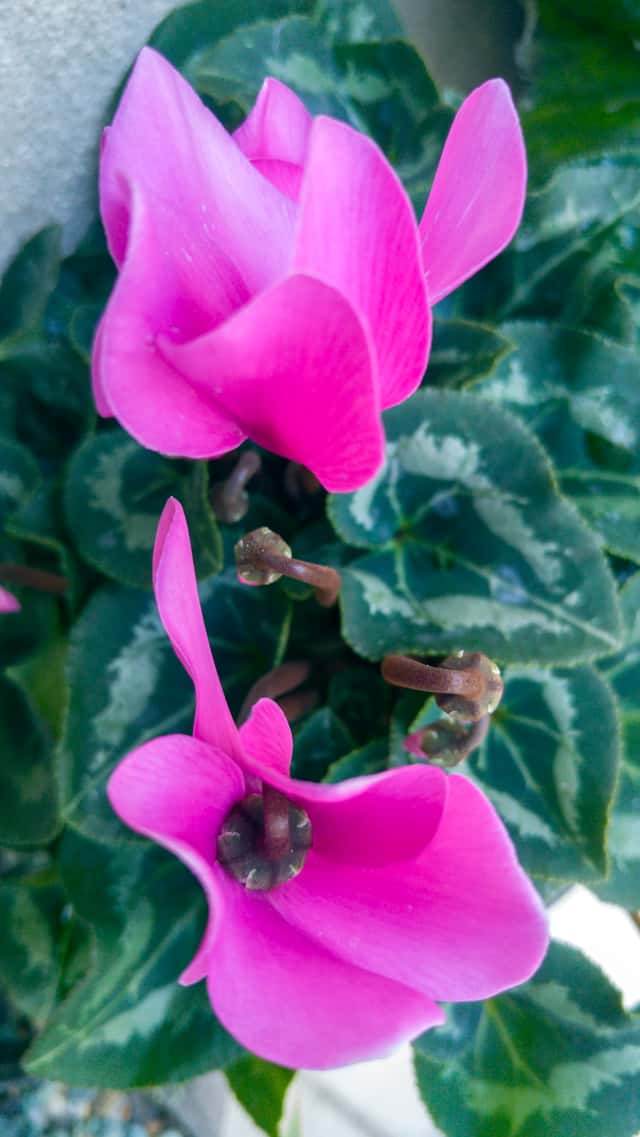
Persian Cyclamen (Cyclamen persicum) is a medium-care plant from the Primulaceae family. Cyclamen persicum is a charming tuberous perennial native to the Mediterranean region, prized for its elegant upswept flowers and heart-shaped marbled leaves. It blooms prolifically during winter when most houseplants are dormant, providing vibrant color indoors. The flowers come in shades of white,...
Persian Cyclamen grows up to 35cm, spread of 35cm, watering every 5 days, 10°C – 18°C, 50–60% humidity. It is suitable for indoor environments and not safe for pets.
Without precautions, ingestion can cause irritation in pets. Keep out of reach of cats and dogs. Without adequate drainage, root rot can develop within 10 days.
How to Care for Persian Cyclamen?
TLDR: Persian Cyclamen needs Partial shade, watering every 5 days, and temperatures between 10-18°C with 50-60% humidity.
How Often Should You Water Persian Cyclamen?
Water from below by placing the pot in a shallow dish of water for 10 minutes. Allow soil to almost dry between waterings. Never water directly onto the tuber as this causes rot.
How Much Light Does Persian Cyclamen Need?
Prefers bright indirect light. A north or east-facing window is ideal. Can tolerate some direct morning sun in winter but avoid harsh afternoon sun which can scorch leaves.
What Is the Best Soil for Persian Cyclamen?
Use a well-draining potting mix with peat moss, perlite, and sand. Slightly acidic to neutral pH (5.5-7.0). Plant with the tuber top slightly above soil level.
What Pot Should You Use for Persian Cyclamen?
Terra cotta or clay pots with drainage holes are ideal as they allow soil to dry properly. Choose a pot only slightly larger than the tuber. Shallow containers work well.
Care Schedule
Fertilize
Every 14 days
Repot
Every 365 days
What Is Persian Cyclamen and Where Does It Come From?
Cyclamen persicum is a charming tuberous perennial native to the Mediterranean region, prized for its elegant upswept flowers and heart-shaped marbled leaves. It blooms prolifically during winter when most houseplants are dormant, providing vibrant color indoors. The flowers come in shades of white, pink, red, and purple, often with a sweet fragrance.
How to Propagate Persian Cyclamen?
Seeds
- Fresh seeds have highest germination rate
- Best sown immediately after pods open in July-August
- Keep consistently moist but not waterlogged
- 1 Soak seeds in warm water with a drop of dish soap for 24 hours to remove germination-inhibiting coating
- 2 Plant seeds in moist seed compost, barely covering them
- 3 Maintain temperature around 18-20°C in darkness
- 4 Germination takes 4-8 weeks, some seeds may take months
- 5 Transplant seedlings when they have 2-3 leaves
- 6 First blooms appear after 12-18 months
Materials needed:
Tuber division
- Only divide large, healthy mature tubers
- Higher risk than seed propagation
- Keep newly divided sections in free-draining mix
- 1 Divide only during dormancy in late spring/early summer
- 2 Lift tuber and clean off soil
- 3 Cut tuber into sections, each with at least one growing point
- 4 Allow cut surfaces to dry and callous for a few hours
- 5 Plant divisions with growing points just above soil level
- 6 Keep soil on the dry side to prevent rot
Materials needed:
How Big Does Persian Cyclamen Grow?
TLDR: Persian Cyclamen can reach up to 35cm tall with Slow growth rate.
Max height
35cm
Spread
35cm
Growth rate
Slow
Foliage
Deciduous
Warning: Toxic Plant
This plant can be toxic if ingested. Keep out of reach of:
Plant Uses
Ornamental
Great for decoration
Is your plant showing symptoms?
Click on the symptom to discover possible causes:
What Diseases Commonly Affect Persian Cyclamen?
TLDR: Persian Cyclamen is susceptible to 12 known diseases. Monitor regularly for early detection.
Gray Mold (Botrytis Blight)
Gray mold, caused by the fungus Botrytis cinerea, is one of the most common fungal diseases in plants. It affects over 200 plant species, including ornamentals, vegetables, fruits, and houseplants. The disease thrives in cool, humid conditions with poor air circulation, causing grayish spots and soft rot on infected tissues.
Fusarium Wilt
Fusarium wilt is a serious fungal disease caused by the soil-borne fungus Fusarium oxysporum. The fungus invades roots and blocks the water-conducting vessels (xylem) of the plant, causing progressive wilting and eventual death. Host-specific forms of the pathogen exist that attack different plant species.
Bacterial Soft Rot
Bacterial soft rot is a destructive plant disease caused primarily by bacteria from the genera Pectobacterium (formerly Erwinia) and Dickeya. These bacteria produce enzymes that break down plant cell walls, causing rapid and foul-smelling tissue decomposition. It mainly affects succulent tissues such as tubers, fruits, stems, and bulbs, being especially problematic in warm and humid conditions.
Spider Mites
Spider mites are tiny arachnids (less than 1/20 inch long) related to spiders and ticks that feed on plant sap. They thrive in hot, dry conditions and can cause significant damage to ornamental and vegetable plants. During severe infestations, crop losses can reach 14% or higher as these pests disrupt vital plant processes including photosynthesis, carbon dioxide absorption, and transpiration.
Meaning & Symbolism
Symbolizes lasting love, sincerity, empathy, and modesty. In Japan, it is considered the holy flower of love. White represents purity, pink represents joy and playful love, red represents passion, and purple represents grace and perseverance.
Compare with similar plants
| Attribute | Difficulty | Light | Watering | Pet Safe |
|---|---|---|---|---|
| Dark Fieldcap | Medium | Low light | 2d | ⚠️ |
| Azalea | Medium | Partial shade | 3d | ⚠️ |
| Muriel's Bamboo | Medium | Partial shade | 3d | ✓ |
| Bougainvillea | Medium | Direct sun | 7d | ⚠️ |




